A packaging journal survey clearly shows that regulatory requirements are currently the biggest challenge facing the industry - closely followed by issues relating to reusable packaging and a lack of recyclates. Digitalisation and AI, on the other hand, play a surprisingly minor role.
What really concerns the packaging industry? This question is the packaging journal on the occasion of Packaging Day last week in a week-long online survey on LinkedIn. Decision-makers from industry, retail and packaging technology took part - with a clear result:
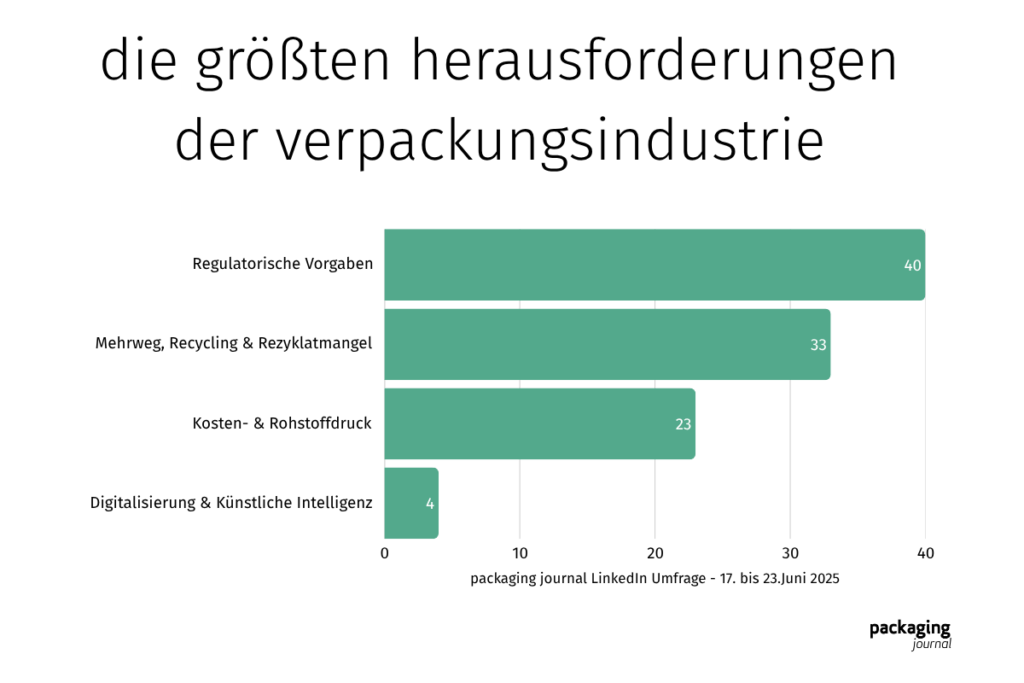
With 40 % From the participants' point of view, the biggest challenge lies in the regulatory requirements, The EU packaging regulation (PPWR), new labelling rules and mandatory quotas for recyclates are just a few examples.

Also highly weighted with 33 % the topics Reusable, recycling and the lack of recyclates - an area that is increasingly turning out to be a bottleneck for sustainable solutions.
Cost and raw material pressure including energy prices and scarce availability of materials 23 % as a central challenge.
Surprisingly low at only 4 % the evaluation of the topic Digitalisation and artificial intelligence although the technological transformation is often seen as a game changer.
Regulation: complex, dynamic, demanding
The dominance of regulatory requirements in the survey results is hardly surprising - and confirms many voices from the industry. The planned PPWR not only places high demands on recyclability, the use of recyclates and reusable quotas, but also brings uncertainties with regard to timetables, design and national implementation.
Internationally active companies in particular are faced with the challenge of reconciling different legal requirements in the EU member states - while at the same time taking responsibility towards retailers, brands and consumers.
Reusable and recyclates: ambitious goals, limited resources
The second biggest concern revolves around the question of where the required quantities of high-quality recyclate come from - especially for food packaging. At the same time, the political requirements for closed loops are growing, for example through mandatory recycled content or reusable quotas in the retail and catering sectors.
The infrastructure for comprehensive reusable logistics is not yet established in many places, especially in e-commerce and smaller businesses. Without investment in take-back, cleaning and tracking, ambitious targets are at risk of failing in practice - or leading to high costs.
Costs and resources: the underestimated perennial issue
Although the topic block „Cost and raw material pressure“ received fewer votes than the two frontrunners with 23 %, many comments in the discussion under the LinkedIn post indicate that the economic framework conditions are perceived as a cross-cutting issue:
„Machine designer Jürgen Schmid, for example, cites “costs and flexibility" as the main factor for his customers in the packaging industry. Machine manufacturers and plant operators report rising production costs coupled with pressure to innovate.
The shortage of skilled labour was also discussed in the comments. The Personnel consultant Thomas Schmitt adds with a wink: „I'll add - shortage of skilled labour. 😉“
AI and digitalisation: potential not yet exhausted?
Just 4 % of the votes went to the area of digitalisation and artificial intelligence - a surprisingly low result given the often-invoked relevance of smart production processes, data-driven decisions and intelligent packaging solutions.
This may reflect the current prioritisation in companies rather than the fundamental importance of the topics. In practice, there is often still a lack of concrete use cases, internal resources or suitable partners to implement AI and digital projects with real added value.
Seeing challenges as opportunities
The survey clearly shows which challenges decision-makers in the packaging industry are currently prioritising: The legal framework, circular economy and economic pressure are clearly in focus.
At the same time, each of these topics also offers opportunities - for example for innovative materials, new business models in the reusable system or digitally supported transparency in the supply chain. The decisive factor will be how companies actively shape these challenges - and which political framework conditions are set for this.
More news


Decentralised drive technology for flexible intralogistics

EFSA has finalised data call

Interaction of machine, adhesive and application technology

SVI publishes guideline