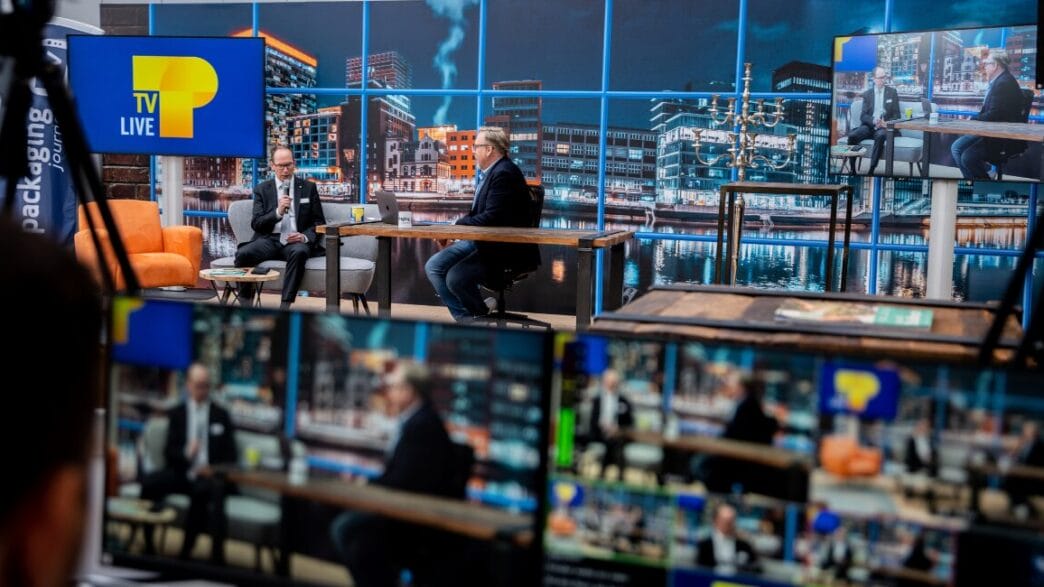
Live talks, analyses and industry voices: With „interpack TV Live“, packaging journal and interpack 2026 are bringing the trade fair back directly to the studio – on-site and digitally. The format provides insights into trends, innovations, and key topics of the global processing and packaging industry.
Following the successful launch in 2023, the Interpack TV live continued and expanded. In cooperation with the packaging journal, a curated programme of talks, analyses, and discussion rounds is being created. It will be broadcast throughout the entire trade fair period from 7 to 13 May – live on site as well as online and on demand.
Current: Market, Regulation and Outlook
A particular focus is placed on the current framework conditions of the industry – from international markets and geopolitical developments to regulatory requirements. In particular, the European Packaging and Packaging Waste Regulation (PPWR), questions of sustainability assessment, and developments in mechanical engineering, raw materials, and the labour market will be analysed.

Insights will be provided by Markus Rustler (Theegarten-Pactec), among others, who will examine the effects of tariffs, geopolitical crises, and regulation, as well as Richard Clemens (VDMA) with an eye on the prospects for mechanical engineering. Further contributions address, among other things Carolina E. Schweig packaging trends in the interplay of regulation and sustainability, and Dr Natalie Brandenburg (German Packaging Institute) on the current market situation. This is complemented by Dr Martin Engelmann (IK Industrial Association for Plastic Packaging) on raw material shortages and price developments, Thomas Reiner (German Packaging Institute) on the market situation as well as Thomas Schmitt (Recruitment Consultant) on dealing with the skills shortage.
Consumers, the circular economy and regulation
The categories „Packaging Background“ and „Packaging Regulation“ focus on consumer perspectives, the circular economy and regulatory requirements. The focus is on the evaluation of sustainable packaging by consumers, the role of materials such as glass, and the digital product passport as a building block for closed material cycles.
Examples of this include contributions from Christiane Nelles (Federal Association of the Glass Industry) on the role of glass as a recyclable packaging material, Daniel Bornemann (Simon-Kucher) on consumer reviews, and Dr Benedikt Brenken (R-Cycle) to the digital product passport. In the regulatory context, organisations such as Der Grüne Punkt contribute to the circular economy of plastic packaging, David Strack (SUSY) and Siddharth Bagri (PackIntelX) for PPWR compliance as well as Alexander Reitz (PreZero) to specific classifications of design strategies. Additionally, it classifies Dr Markus W. Pauly (Lawyer) the requirements from the PPWR and the Packaging Act Implementation Act.
Technological solutions for the practice
The category „Packaging Solutions“ showcases concrete technological approaches along the entire value chain, from digitised production environments to new packaging solutions. The focus is on efficiency, resilience and sustainability in industrial practice.
Contributions from mechanical engineering, automation, and packaging development offer insights into software-based production models, integrated packaging solutions, and new labelling technologies. Further examples demonstrate how sustainable packaging concepts, circular economy solutions, and modular machine approaches can be implemented in practice. This is supplemented by categorisations of advanced packaging functions and safety standards in mechanical engineering. Practical discussion formats and contributions on automation, service concepts, and industry-specific applications round off the programme, showing how technological innovations are specifically applied in industrial use.
Trends and future prospects
The category „Packaging Trends“ focuses on future developments in materials, technologies and business models. Topics include sustainable packaging materials, new design approaches, and the role of reusable and co-packing concepts.
Contributions from research, industry, and market research show how alternative materials – such as those based on textile waste or cellulose – are developing and what role they can play in the future. At the same time, tools for assessing recyclability and new approaches in packaging design are presented. Further analyses deal with the future of mechanical engineering, the increasing importance of reusable systems in e-commerce, and the role of co-packing in global supply chains. Perspectives from market research and design complement these developments and provide insights into changing consumer behaviour and new requirements for packaging solutions.
Online and on site, live and on demand
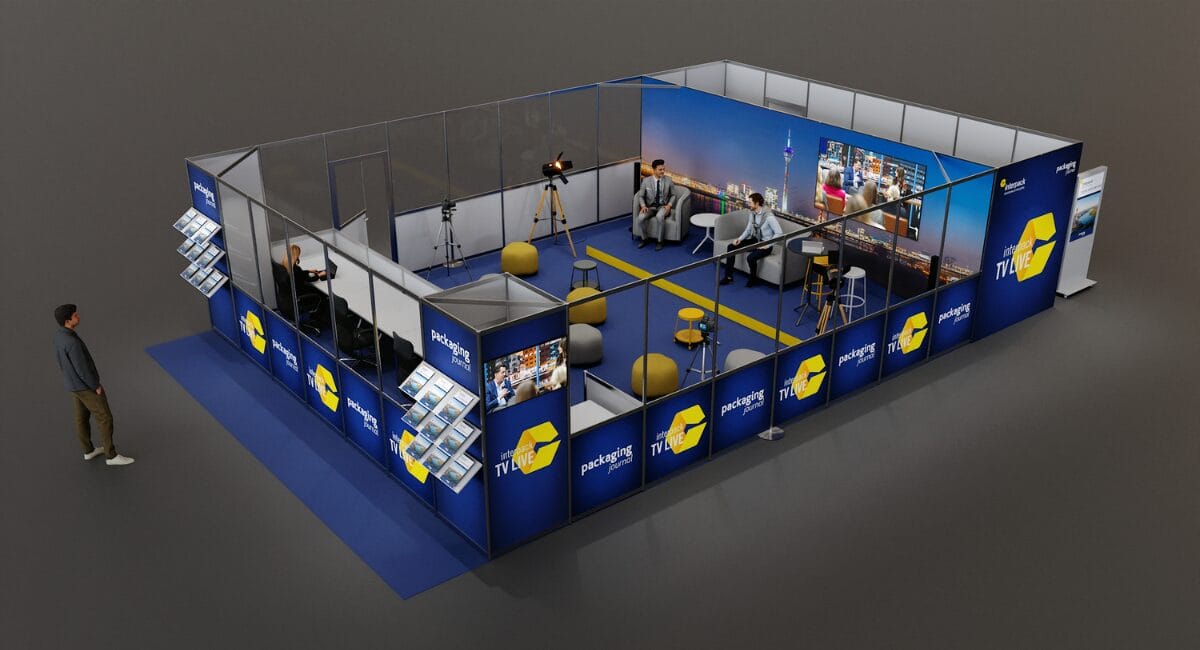
The point of contact at the trade fair is the TV studio in the North Entrance. At the same time, the content will be broadcast live on the websites and channels of packaging journal and interpack. German- and English-language contributions will alternate and will continue to be available after the trade fair.
Here's where to find the live programme: https://interpack.packaging-journal.de