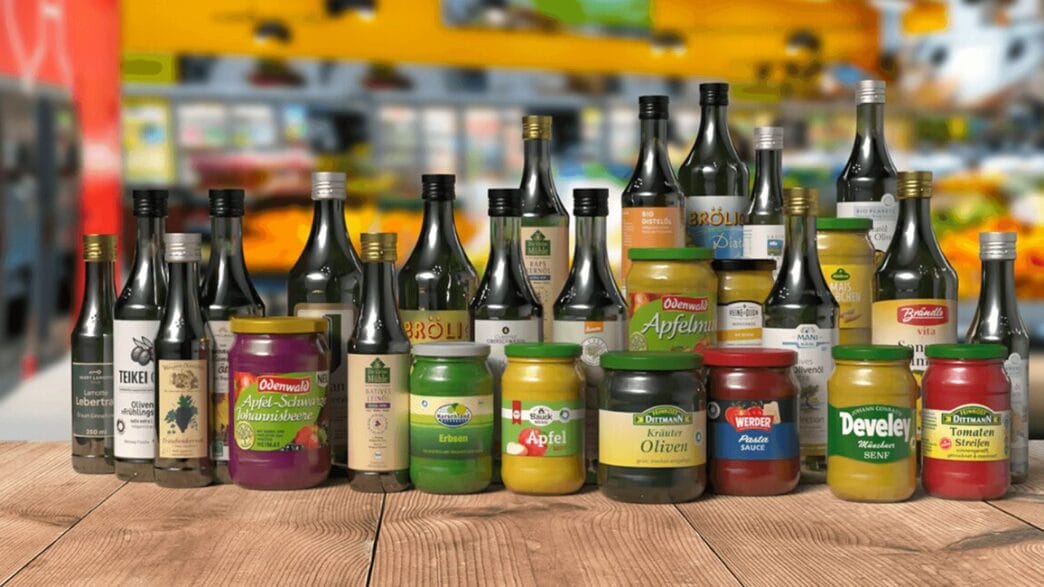
24 manufacturers of fruit and vegetable preserves, edible oils, mustard, and sauces want to gradually switch their glass packaging from single-use to a standardised reusable system. Together with Berlin-based system provider dotch, the companies are citing rising costs for single-use glass and regulatory developments at the EU level as the reason for this move.
According to those involved, both expected CO₂ costs for glass production and increased packaging licensing fees are increasing the economic pressure on disposable solutions. The European Packaging Regulation (PPWR), which aims to make reusable systems more attractive, is cited as another driver.
Cost and regulatory effects strengthen reusable systems
According to the communication, the industrial CO₂ price for single-use glass is forecast by the GMK Center to rise to around €147 per tonne of CO₂ by 2030. At the same time, according to data from Verpackungslizenz24, the licensing costs for glass packaging in 2026 will be around 71 percent higher than in 2020.

Manufacturers see this as an incentive to switch to reusable packaging solutions. Timm Reichold, co-partner and managing director of Feinkost Dittmann, is quoted in the statement as saying: „In times of disrupted supply chains, rising energy and raw material prices, and general economic uncertainty, reusable packaging creates more planning security and stability for us.“
Studies see potential for savings
To support the ecological advantages, the manufacturer alliance refers to several studies. According to one study by the German Environmental Aid (Deutsche Umwelthilfe) and the German Reusable Association (Mehrwegverband Deutschland), up to 710,000 tonnes of packaging waste and 409,000 tonnes of CO₂ could be saved annually for pre-packaged foods such as oils, vinegars, and fruit and vegetable preserves.
Furthermore, the communication refers to a study by ifeu and GVM on behalf of NABU. This demonstrates, using the example of fruit and vegetable preserves, that greenhouse gas emissions caused by packaging could be reduced by 58 percent if twelve single-use jars are replaced by one reusable jar.
dotch organises the reusable cycle
The system, organised by dotch, is based on six standardised reusable glass containers. According to the company, it handles the provision of containers, logistics, cleaning, and return of the packaging. The system is already used in organic retail and wholesale in Germany and Austria and, according to the company, comprises around 1,800 affiliated branches.
The companies involved include, among others, Carl Kühne, Feinkost Dittmann, Werder Feinkost, Andros, Develey, Alfred Paulsen, Marschland, Bio Planète, Allgäuer Ölmühle and Teutoburger Ölmühle.
Source: Glass can also be disposed of.