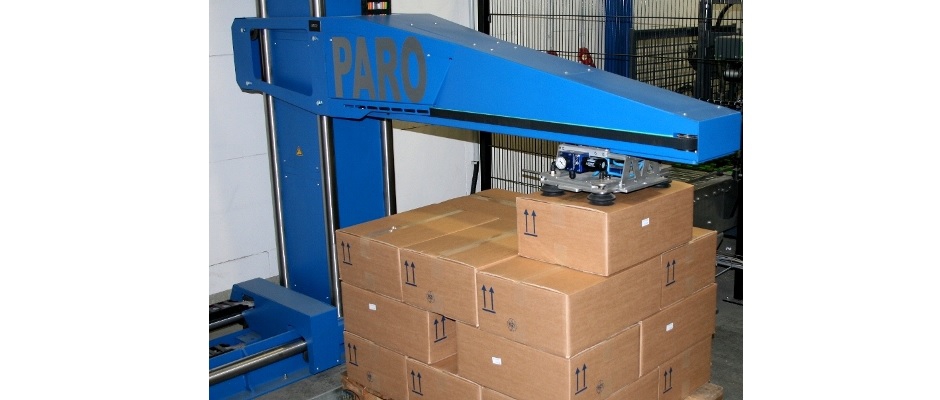
The fully automated assembly of shipping pallets has now given the printing ink manufacturer RUCO a further boost in productivity. The core component of the fully automated system is the PARO palletising robot from roteg AG with a specially configured vacuum gripper and intuitive controls.
Printed on packaging made of plastic, paper or film as well as on glass, labels, CDs or toys, colours make a wide variety of products more attractive. The business success of the traditional printing ink system supplier RUCO, Eppstein, rests on three pillars Innovation, quality and Productivity. In the dispatch department, which has to deliver around 10,000 tonnes of precisely picked paint to customers at home and abroad every year, the aim was to significantly increase the output quantity per shift and at the same time avoid manual lifting of heavy loads: A PARO palletising robot has recently been installed there. This robot is the core component of the system solution developed by Dortmund-based automation specialist roTeg.
Grippers for all types of containers and pallets
In the past, the shipping pallets were mainly assembled by hand. Even the use of a semi-automatic lifting aid did not relieve the staff to the desired extent. Therefore, a Fully automatic solution, which takes all container and pallet types into account, is easy to operate and works independently.

RUCO fills the printing inks produced in plastic buckets and plastic or tin cans. The cans are in turn packed in cardboard boxes. This means that there are two different types of container that the palletising robot has to process automatically without any changeover effort: Paint buckets and cardboard boxes. For a productive solution, the gripper used has the Key role to.
In principle, both the cardboard and plastic containers to be handled are suitable for processing with a vacuum gripper, which grips the package by suction. With plastic buckets, however, there is a risk that the lid will come off due to its own weight during the gripping process. Paint manufacturer RUCO uses plastic buckets with a stable and hermetically sealed lid that eliminates this risk. However, the lid surface is not completely smooth, but has a ribbed edge and a spout. This aspect initially made tests on the roTeg test stand required. Different materials, suction cup models and also prototypes of newly developed gripper types were tested for their suitability.
The result is a combination of a large, centrally positioned suction cup for the buckets and four smaller, more widely spaced suction cups with a separate suction circuit for the cardboard boxes. This makes the entire automation solution very convenient for RUCO. In the programme menu of the system control unit, all that needs to be done is to select the Package type can be selected. The control system then automatically activates the gripper area for the specific package. This prevents errors due to incorrect operation.

Several working variants are possible
The gripper used also ensures a high degree of flexibility with regard to the various palletising tasks. Flexibility. In addition to the Euro pallet, wide chemical pallets of type CP 1 or CP 2 can be used. The package type selected in the programme menu of the control system also automatically adopts the palletising scheme and the load carrier used.
The robot operates Two palletising stations. The first station enables high palletising performance with short cycle times due to short travel distances. Picking can also take place at the second palletising station, which extends the pallet change interval. The robot therefore works for longer without interruption. However, the second palletising station can also only hold intermediate layers, which can be used in the first station if required.
A special variant is the palletising of cardboard boxes and buckets in one process. As the gripper is designed for both package types and requires no manual changeover, a cardboard box or a bucket can be gripped alternately. Both types of package can be picked by type at fixed assigned locations or mixed for customer orders.
Control software with integrated service package
The entire palletising system is operated intuitively and the graphical user interface quickly familiarises the user with the main functions. This includes both the selection of the palletising program and new layer patterns, which only need to be set up by specifying the length, width, height or diameter. After selecting the pallet size, the PARO-Control programme suggests a suitable layer pattern that can be adopted or edited. The new packing pattern is ready for palletising within a minute.
However, the control software is set to offer users even more in the future. The roTeg developers cite the following goals: „We are currently working on expanding the service menu. A virtual spare parts catalogue already exists. The next step will be to link it with the automatic wear indicator to ensure that wear parts are reordered in good time. This will save the user the otherwise necessary stock-keeping. And connecting an online shop would further simplify spare parts procurement for the user.
The self-diagnosing automation system, in conjunction with the robust design at RUCO, realises a High availability and Process reliability. Maintenance costs are reduced to the contact parts in the gripper or the cyclical replacement of the drive belts; there are no other wearing parts. The cantilever arm and robot tower are mounted on rollers and move on polished stainless steel tubes. This guarantees smooth running with low operating noise.