SIG Combibloc: Pioneering idea becomes a global success
The revolutionary idea of packaging beverages in liquid-tight cartons 85 years ago laid the foundations for a success story that continues to this day all over the world with numerous new shapes and closure ideas from SIG Combibloc.
21 July 2021
The revolutionary idea of packaging beverages in liquid-tight cartons 85 years ago laid the foundations for a success story that continues to this day all over the world with numerous new shapes and closure ideas from SIG Combibloc.
For the 44-year-old Rolf Stangl, Chief Executive Officer (CEO) of the SIG Combibloc Group, carton packaging is more than just the core business of the company, which he has headed since 2009.
Rolf Stangl
„Our carton packs are a piece of Cultural asset. Over the decades, the development of this packaging has always been a reflection of how the product world, distribution channels and also people's zeitgeist and consumer habits have changed. And we remain committed every day to working together as partners to bring food to consumers around the world in a safe, sustainable and affordable way.“
From the folding carton to the beverage carton
Ferdinand Emil Jagenberg opened a paper shop in Düsseldorf in 1878. His two sons Max and Emil, both engineers, expanded the business in the following years: They designed machines to process paper into folding boxes, for example, the packaging of the early days. And they were successful: the high quality of their products earned them worldwide recognition, so much so that representatives of the company took part in the 1903 World's Fair in St. Louis.
After the First World War, a fundamental change in society was underway. Mechanisation and rationalisation are the buzzwords of the time. Trade structures change, cities grow, distribution routes for food become longer.
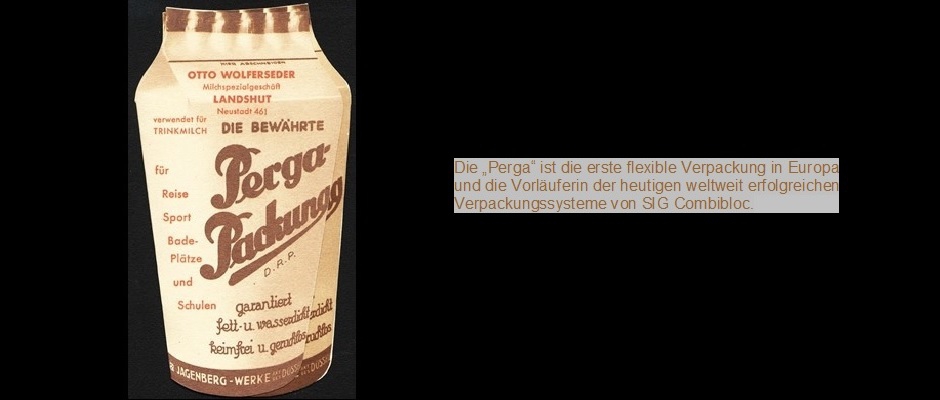
During this time of upheaval Günter Meyer-Jagenberg, a nephew of Emil Jagenberg, was introduced to milk cartons on a trip to the USA, which were previously unknown in Europe. In principle, these cartons were similar to Jagenberg's folding cartons: However, the paper bags were labelled with Paraffin wax coated and therefore waterproof. They were supplied pre-moulded to large dairies and filled with milk. The impetus for the European beverage carton was there.
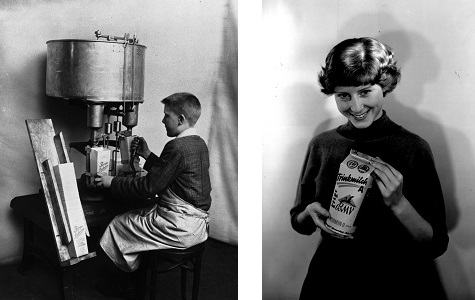
The first Perga filler: the so-called „Iron Cow“ (left). Beverage cartons begin to boom in the 1950s: example from the advert (right).
Meyer-Jagenberg utilised the expertise of the family business and developed the Folding carton production In 1929, he registered the trade mark for a „conical grease bag“ coated with paraffin. One year later, on 8 November 1930, he applied for the Patent for the „Perga“ as a „watertight paper container with folding closure and device for its manufacture“.
However, packaging only became a mass product after the Second World War: drinks cartons began to boom in the 1950s. They emphasised the modern lifestyle of the years of the economic miracle. The Düsseldorf site soon became too small for the Jagenberg-Werke headquarters. In 1958, the company management found a suitable new location in Linnich near Aachen. PKL (Papier- und Klebstoffwerke Linnich) was founded and later renamed SIG Combibloc.
Packaging in transition
And the „Perga“ also changed over the course of time. While small corner shops were the order of the day in the 1950s, this picture changed fundamentally in the 1960s. Starting in the USA, a new form of goods distribution came into fashion: the supermarket. Self-service is the buzzword. Chilled counters and shelves fill the shops. They place different demands on the products: They now have to be bottled and offered in large quantities. A requirement that the Perga beverage carton no longer fulfils - a successor must be found.
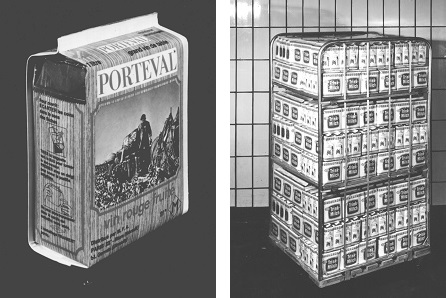
„blocpak“ becomes the company's first mass-produced packaging, with the major advantage that it can be stacked.
In 1962, blocpak is established as a new packaging system that better meets the increasing demand and requirements of the markets - for example in terms of Stackability. „blocpak“ becomes the company's first mass-produced packaging. The former paraffin impregnation of the carton is replaced by the Coating with polyethylene and the dimensions of the packaging were designed in a standard size so that they could be optimally stacked on the pallets of the time.
In addition to milk, these packs could also be used to fill wine and sherry, for example. Within a very short time, blocpak becomes one of the leading packaging systems for fresh milk and fresh milk products in Europe. By 1969, 14 billion packs had been produced and distributed.
International breakthrough
In the 1970s, daily shopping was increasingly replaced by weekly shopping at the supermarket. This meant that food had to be preserved using new filling and packaging technologies. With the market launch of the packaging system „combibloc aseptic“ to the aseptic filling The first SIG Combibloc product to be presented at interpack in Düsseldorf in 1975 was the international breakthrough in this respect.
Another chapter in the success story begins in the mid-1980s: the first aseptic carton pack containing chunky soups revolutionises the packaging of food products.
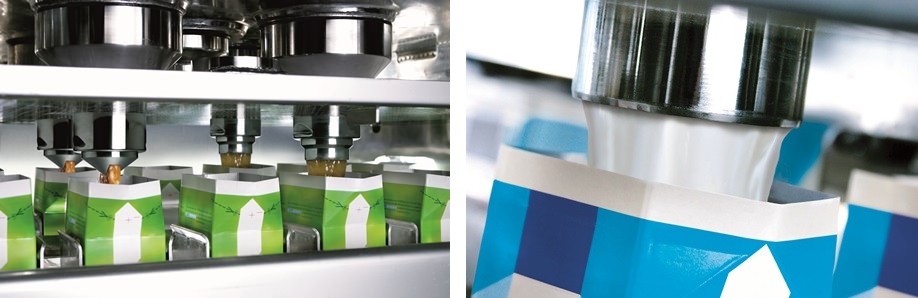
„Today, our customers fill more than 10,000 products from over 50 product categories from the NCSD (non-carbonated soft drinks), LD (milk and dairy products) and food segments into our carton packs. This is made possible by our flexible filling technology,“ emphasises Rolf Stangl.
More than 10,000 products from over 50 product categories are now filled into the carton packaging.
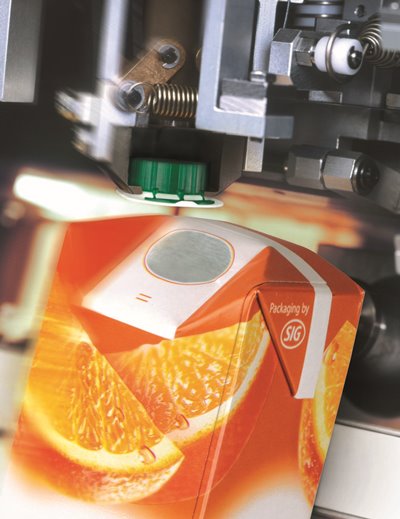
In the 90s, the Need for convenience of the consumer. Consumers want their food packaging to be ever more convenient. Against this background, in 1993 SIG Combibloc launched combiTop the world's first resealable spout on the market.
In 1993, SIG Combibloc launches combiTop, the world's first resealable pourer.
This was followed in 2000 by combiTwist the first Screw cap. The elegant, slim cardboard packaging combifit with its typical bevelled top in 2001 and the technologically innovative combiSwift screw cap in 2005 make opening and pouring even easier and more convenient.
With the market launch of the screw cap combiSmart (2006) makes opening and reclosing very easy, even for small pack sizes of less than 500 ml.
The first screw cap, combiTwist, followed in 2000. The elegant, slim combifit carton pack with its typical sloping top in 2001 and the technologically innovative combiSwift screw cap in 2005 make opening and pouring even easier and more convenient.
The combifit carton pack (2001) and the technologically innovative combiSwift screw cap (2005) make opening and pouring even easier and more convenient.
The market launch of the combiSmart screw cap (2006) makes opening and reclosing very easy, even for small pack sizes of less than 500 ml.
Innovation in the name of the environment and sustainability
It should also be practical for the consumer in the new millennium. But in the wake of climate change and resource scarcity, the demands on the environmental compatibility and sustainability of products and packaging are also increasing worldwide. Carton packs from SIG Combibloc also score highly in this respect, as they consist of around 75 per cent cellulose fibres obtained from the renewable raw material wood. Because trees absorb CO2 and release oxygen during the growth phase, sustainably managed forests also help to protect the climate.
The combibloc innovation EcoPlus shows in 2010 that there is nothing that cannot be done better: With combiblocSlimline EcoPlus for example, can save a further 28 per cent of CO2 compared to a conventional carton pack of the same format.
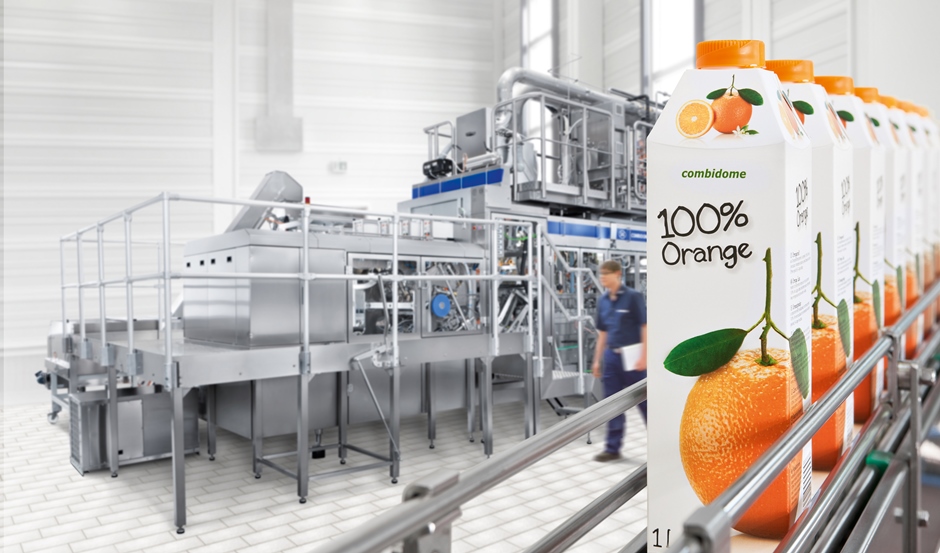
Combining the best of a carton pack and the best of a bottle, 2013 combidome guarantees exceptional differentiation of a beverage.
Carton. Bottle. combidome
With combidome In 2013, SIG Combibloc presented something that was unlike anything else on the shelves at the time. This packaging combines the best of a carton pack and the best of a bottle, guaranteeing exceptional differentiation of a beverage. Thanks to its shape, stability and pouring behaviour, combidome is as easy to handle as a bottle and also offers all the proven and unmistakable advantages of a carton pack when it comes to product protection, ecological and economic aspects.
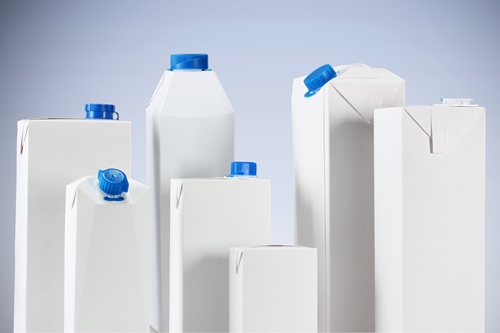
Today, food and beverage manufacturers can choose from a wide range of different pack formats, volumes and opening solutions.
Over 300 packaging variants
Rolf Stangl: „What has allowed us to grow in the past and continues to make us strong today is the commitment of our employees. Today, we have more than 5,000 employees in over 40 countries who work for our customers every day with their expertise and experience. I am very proud of this. This is the only way we can offer our customers added value, which is characterised by excellent packaging solutions at competitive prices, first-class systems and reliable service.“
Customers benefit from SIG Combibloc's 40 years of system expertise. Food and beverage manufacturers have over 300 options to choose the right solution for their product portfolio from a wide range of different pack formats, volumes and opening solutions.
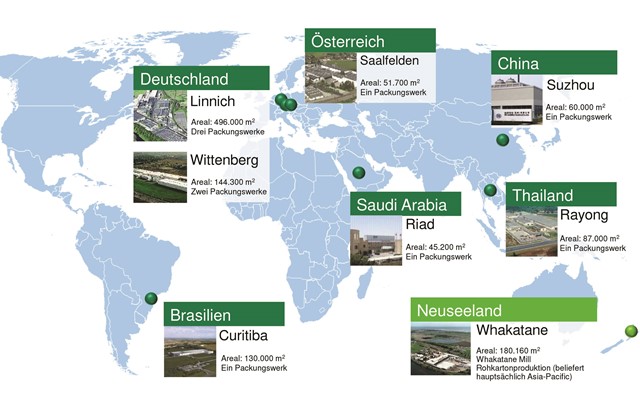
The production of packaging material (sleeves) and raw cardboard worldwide.
SIG Combibloc has been owned by the Canadian private equity company Onex Corporation since 2015. In 2014, SIG Combibloc achieved a turnover of 1.63 billion euros.