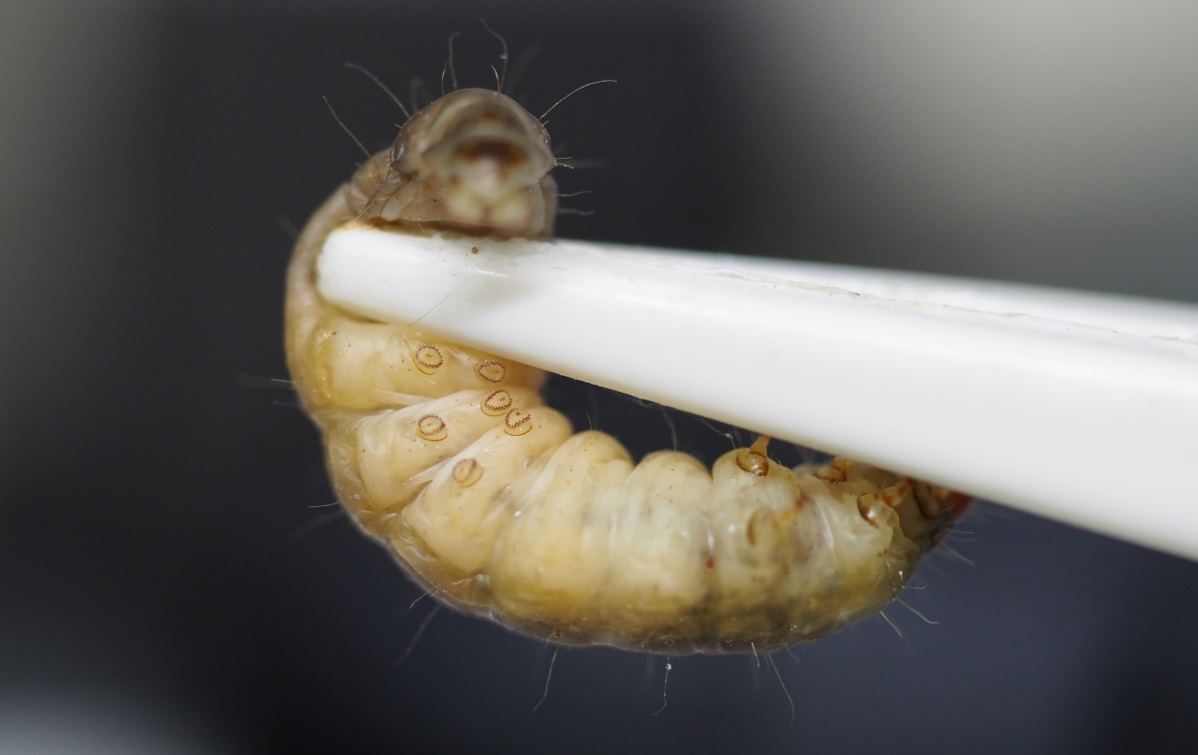
Can caterpillars be used in the fight against plastic waste? Researchers at the Fraunhofer Institute for Structural Durability and System Reliability LBF have investigated this question in detail. They have come to a sobering realisation.
According to a study published at the beginning of 2019, larvae of the Wax moth Galleria Melonella are able to eat polyethylene (PE) and convert it at a remarkably high rate: 100,000 caterpillars eat around 5.2 kilograms of PE within a week. This would open up promising possibilities for Disposal and removal of large quantities of plastic waste open.
The question of whether the caterpillar can actually do this or whether it can do the PE merely crushed and excreted has been investigated by the Fraunhofer Institute for Structural Durability and System Reliability LBF in a current research project.

No biodegradation of polyethylene
The results of the research project so far have astounded the project team: caterpillars eat holes in the polythene, take up small quantities and at the same time lose a significant amount of body mass.
If holes are present, the caterpillars stop further material intake. The analytical measurement data show that the caterpillars excrete the polyethylene unchanged.
„The fact that caterpillars biodegrade conventional plastics remains a mystery for the time being. Vision. This makes it all the more important for scientific research to avoid and recycle plastic waste, taking into account all stages along the packaging value chain,“ emphasises Dr Bastian Barton, who supervised the research project at Fraunhofer LBF.
There is an urgent need for improved concepts and suitable technologies for the Production of post-consumer plastics with high quality and constant availability. Only then could plastics already in use be reused on a large scale and for a wide range of products, Barton continued.
The RauPE research project
As part of a research project on the Imaging chemical analysis of plastic digestion in caterpillars (RauPE), a team from Fraunhofer LBF used high-resolution Raman microscopy and special software to track the plastic's path through the caterpillar.
As part of the project, the team also developed dedicated software for the Raman microscopy of mixtures developed in Python. With the help of machine learning, it can unmix the superimposed Raman spectra of the components. It provides the spectra of the individual components on the one hand and their local concentration on the other. This enables researchers to detect even low concentrations of a substance such as PE within a complex mixture.
The combination of Raman microscopy and software is able to spatially visualise low concentrations of plastics within a mixture of different organic substances as they are present within the caterpillar. This is three-dimensional with a resolution of up to one micrometre (0.001 mm) is possible. By using confocal optics, the scientists can examine caterpillars non-destructively, i.e. largely without dissection.
The RauPE research project was developed by the Darmstadt researchers in a Video documented.
Source: Fraunhofer Institute LBF