After the introduction of the deposit on cans, many manufacturers said goodbye to tinplate or aluminium containers. For some years now, however, the beverage can has been making a remarkable comeback, including at the Gold Ochsen brewery in Ulm. In order to cope with the increased production volume, the technology also had to be significantly upgraded.
Even in the years when many colleagues took cans completely out of their product range and the metal packaging was replaced in Germany by over seven billion units sold per year at the turn of the millennium to less than 100 million in 2005 it remained in Gold Ochsen's portfolio.
„We never took them out of our range, even though we didn't sell much in some cases. Recently, however, the tin has even seen double-digit growth in our range, even though we don't explicitly advertise it. As our old fountain pen was getting on in years, we were looking for a new one“
Operations Manager Stephan Verdi, Gold Ochsen Brewery Ulm
Offers were obtained from all major and established filling machine manufacturers - and the decision was then made in favour of a filler from the Peter Markl Brauereimaschinen GmbH in Reichenbach-Kienleiten.

Quality with a long service life
„My aim is always to provide my customers with first-class quality for the output range from 1,000 to 15,000 bottles or cans per hour: Bottled low in oxygen, with minimal use of CO2, energy and cleaning agents,“ explains owner Peter Markl. With a very high level of vertical integration, he and his 23 specialists design and build robust, easy-to-operate and easily accessible filling machines, cappers and transport systems for glass bottles, PET containers and cans.
The company builds special and customised systems, from individual machines to small series of ten units, for medium-sized companies.
(Image: broesele)
In contrast to the very large competitors, the machines are not down-regulated, but rather exactly for the medium-sized service sector designed. The company builds special and customised systems as well as individual machines up to small series of ten units. The machines are not scaled down, but designed precisely for the performance range of medium-sized companies.
Wash and apply MHD
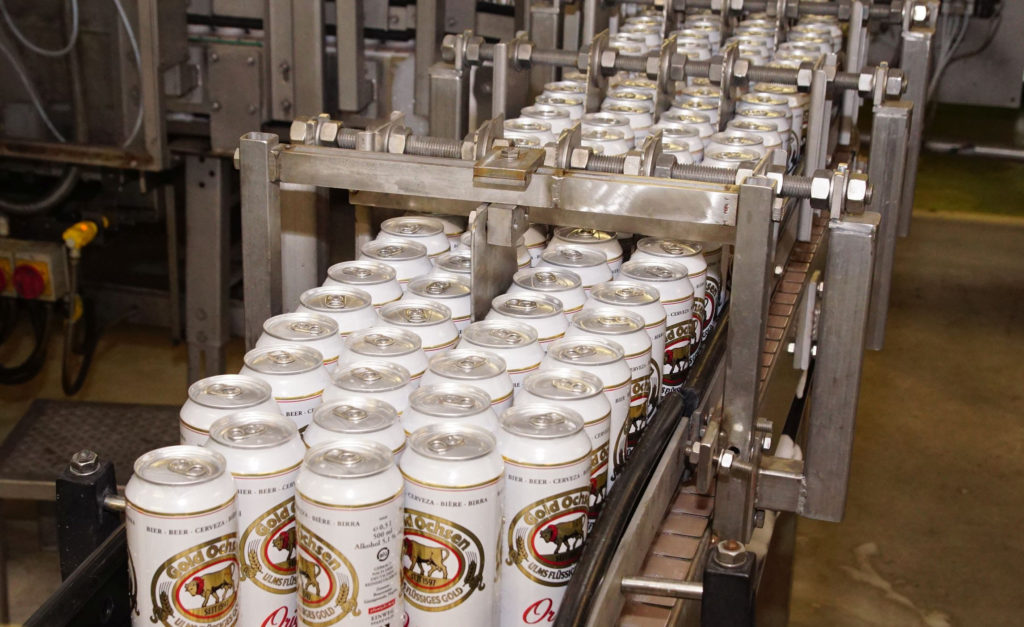
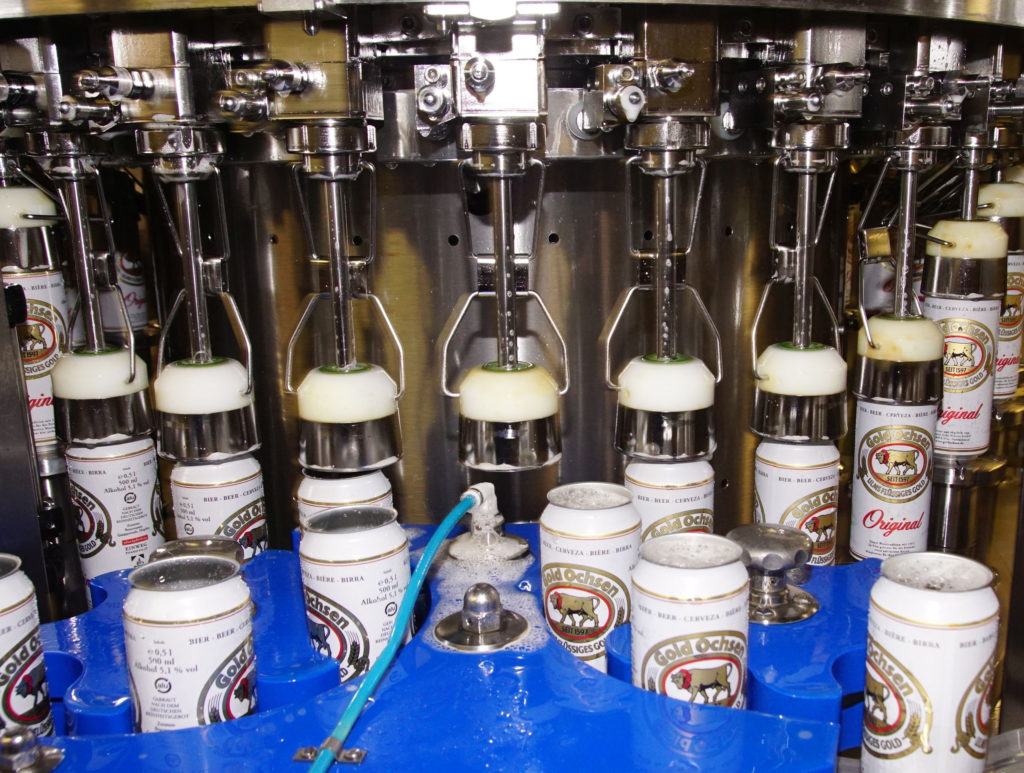
At Gold Ochsen, the empty cans are lifted off the pallet and travel individually on a conveyor belt to the filling station. On the way, they are rinsed with fresh water and then turned over. The best-before date, which is exactly nine months after the filling date, is printed upside down on the base using a laser printer. Turned back, they enter the Bavaria can filler, protected from any contamination by a stainless steel roof. This has 30 filling stations and an output of 10,000 cans per hour.
Filling and sealing
Each can becomes a filling valve from above when it is lifted Completely enclosed with a centring bell and thus sealed without gaps. CO2 is blown in first and the entire container is flushed. As Markl dispenses with pre-evacuation, there is no need for an expensive and susceptible vacuum pump. The beer flows into the can by gravity without foaming up or losing carbon dioxide. Markl relies on its tried and tested Long-tube counter-pressure filling principle, The beer therefore flows into the can from below and displaces the CO2 at the top.
Before sealing, it is important that the headspace is filled with foam. This is done by a small high-pressure spray that brings water to the surface, followed by a „Bubble Breaker“, which destroys the largest bubbles with a CO2 shower. Finally, the lid, which is also flushed with CO2, is put on and the can is securely sealed in the blocked seamer from Swiss specialist Ferrum.
Cleaning and testing
Thanks to the ingenious clamping gas routing with CO2 purging, the entire Very low carbon dioxide consumption, The machine is designed for highly efficient CIP cleaning. The machine is designed for highly efficient CIP cleaning, and the hygienically designed, internally polished filling valves also contribute to this.
Specially reinforced and sealed drive elements as well as the all-stainless steel design are evidence of the company's expertise in Decades of durability orientated machine designs.
Finally, an X-ray fill level check verifies that each container is filled exactly. This is followed by packing into trays of 24 pieces, shrink-wrapping in film and palletising.
„We are very satisfied with the machine, which doesn't have many buttons and switches and works very reliably without unnecessary bells and whistles.“
Margot Finkler, Head of Bottling Gold Ochsen Brewery, Ulm
Equipped for the future of cans
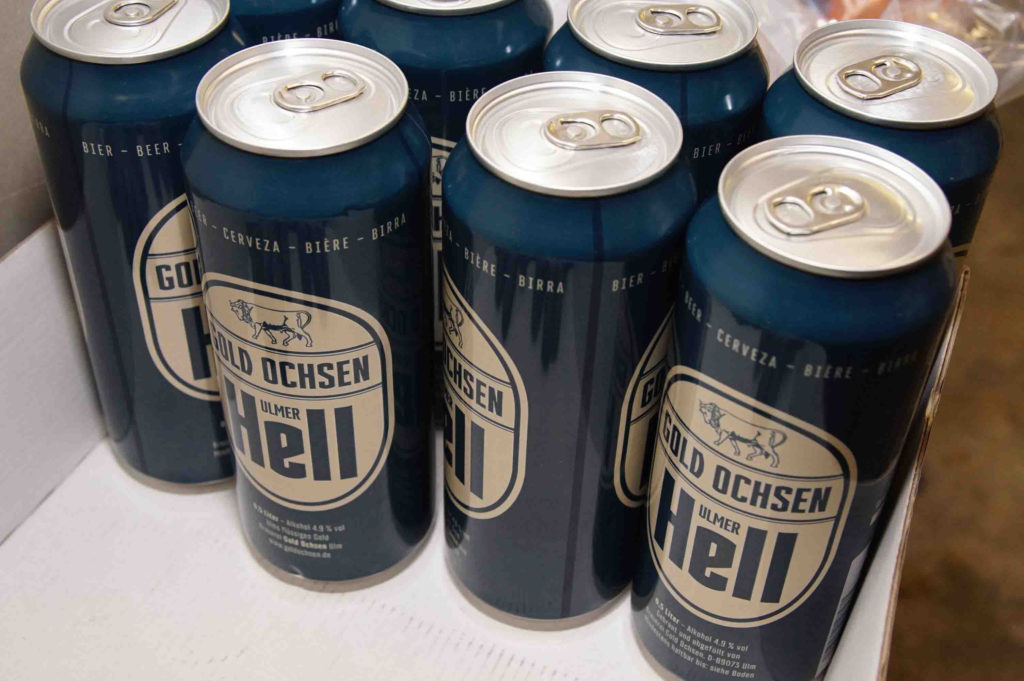
„We were looking for a machine that would suit us in terms of performance, that was reliable and not too complicated. That's exactly what we found with the Markl Bavaria filler. I'm particularly impressed by the excellent oxygen values,“ says Operations Manager Verdi. They are not yet filling cans every week, but the trend is very positive, although Gold Ochsen sells the cans with „Original“ and „Hell“ at a high price and does not specifically advertise them.
http://www.brauereimaschinen-markl.de