Innovative corrugated cardboard corners with a dynamic spring function now protect sensitive goods in transport packaging. The ecological solution made of 100 per cent corrugated cardboard makes additional filling materials and plastic transport cushions superfluous.
According to the German Insurance Association (GDV), global goods transport causes billions of euros worth of product damage every year. According to transport insurers, almost 70 per cent of all damage could be avoided. A significant contribution to prevention is made by packaging concepts that Customised to the respective supply cycle are.
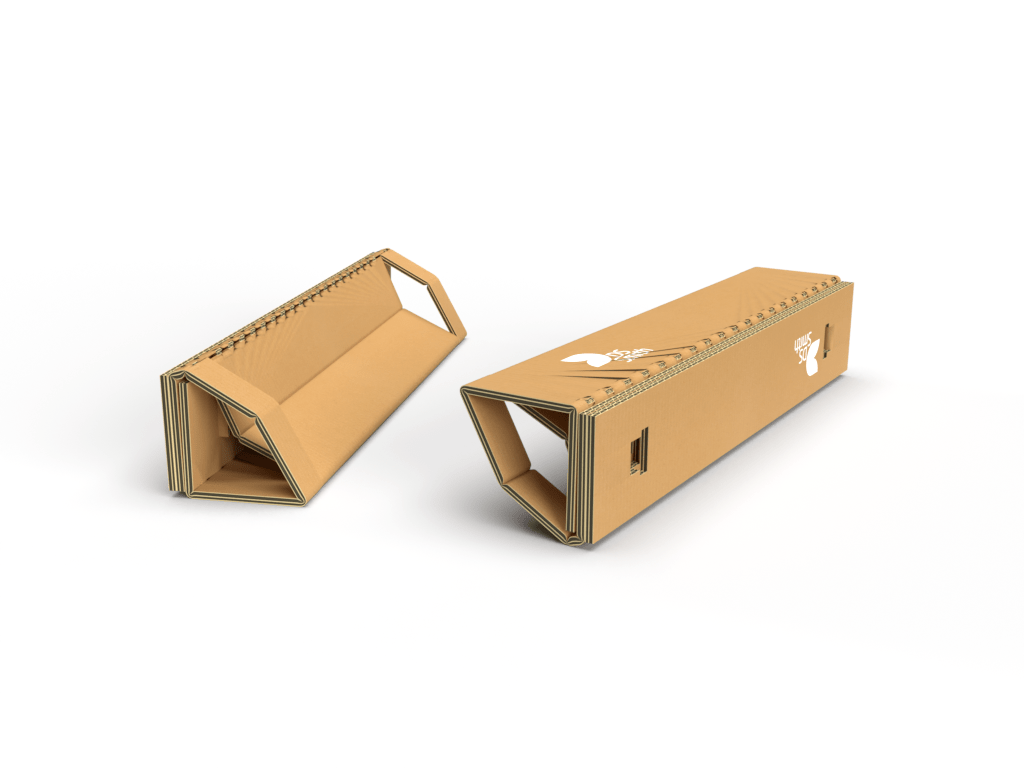
DS Smith now wants to use „Sustainable Protector“ for More security and sustainability in goods dispatch provide. The special feature of the innovative corrugated cardboard corners: they have a dynamic spring function. This means that even sensitive goods in transport packaging are reliably protected against knocks, shocks and vibrations.

The clever design minimises the risk of cost-intensive product damage. At the same time, the ecological Solution made from 100 per cent corrugated cardboard The new plastic padding protects the environment and makes additional filling materials and transport cushions made of plastic superfluous.
The corrugated cardboard spring corners have been Circuit design principles, DS Smith together with the Ellen MacArthur Foundation developed and replaces packaging inserts made of EPS (expanded polystyrene) or foams to 100 per cent.
Customised corrugated cardboard spring corners
The corrugated cardboard protectors can be customised to the dimensions and weight of the respective products as well as to the respective primary and secondary packaging. The simple handling guarantees efficient packaging processes. The spring corners only need to be manually or semi-automatically erected and attached to the edges of the product or the primary packaging. Both are then packed in the appropriate outer carton and that's it. If you need it particularly quickly, DS Smith supplies the spring corners Already in pre-assembled condition.
Good for the environment and image
With DS Smith's Sustainable Protector, manufacturers are also meeting the growing demand for more sustainable, recyclable packaging concepts. According to a recent study conducted by DS Smith together with Ipsos 42 per cent of European consumers buying products that are not packaged in plastic. More and more consumers want to consume more sustainably and are demanding packaging that avoids waste and conserves resources.

According to a 2019 study by the Gesellschaft für Verpackungsmarktforschung (GVM), the mail order business in particular offers above-average potential for replacing plastic with more environmentally friendly corrugated cardboard: Every year, this could save 75 per cent of the plastic contained in shipping packaging in Germany, Austria and Switzerland.
As a monomaterial solution, the corrugated cardboard spring corners developed by DS Smith can make an important contribution to this. They are made from 100 per cent corrugated cardboard and are therefore 100 per cent recyclable. This innovative solution is in line with the goal that DS Smith has set itself as part of its Sustainability strategy „Now. And in the future.“ to produce 100 per cent reusable or recyclable packaging by 2023.
Source: DS Smith