Doris Peters
CosPaTox Consortium
Vinegar cleaner and balsamic vinegar, body milk or UHT milk. Everyone realises that these are completely different products. But when it comes to packaging them in recycled plastic, household and food products are still treated in the same way. A consortium that emerged from the Forum Rezyklat and now has almost 50 members wants to change this.
We spoke to project manager Doris Peters about the motivations and ambitious goals of the CosPaTox consortium, which has now been launched.
Mrs Peters, is it fair to say that this newly founded consortium is now set to give recyclate development a real boost?
No, I don't think the impression is misleading at all. Of course we have this ambition and have set ourselves ambitious goals. Toxicological safety standards are to be developed and summarised in a voluntary industry standard. So that more recycled material is used and consumers are adequately protected at the same time.
These standards are still lacking for high-quality PCRs. What could they look like at the end of the process?
Yes, so far there is only a standard for food, and this is of course very, very high. The idea is that I don't have to comply with the high standards for food quality for a shampoo bottle or floor cleaner, but a lower standard that still offers protection for the consumer. Between the current hodgepodge of plastics and the rules for food, we want to create a standard that lies in between and is still sufficiently safe for the packaging we are focussing on.
What packaging are you particularly interested in?
We are focussing on cosmetic packaging and have divided our project into cosmetics that remain on the skin (leave-on) and cosmetics that are rinsed off (rinse-off). Our group of considerations also includes the packaging for a simple household cleanser.
The whole interview in the packaging journal TV Talk
So the aim of your work is to ensure that more recyclates can be used and the proportion of recycled packaging increases?
Exactly. Because the problem we have today is that we already collect household plastics in the Yellow Bag, but they are not yet sufficiently separated by type. The aim is to increase the use of recycled plastics from the current level of around four per cent to over 20 per cent. It is also about designing packaging more cleverly and ensuring from the outset that there is less waste or that waste is much easier to separate.
Now, it has to be said that none of this is entirely voluntary. Of course, this is also a reaction to stricter EU regulations. How much is politics breathing down your neck?
Of course, people are worried about how to achieve such high political targets. Nevertheless, there is also extreme pressure from consumers, for example on cosmetics companies to generate less waste from the outset. Or if I have intelligent packaging and tell the consumer that it can either be recycled or recycled much more easily. Or you explain to them that the product has a laminate structure with its own packaging for the outside, which has no contact with the contents. Here I can work with a lower quality on the outside, but still have the product safe so that the consumer is absolutely protected.
The exciting thing about your consortium is that companies from the entire value chain are involved. That makes sense, but perhaps not always easy because many have very different expectations?
First of all, it's nice to be able to say that the CosPaTox consortium has met with great interest. The topic is omnipresent and we have deliberately managed to gain the entire value chain as members. It's not easy to bring all interests under one consortium umbrella. But that's what we do as project managers. And ultimately, everyone benefits from our results, regardless of whether they are recyclers, cosmetics or machine manufacturers.
All of this is a major challenge in an exciting process, but there are also consumers and certainly also political representatives who are saying that it would be best to do without plastic altogether in future. Is one of your goals to make it clear that we can't do without plastic? And can we do it better together?
Most certainly. Because our assessment is indeed that we can't do without plastic. The question is, how can we do better with plastics than we do today? And this will of course also be a big part of the interest of our members who have already tested or looked at alternatives. A glass bottle, for example, has other risks than a plastic bottle for shampoo.
Your wish is our command. That's why we'll be happy to ask you again in a year's time. For today, thank you very much for the interview!
Until then!
About CosPaTox
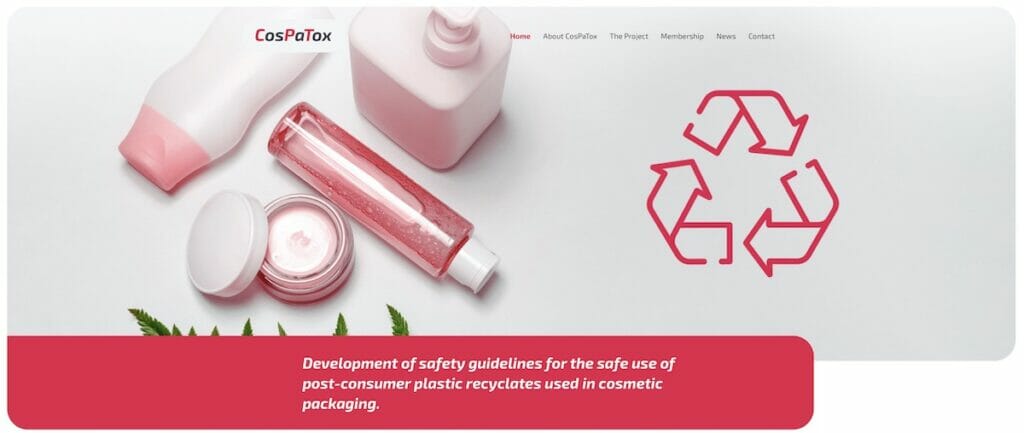
CosPaTox stands for Cosmetics, Packaging and Toxicology. The aim is to create special safety standards for high-quality post-consumer plastic recyclates (PCRs) for cosmetics and other household packaging that have been lacking to date.
The consortium consists of major European brand owners from the cosmetics, hygiene and detergents and cleaning products industries in collaboration with recycling companies, plastics manufacturers and plastics processors. The timeframe is ambitious: CosPaTox aims to publish the results of this work within 24 months.
CosPaTox stands for Cosmetics, Packaging and Toxicology. The aim is to create special safety standards for high-quality post-consumer plastic recyclates (PCRs) for cosmetics and other household packaging that have been lacking to date.
The consortium consists of major European brand owners from the cosmetics, hygiene and detergents and cleaning products industries in collaboration with recycling companies, plastics manufacturers and plastics processors. The timeframe is ambitious: CosPaTox aims to publish the results of this work within 24 months.
Published in packaging journal 6/2021
Perhaps also interesting?

Change of leadership at the BDE: Executive President Anja Siegesmund hands over her office to Vice President Matthias Harms on 31 January 2026.
Read more "

BDE calls for improvements to the Packaging Act
Despite a 70 per cent recycling rate for plastic packaging, the BDE sees a need for reform of the Packaging Act - and is calling for investment security, recyclate markets and clear incentives.
Read more "

UBA and ZSVR: packaging recycling works
With new figures on packaging recycling, UBA and ZSVR prove that recycling is not a myth, but works and is well monitored.
Read more "

Waste disposal associations support plastic levy
The planned plastic levy in Austria is intended to incentivise recyclable packaging.
Read more "

Sharp invests massively in expanding packaging capacities
The investment focus is on the locations in Belgium and the Netherlands.
Read more "

ACG launches sustainable blister solution on the market
ACG Packaging Materials presents SuperPod, an innovative cold-form blister solution that significantly reduces material consumption and promotes sustainability.
Read more "