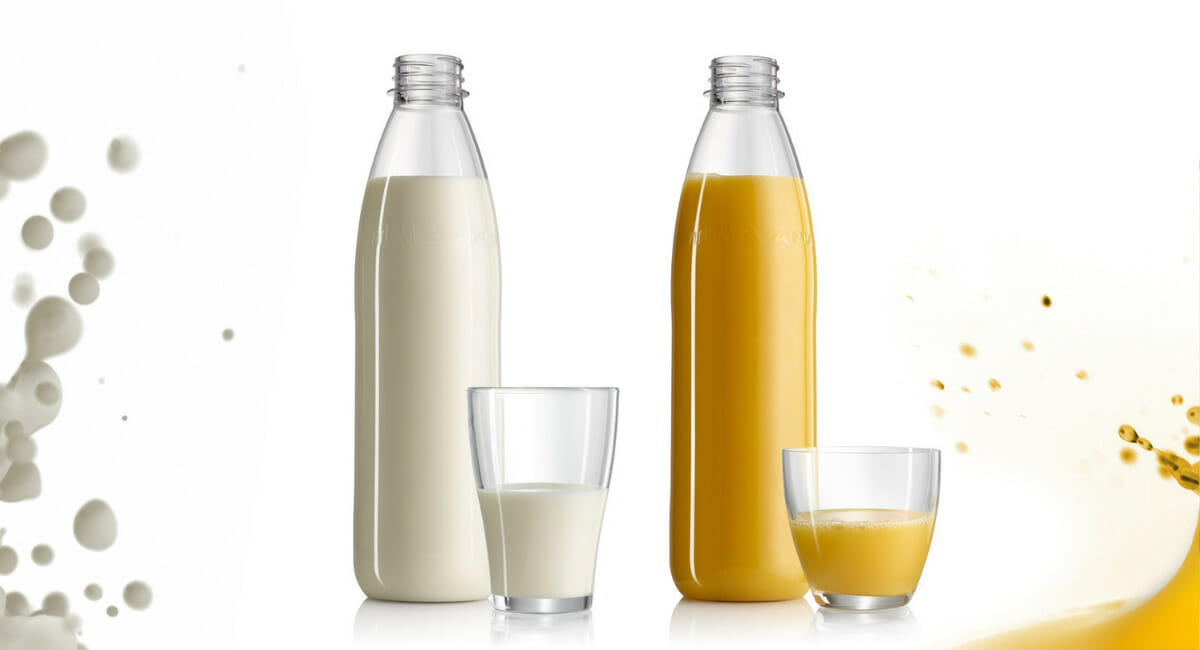
Krones and Alpla have developed a reusable PET container that is also suitable for sensitive products such as juice and milk in the cold chain. The development was preceded by a joint research project.
Out of the niche: Reusable PET containers tend to play a subordinate role in the packaging market for beverages. Wrongly so, as a joint research project by Krones and Alpla. In this material and process parameters were first subjected to a comprehensive scientific evaluation. Based on the knowledge gained in this way, the cooperation partners succeeded in developing a reusable PET container that also provides an ideal home for sensitive ESL (Extended Shelf Life) products such as juice and milk in the cold chain.
Reusable PET with a good environmental balance
Be it due to legal requirements, voluntary climate targets or increasing environmental awareness among consumers: Sustainability issues are becoming increasingly important when choosing packaging.

„Which type of packaging performs best from an ecological point of view depends on a variety of influencing factors and must be evaluated individually for each application,“ says Martina Birk, enviro sustainability programme officer at Krones. Reusable PET containers are often not even considered. „They can offer an extremely attractive environmental balance, especially with predominantly regional distribution.“
Bottle samples and cleaning processes tested
Krones and Alpla have joined forces to utilise these advantages for a wide range of beverages. „Until now, reusable PET containers have primarily been used for carbonated soft drinks and water,“ explains Jörg Schwärzler, reusable expert and project manager at Alpla. Alpla. „But we were certain that if we could Bringing together expertise in materials science, preform design, container design and plant engineering, we also find a solution for sensitive beverages such as juices or dairy products. The option of a 38-millimetre neck finish has particular advantages for sensitive returnable applications.“
The partners paid particular attention to the cleaning process for the containers, because: „PET is less heat-resistant than glass,“ explains developer Ines Bradshaw. „We therefore had to find a way of High microbiological safety even at lower cleaning temperatures and ensure a large number of rotations.“
To collect an objective and meaningful data basis, the Krones Technical Centre for Washing Technology in Flensburg carried out an elaborate series of tests in which the Interaction of different bottle patterns and cleaning processes analysed has been realised. „The tests gave us a very clear picture of the thermal, chemical and mechanical influencing factors,“ says Bradshaw. „Among other things, it became clear that with the right choice of parameters - particularly in terms of lye concentration, temperature, additive and mechanical impact - the temperatures around 60 °C are sufficient, to reliably remove even dried protein, fat and starch soiling from the containers.“
Direct comparison with returnable glass
The direct comparison of reusable PET and reusable glass brought another discovery to light: as the cleaning cycles progressed, the alkaline cleaning medium visibly roughened the surface of the glass bottle. PET containers, on the other hand, nothing comparable could be determined. „Consistent container quality can be an advantage that should not be underestimated, especially when bottling sensitive beverages,“ notes Ines Bradshaw.
Microbiological tests are currently being carried out to obtain final certainty about the safety of the water. The initial results are already available and confirm the previous observations: „Microbiologically, PET bottles that had already undergone 25 cycles were indistinguishable from new ones“ says a delighted Ines Bradshaw. With proof of feasibility, the project has reached an important milestone - and is now ready for the next big step: preparations for the technical field test are already underway.
Source: Krones