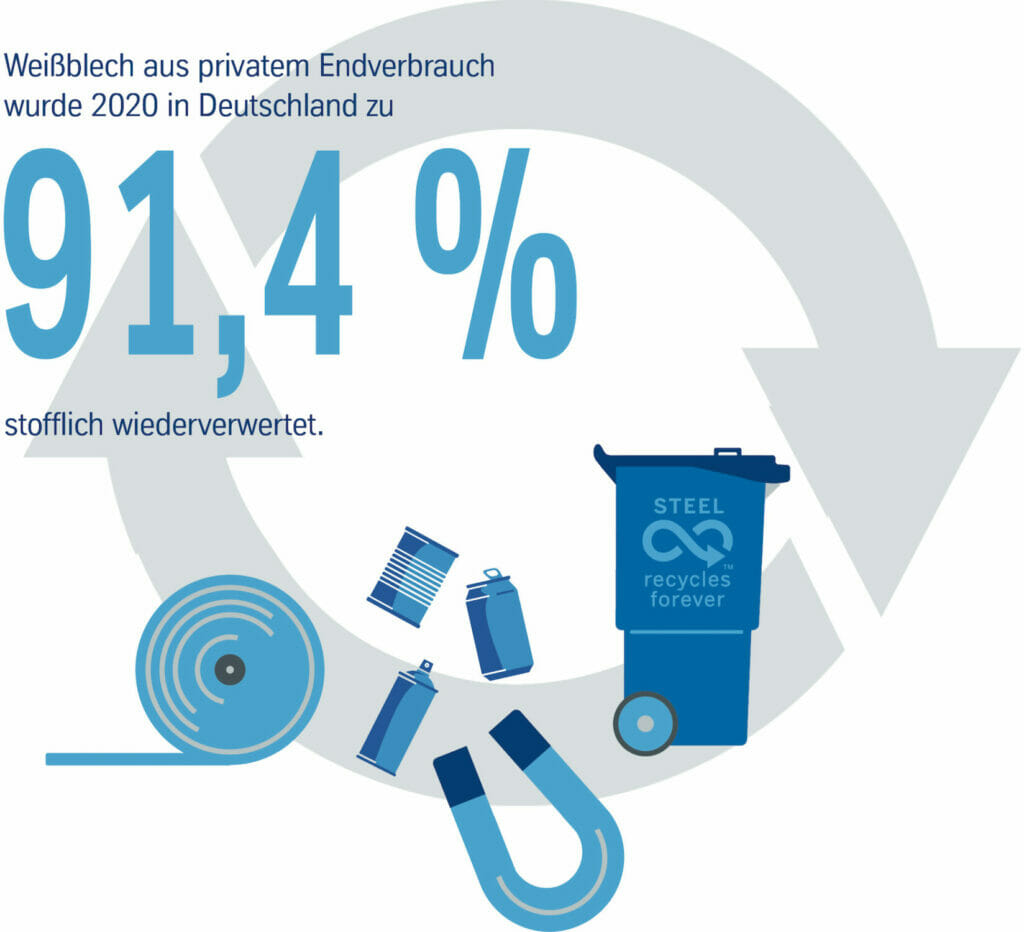


The Society for Packaging Market Research (gmv) reports high recycling rates for tinplate in its latest packaging recycling report. In Germany, 91.4 per cent of tinplate from private final consumption was recycled in 2020.
Tinplate has a convincing advantage over many other packaging materials: it is Almost 100 per cent recyclable. The characteristic properties of this metal allow steel to be melted down again and again and processed with pig iron from the blast furnace into crude steel and then into a new steel product.
"Tinplate is thus once again proving itself to be a sustainable packaging material in a closed, well-functioning material cycle. It can be recycled over and over again without losing its inherent properties. A tin can, a cam cap or a crown cork can be recycled after use into a new, high-quality steel product as part of a wind turbine, a car component or a bicycle part."
Dr Peter BieleCEO of the thyssenkrupp Rasselstein GmbH
Display
Correct separation plays an important role
thyssenkrupp Rasselstein GmbH itself contributes to effectively closing the material cycle by securing the recycling of packaging steel in Germany through its own recycling systems - DWR - Deutsche Gesellschaft für Weißblechrecycling mbH for the private sector and Kreislaufsystem Blechverpackungen Stahl GmbH for the commercial/industrial sector.
"So that this is possible, tinplate must be disposed of correctly - this is the consumer's turn. Emptied tinplate packaging belongs in the yellow bag or the yellow bin. This is the only way to ensure that the steel packaging is returned to the material cycle."
Dr Peter Biele
2020 was an exceptional year overall - characterised by the start of the coronavirus pandemic. For example, the Consumption of food cans up 9 per cent due to coronavirus, according to gvm reportas households stockpiled more supplies. The consumption of chemical-technical packaging even recorded an increase of 16%, as the do-it-yourself market flourished in the reporting period. The calculation of the recycling rate was modified by gvm for the 2020 reporting year in accordance with EU Implementing Decision EU 2019/665.
Source: thyssenkrupp
thyssenkrupp - More news


Chromium-free into the future

Change in the Executive Board at thyssenkrupp Rasselstein

Hiking with tinplate

Survey: Food in tin cans is becoming more popular