Campaign for energy-efficient printing processes

Heidelberg launches an energy efficiency campaign for print shops and presents a further development of the Speedmaster. 

Heidelberger Druckmaschinen AG is launching a campaign on energy efficiency for print shops. Experts provide advice, hints and tips on how to increase energy efficiency in print shops and reduce costs. The company is also presenting a further development of the Speedmaster. 

In the coming months, the company will be placing several highlight topics at the centre of its communications.

„The issue of sustainability and energy efficiency is now one of the key competitive and cost factors for suppliers in the print media industry - this applies equally to our customers and Heidelberg. Together with its customers, Heidelberg also wants to be a pioneer in the industry when it comes to energy efficiency. Thanks to our technological and data expertise, we are in a position to make our customers attractive offers for energy-efficient production and also provide them with comprehensive advice. We must all work together to achieve the climate protection targets.“

Dr Ludwin Monz, Chairman of the Management Board at Heidelberg

Display

To kick off the campaign, Heidelberg is presenting the energy efficiency of the Speedmaster XL 106: A comparison of the Speedmaster CD 102-6+L from 1990 with the current Speedmaster XL 106-6+L shows that the Energy consumption per 1,000 sheets reduced by 40 per cent from 13.8 kWh to 8 kWh could be realised. A large number of innovations and improvements across the entire system are responsible for this.

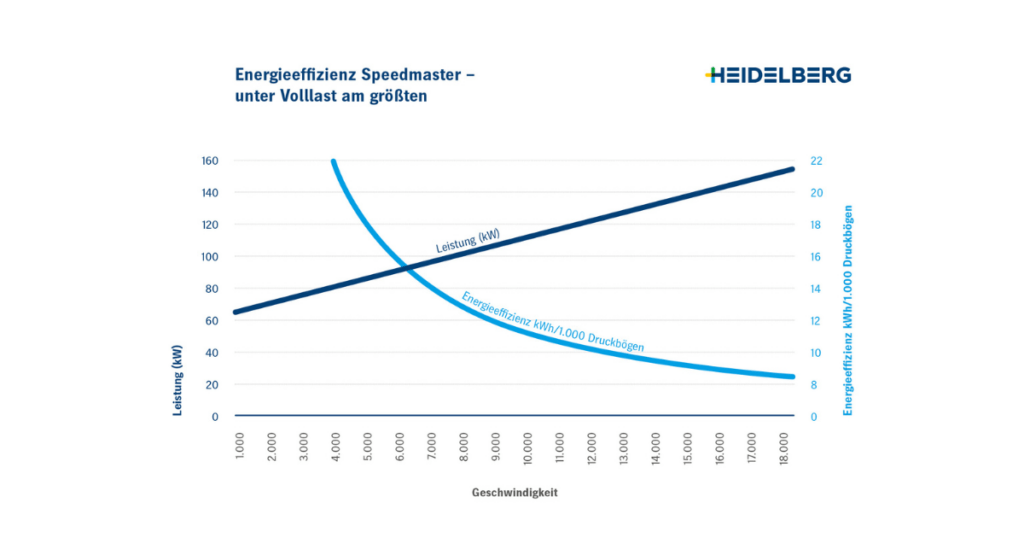
In addition to investing in state-of-the-art equipment, print shops can further increase energy efficiency by optimising their applications: this is based on a principle that distinguishes printing presses from cars, for example, which consume more energy the faster they drive: A printing press, on the other hand, requires a basic energy requirement to cover the basic operating functions. Above this value, the energy requirement increases linearly with increasing printing speed. However, as the energy requirement is spread over more printed sheets, energy efficiency improves. A printing press therefore works most efficiently when a job is printed at full speed - preferably fully automatically - and when the system then goes into standby mode if there is no immediate follow-up job.

The energy efficiency of a printing press is highest under full load, as the basic energy requirement is then spread over more printed sheets.
(Image: Heidelberger Druckmaschinen AG)

„When it comes to energy efficiency in print shops, the equipment used forms the basis, but the optimal operation of the systems is just as important. This is often a major lever for companies. This is precisely where the campaign launched by Heidelberg for greater energy efficiency comes in and forms the basis for exploiting the existing potential.“

Dr Eva Boll, Head of ESG at Heidelberg

From April 2023, the Speedmaster XL 106 will be delivered with an energy meter as standard, initially only in Germany. This will allow the energy consumption of the press to be permanently read off in kilowatt hours per 1,000 sheets at the press control console. The display motivates operators to run the press in an energy-efficient state, i.e. at maximum speed. Overall, various Energy efficiency measures also help print shops to reduce CO2 emissions from their industrial processes.

The second theme of the campaign shows the potential for savings offered by the Speedmaster's peripherals, thereby enabling energy-efficient production. Then The campaign is dedicated to the area of
„Maintenance“ and shows the extent to which regularly maintained machine systems conserve resources and improve the energy balance. To complement the campaign, the company offers a corresponding consultancy service to identify potential energy savings in the print shop together with customers and to draw up action plans to realise this potential.

Source: Heidelberger Druckmaschinen AG

More news about packaging printing