Bacterium eats plastic

A laboratory experiment at the NIOZ has shown that the bacterium Rhodococcus ruber eats and digests plastic.

A laboratory experiment at the Royal Netherlands Institute for Sea Research has shown that the bacterium Rhodococcus ruber eats and digests plastic. The bacterium could be part of the solution for dealing with plastic in the world's oceans. 

Based on a model study with plastic in artificial seawater in the laboratory, doctoral student Maaike Goudriaan calculated that bacteria can cause about one per cent of the plastic supplied per year in CO2 and other harmless substances. „But,“ emphasises Goudriaan, „that is certainly No solution to the problem of plastic soup in our oceans. But it's another part of the answer to the question of where all the ‚missing plastic‘ in the oceans has gone.“

Goudriaan had a special plastic containing a specific form of carbon (13C) produced especially for these experiments. When she fed this plastic to bacteria in a bottle of simulated seawater after pre-treatment with „sunlight“ - under a UV lamp - she saw that these bacteria were able to grow. special version of carbon as CO2 appeared above the water. „The treatment with UV light was necessary because we already know that sunlight partially breaks down plastic into bite-sized pieces for bacteria,“ explains the researcher.

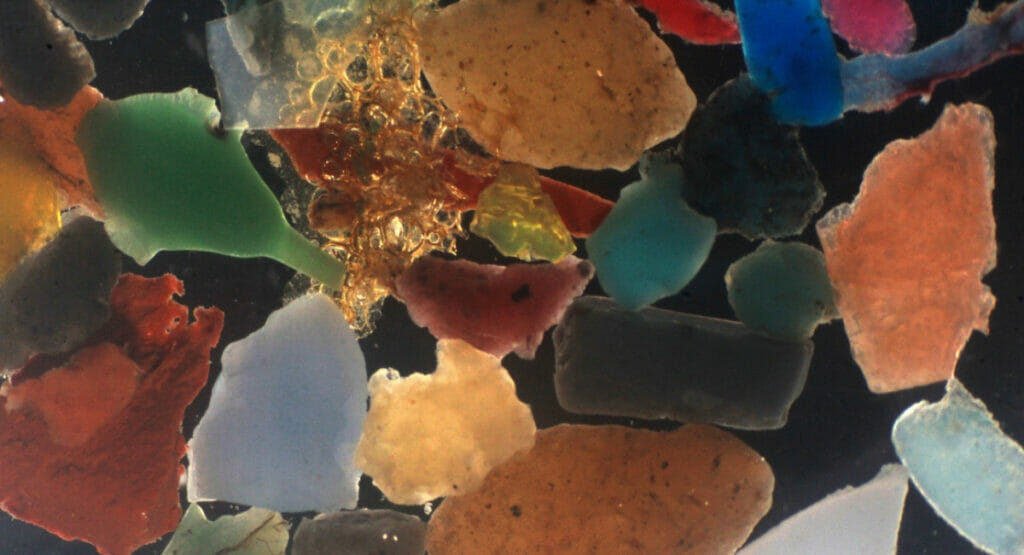
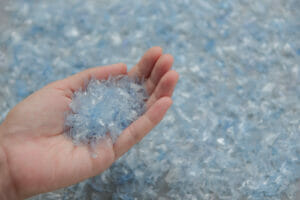
2 millimetre plastic particles
(Image: NIOZ)

„This is the first time that we have demonstrated in this way that Bacteria actually convert plastic into CO2 and other molecules„, explains Goudriaan. It was already known that the bacterium Rhodococcus ruber can form a so-called biofilm on plastic in nature. It was also possible to measure that Plastic disappears under this biofilm. „But now we have really shown that the bacteria actually digest the plastic.“

Display

When Goudriaan analyses the entire degradation of plastic in CO2 she estimates that the bacteria can break down around one per cent of the available plastic per year.

„This is probably an underestimate. We have only analysed the amount of carbon-13 in CO2 so not in the other degradation products of the plastic. There is certainly 13C in various other molecules, but it is difficult to say which part of it was degraded by the UV light and which part was digested by the bacteria.“

Maaike Goudriaan

Even though marine microbiologist Goudriaan is enthusiastic about the plastic-eating bacteria, she emphasises that Microbial digestion is not a solution to the huge problem of all that plastic that floats on and in our oceans.

„These experiments are above all a proof of principle. I see them as one piece of the puzzle in the question of where all the plastic that disappears into the oceans ends up. If you try to trace all our waste, a lot of plastic is lost. Digestion by bacteria could possibly provide part of the explanation.“

Further research is needed to find out whether „wild“ bacteria also eat plastic „in the wild“. Goudriaan has already done some Pilot experiments with real seawater and some sediments collected from the bottom of the Wadden Sea.

„The initial results of these experiments indicate that plastic is also degraded in nature. A new PhD student will have to continue this work. Ultimately, of course, the hope is to calculate how much plastic in the oceans is actually broken down by bacteria. But prevention is much better than cleaning up. And only we humans can do that.“

Maaike Goudriaan

Source: NIOZ

More news on plastics and composites