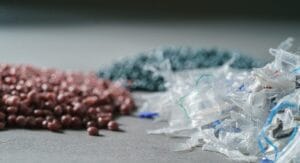
Neste has successfully completed the second series of tests for processing liquefied plastic waste on an industrial scale at its refinery in Porvoo, Finland. To date, the company has processed a total of almost 3,000 tonnes of liquefied plastic waste.
The company hopes to gain further insights through the test runs, how different types of plastic waste behave during chemical recycling in the refinery processes. The end product manufactured in the test runs - Neste RE, a drop-in raw material for the petrochemical industry - is processed into new plastics by Neste's partners.
While Neste is already operating at its site in Porvoo is working on building up large capacities for processing liquefied plastic waste, existing plants built for refining crude oil are being used for the current test runs.
Since Neste's first test run in 2020, the company has successfully completed a total of six runs, achieving a total volume of almost 3,000 tonnes of liquefied plastic waste was processed. After processing 800 tonnes in the first series of tests completed in 2022, the company has more than tripled this quantity to date. The tests are part of Neste's strategy, promote chemical recycling and contribute to a circular economy for plastics.
„Our test runs not only provide us with valuable insights into the technologies, but also serve as proof of concept: chemical recycling can be carried out on an industrial scale. Our goal remains the expansion to continuous operation.“
Heikki Färkkilä, Vice President Chemical Recycling at Neste.
Display
So-called „difficult-to-recycle“ plastic waste was processed, which would end up in incineration or landfill without chemical recycling. This makes it clear, how chemical recycling complements existing mechanical recycling technologies.
Neste is planning to develop a new product within the framework of the PULSE project build up corresponding capacities at its Porvoo site in order to process 400,000 tonnes of liquefied plastic waste per year. From 2030, Neste aims to process more than one million tonnes of plastic waste per year.
This ambitious goal is an important part of the study conducted by the company on the Conversion of its refinery in Porvoo into a production site for renewable and circular solutions with the potential phase-out of crude oil processing by the mid-2030s. Liquefied plastic waste would play an important role in replacing fossil crude oil.
Source: Neste
Recycling - More news


Vilsa bottle combines the advantages of glass and PET

Anja Siegesmund leaves the BDE

BDE calls for improvements to the Packaging Act

UBA and ZSVR: packaging recycling works