An EU directive passed in 2015 aims to reduce the annual per capita consumption of petroleum-based bags to less than 40 by the end of 2025. The German retail sector responded to this back in 2016. The permanent carrier bag from Victorgroup GmbH, for example, offers a resource-saving alternative.
4. July 2018
Expertise in bioplastics.
An EU directive passed in 2015 aims to reduce the annual per capita consumption of petroleum-based bags to less than 40 by the end of 2025. The German retail sector responded to this back in 2016. The permanent carrier bag from Victorgroup GmbH, for example, offers a resource-saving alternative.
A voluntary commitment agreed between the German Retail Association (HDE) and the Federal Ministry for the Environment has been in force since July 2016. The signatories include large chains such as C&A and H&M, but also the small retailer around the corner. Retailers charge between five and 25 cents for a plastic carrier bag. The situation is different at the weekly market or greengrocers. Plastic bags are still widely used here. This makes it clear that not all retailers and customers can or want to do without the convenience of carrier bags.
In order to reduce the consumption of petroleum-based plastic bags, the market now offers various alternatives. Particularly resource-saving are the Permanent carrier bagwhich Organic bag and the Organic waste bags from Victorgroup. They are each produced with a high proportion of renewable raw materials, are biodegradable and also provide additional practical benefits. The company from Frechen near Cologne launched the first loop carrier bag made from biodegradable plastics on the German market back in 2008, which was supplemented by the bio-based permanent carrier bag in 2014. Over 100 people are employed at various production sites across Germany. More than 125 million euros in turnover are generated annually.
The permanent carrier bag
„Eco“ and lifestyle are no longer a contradiction in terms: as an alternative to the classic PE plastic bag, retailers are increasingly focussing on sturdy bags that can be used for a long time. And if they also look good, they hit the nerve of environmentally and fashion-conscious consumers.
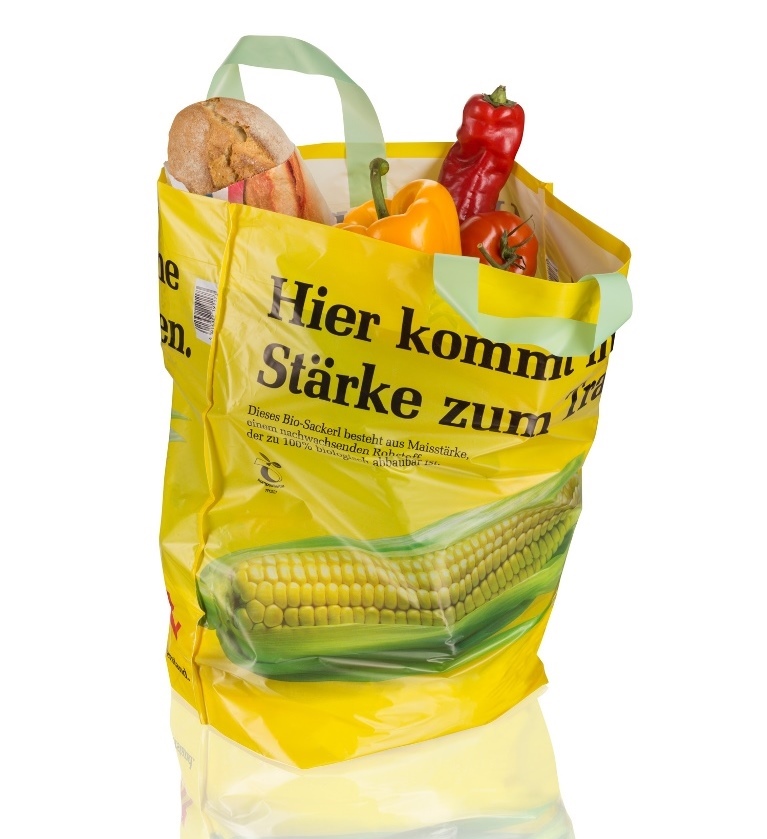
Attractive features and design options make the permanent carrier bag, which is already made from over 95 per cent renewable raw materials, a trendy „eco-fashion bag“.
The permanent carrier bag not only consists of a high proportion of renewable raw materials, but is also Fully biodegradable and compostable. „With our permanent carrier bag, we are providing retailers and consumers with a particularly resource-saving solution that is ideally placed to become a cult object,“ explains Ursula Weck, Managing Director of Victorgroup. This permanent carrier bag is made from a bioplastic based on tapioca starch from the cassava root. This almost completely bio-based plastic makes the bag as hard-wearing as a conventional permanent carrier bag made of polythene. The bag can even be washed in the washing machine if it gets very dirty. It is certified in accordance with the EN 13432 standard and labelled with the Compostability logo „Keimling“ labelled.
Compostability logo Keimling
During dismantling „more “biodegradable" respectively „compostable“ plastics There is no accumulation of microplastics, only CO2, H2O and biomass are produced. Complete biodegradation has been scientifically proven for these products. It takes place equally for all compostable materials, regardless of whether they are fossil-based or bio-based. In German-speaking countries, the manufacturer-independent „Keimling“ certification system has been established for compostable plastic products Similar to other carrier bags made from bioplastics, the permanent carrier bag can be completely degraded in an industrial composting plant for domestic biowaste in ten to twelve weeks. Printed with soya or water-based inks that are free of heavy metals, they fulfil all requirements.
The organic bag
The company's organic bag has already become a classic. The percentage of renewable raw materials increases with each development stage of the material. Currently the Organic content of up to 60 per centIn the foreseeable future, the bio-bag should consist of almost 100 per cent renewable raw materials. Together with leading material suppliers such as BASF in Germany, Victorgroup is the driving force behind the bio-bag innovation and has laid the foundations for its market maturity.
The classic: Victorgroup's organic bag made from corn starch has been around since 2008 and is not only environmentally friendly but also more robust than conventional PE bags.
It took the company a comparatively short development period of just under four years to find the optimum material mix and launch the first bag on the market in 2008. The biobag is made from the raw material Ecovio® developed by BASF. This in turn is made up of two parts: the petroleum-based plastic Ecoflex® and the bio-based plastic polylactide (PLA), which is obtained from corn starch. The combination of Ecoflex and PLA ensures, among other things, that the organic bag is significantly more tear-resistant and hard-wearing than a conventional plastic bag. As a result, it naturally lasts longer and can be used more frequently. Back in 2011, VICTORGROUP was honoured with the Brandenburg Future Prize for the development and production of the organic bag.
The biowaste bags
Since January 2015, German legislation has required the separate collection of biowaste. Since 2013, it has been permitted in Germany to dispose of biowaste bags that are fully biodegradable and consist predominantly of renewable raw materials in the organic waste bin together with the organic waste. Details are regulated by the local waste regulations.
Clean disposal: The organic waste bag for the hygienic collection of organic waste already consists of up to 60 per cent renewable raw materials.
With the compostable bio-waste bags Victorgroup offers a hygienic and sustainable everyday helper for this purpose. Like the organic bag, the waste bag is made from a predominantly bio-based bioplastic. Bioplastic films must be fully composted within 180 days in accordance with the EN 13432 standard. As with the biobag, however, this happens much faster in practice due to rapid technical development.
Ursula Weck
„The great interest shown by legislators, retailers and consumers in finding environmentally friendly solutions allows us to continue investing in the development of bio-based plastics and to bring additional sustainable carrier bag solutions onto the market,“ emphasises Ursula Weck, Managing Director of Victorgroup.
[infotext]Even in the long term, retailers will not be able to completely dispense with bags. Permanent carrier bags with increasing organic content provide a solution that is doubly environmentally friendly: on the one hand due to its long service life and on the other due to the resource-saving, biodegradable material.