A successful symbiosis

Intermediate Bulk Alliance GmbH and Werit have realised a sterile reusable bulk packaging for ice cream in a joint project.

As is so often the case, the idea for the development of a new sterile reusable bulk packaging resulted from the specific requirements of an interested party: in this case for the transport of chocolate chips. The project was realised in collaboration between Intermediate Bulk Alliance GmbH (IBA) and IBC specialist Werit.

Liquid Concept GmbH & Co. KG is the second largest lessor of reusable stainless steel IBCs in Europe and has a very strong presence in the food market. The subsidiary Intermediate Bulk Alliance GmbH (IBA) focusses on the food industry. Development of aseptic disposable packaging for the transport of liquid foodstuffs. So far, 250 to 1,000 litre inliners have been developed primarily for various collapsible containers. The forces generated by the filler on the disposable film are absorbed by the container and the outer packaging.

When a suitable packaging solution was sought for the transport of chocolate chips, the challenge was accepted and a new packaging solution was developed. Innovative, sterile large reusable packaging designed.

Working together

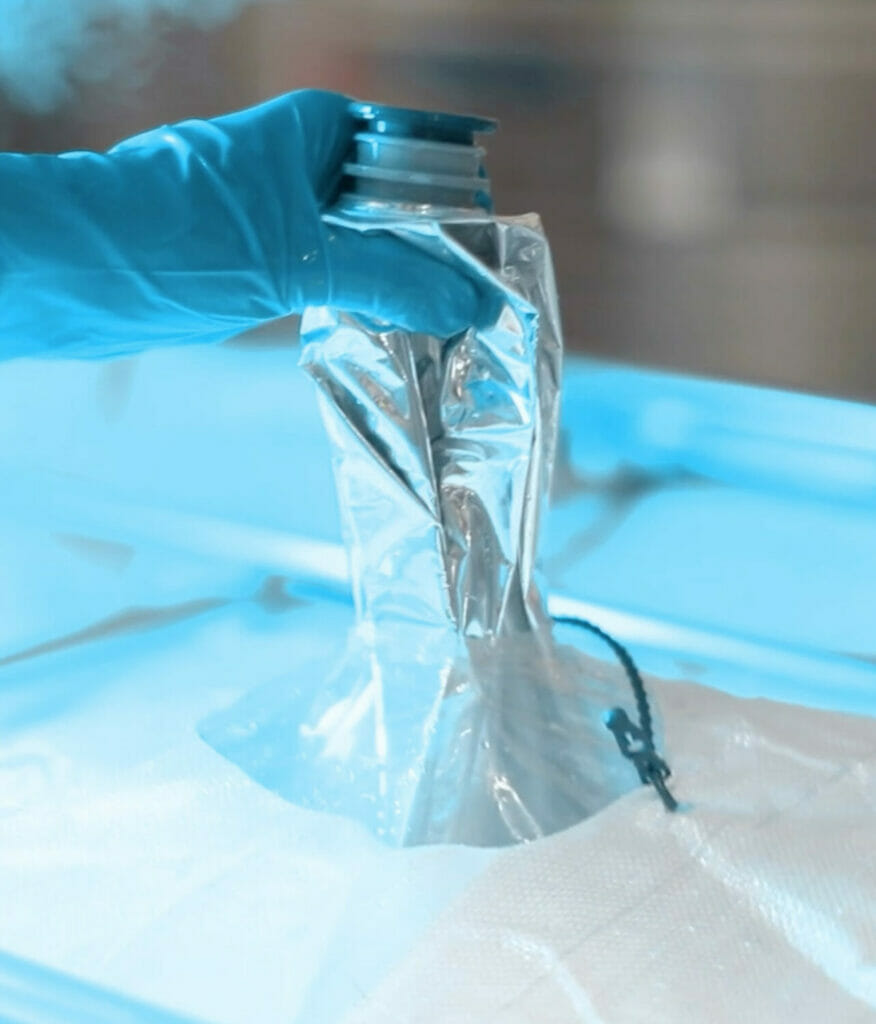
First of all, IBA developed an innovative, aseptic flexbag with a woven outer bag and an inliner with an outer opaque metallised PET film and a thermolaminated inner layer made of PE and PA. Werit contributes its specific expertise to the optimally fitting tubular steel frame.

Display

This close collaboration has resulted in the NUTRiline aseptic, a Sterile reusable packaging, that convinces. It can be used for both low and high viscosity liquids.

Detailed information about the Development stages and the special features of the new reusable IBC for foodstuffs says Sascha Siebel, an expert in bulk food packaging and minority shareholder of IBA since 2020.

Sascha Siebel, expert for bulk food packaging, Intermediate Bulk Alliance GmbH (IBA)
Sascha Siebel, expert for bulk food packaging, Intermediate Bulk Alliance GmbH (IBA) (Image: IBA)

Mr Siebel, what was the biggest challenge in developing the new container?

Chunky goods such as chocolate chips or cereals behave differently in liquids and require an acute angle of repose. If they hit a smooth surface, they wedge into each other when they hit the substrate. The biggest challenge was therefore to remove such products from the packaging without them separating so that they could then be evenly incorporated into the end product. At the same time, the residual quantity had to be minimised and the ability to fill and remove it using the same processes had to be guaranteed. Combining all these factors and not deviating from the specifications offered by a stainless steel IBC was the greatest difficulty. For these processes, we utilised the customer's existing compressed air connection. An air bag is successively inflated, expands and pushes the contents towards the outlet from the open IBC valve. To ensure sterility, the compressed air is not directed straight at the product, but a separate chamber is deployed, which is separated from the contents.

How does the flexible inner packaging react during transport?

The thermolaminated inner layer must be supported. This is provided by the fabric of the woven outer bag in combination with the IBC frame. In this way, the forces during transport are optimally absorbed and the inner film is subjected to as little stress as possible. It has the task of forming a safe, hygienic barrier layer. This combination creates a high degree of flexibility and minimises flex cracks.
The flexible inliner facilitates filling from above.
The flexible inliner facilitates filling from above. (Image: Werit)

Why are there two filling methods?

For low-viscosity liquids such as fruit juice concentrates, a top filling with an optimised Superflex film has been developed, which is fitted with an Elpo connection. The Air Assist is used for high-viscosity liquids. The viscous mass is sucked in by the pump and pressed towards the valve and emptied by the air assist.

How are chocolate chips emptied efficiently?

The chocolate chips are filled with a carrier material and placed in dairies, for example in yoghurt, using air-assisted emptying. There must be no haze due to possible abrasion. We therefore started the development of new packaging with a product with the highest requirements. Similar to the stainless steel IBC, a residual emptying rate of 99 per cent had to be achieved and process capability for the customer's standard filling systems had to be guaranteed. Even the size was limited. For example, the width of the container was only allowed to be one metre because of the corresponding transport options. The new outer packaging, the NUTRiline aseptic, consists of a flexbag on an IBC frame including a plastic pallet. This fulfils all hygiene guidelines and the frame is stable and stackable. All in all, ideal conditions for logistics.

What advantages do you see in NUTRiline aseptic?

From my point of view, a lot comes together: One of the advantages is the sealed system. With a stainless steel IBC, the compressed air goes directly to the product, so it has to be of a certain quality to avoid contamination. Here, the filling takes place in an empty inliner so that no additional medium reaches the product. When emptying, the inliner collapses without the volume having to be refilled. This means that multiple withdrawals are also possible and sterility is maintained, which is another advantage over stainless steel IBCs. The airless, folded film liner and the valve of the NUTRiline aseptic are sterilised in advance using energetic radiation and are then sterile. Stainless steel IBCs, on the other hand, have to be sterilised very carefully and at high temperatures.

And what about transport?

Compared to the stainless steel IBC, the NUTRiline aseptic has better space utilisation, can be stacked and can also be stored on standard industrial shelving. The empty weight of a stainless steel IBC is around 140 kilograms, while the new IBC weighs just over 40 kilograms. An extra 100 kilograms of payload is a significant factor in logistics. The special design of the Werit frame with vertical struts supports the Flexbag exactly where it is needed and provides fewer surfaces for dirt to accumulate. There are no sharp edges due to any welded or plug-in connections. The design of the frame with free corner access enables the Flexbag to be installed and removed without tools.

More news from the magazine

One hundred years blue tin

Since 1925, the Nivea cream can has borne its deep blue colour, white lettering and round shape - a design that has remained stable over generations, markets and crises and is now celebrating its 100th birthday.
Read more "