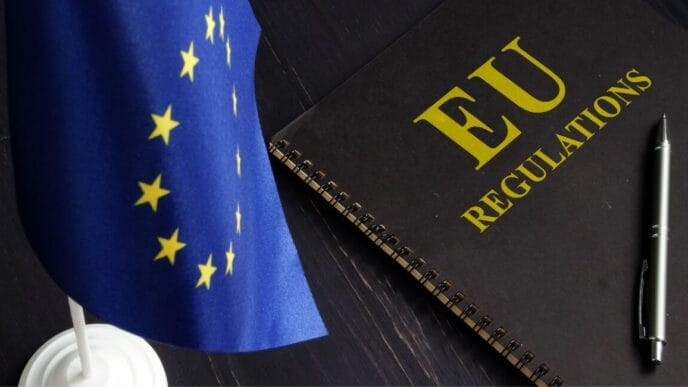
Well over 100 companies from the beverages, food, packaging, and recycling industries have recently written a joint letter to EU Commission President Ursula von der Leyen, EU Parliament President Roberta Metsola, and EU Council President António Costa. In it, the signatories are demanding a postponement of key provisions of the European Packaging and Packaging Waste Regulation (PPWR) and a targeted revision of individual regulations.
Companies particularly criticise the perceived lack of legal certainty in the implementation of the PPWR. Although the regulation is to apply generally from 12 August 2026, important definitions, methods and guidelines remain unclear. This creates significant risks for investment, compliance and competitiveness within the European internal market.
The signatories include, among others, Coca-Cola, Heineken, Mondelez, McDonald’s, Kraft Heinz, Red Bull, Eckes-Granini, Carlsberg, Pfanner, Henglein, Verallia, Vetropack, Wiegand-Glas, Ardagh Glass, Ball Corporation, as well as numerous other beverage manufacturers, food companies, and retailers from Europe.

Criticism of PFAS rules and recyclate quotas
The focus of the criticism is Article 5(5) of the PPWR concerning PFAS in food packaging. Companies complain that there is currently no harmonised and legally binding EU-wide testing methodology to prove compliance. This threatens to lead to differing interpretations and enforcement practices in the Member States.
The requirements for recycled content and recyclability are also described as problematic. In the view of the companies, formulations such as „any plastic part“ or „average per manufacturing plant“ remain unclear and could lead to additional administrative costs and legal uncertainty.
For specific packaging applications such as aseptic packaging or packaging for food supplements, the signatories currently see no technically and economically viable alternatives. They warn that individual packaging solutions could effectively disappear from the market due to current requirements.
Doubts surrounding reusable and reuse targets
Furthermore, companies are criticising the PPWR's reuse and refill targets. The exemptions planned for countries with high-performing recycling systems are not applicable in practice. Moreover, several signatories referred to life cycle analyses, according to which single-use recycling systems could achieve better environmental impacts in certain cases than reuse systems.
The obligations for the away-from-home sector are also meeting with resistance. Companies argue that so-called bring-your-own-container systems present considerable challenges in terms of food safety and logistics.
In their letter, companies therefore call for the application date of individual regulations to be adjusted and for key provisions of the PPWR to be specifically reviewed. At the same time, they emphasize their fundamental support for the objectives of the regulation and their willingness to contribute to practicable solutions.