A wide variety of goods are shipped all over the world by air freight. To ensure that they arrive on time and undamaged, they must be packed correctly. PortGround GmbH, a subsidiary of Mitteldeutsche Flughafen AG, provides support with this and other comprehensive services at Dresden and Leipzig Airports.
Over the past 50 years, the shipping of goods by air has increased to such an extent that the Air transport has the highest growth rates of all modes of transport has been recorded. Civil air freight has developed particularly strongly. The high freight volume is primarily due to the global expansion of the division of labour in the manufacturing industry and the expansion of trade. Just-in-time deliveries are no longer the exception, but the rule.
Accordingly not only cargo aircraft used for the transport of goods, but also the Lower decks of passenger aircraft, which now transport almost half of the world's air freight. In addition to the number of aircraft, their size and capacity have also increased significantly. In particular, transport aircraft, which were originally designed to carry military air freight, i.e. large and heavy goods, can now easily be used for the civilian transport of motor vehicles, industrial parts and even heavy machinery.

Special features of the sensitive air freight business
The employees of PortGround GmbH as the Authorised Economic Operator (regulated agent according to AEO) in Leipzig and Dresden handle the handling of incoming and outgoing freight. The operator is certified for this in accordance with DE/RA/00604-01 to 03. All services, especially the Selection of packaging, The air freight services are carried out in compliance with the Technical Instructions of the International Civil Aviation Organisation (ICAO TI) and the regulations of the International Air Transport Association (IATA), whereby security precautions in air freight shipping have become particularly stringent since the terrorist attack of 11 September 2001.
The most frequently shipped goods, most of which also require packaging, are important spare parts deliveries, perishable goods, sensitive high-value goods, hazardous goods, art objects, textiles and semiconductor products. PortGround's employees have to be able to the nature and properties of the delivered goods, which the sender must communicate, the route, and the distances that normally occur in air traffic. mechanical and climatic conditions to decide how the goods need to be packed so that they reach the recipient safely and intact.
Transport loads influence the design of the packages
Air freight packaging should be designed in such a way that it Impacts of 3 g (equivalent to three times the weight of the cargo item) in the vertical direction and 1.5 g in the horizontal direction, but can also withstand accelerations and vibrations of 5 to 500 Hertz. In addition, there are often static loads (pressure), for example when stacking in interim storage or in the cargo hold. For example, a loading height of 1,600 millimetres is to be expected in the lower cargo hold, and for some aircraft types even more than 2,300 millimetres.
As the cargo hold of many aircraft types is air-conditioned and pressure-equalised, this reduces air conditioning loads. Nevertheless Temperature or pressure drop can be expected. Climatic fluctuations may also occur when the cargo hold is opened, or the cargo may be exposed to heavy precipitation during handling. These environmental conditions must be taken into account when packing hygroscopic or corrosion-prone products.
Fields of activity of PortGround's air freight experts
The company has extensive expertise and advises air freight customers on the Development and application of suitable packaging and loading units, perishable products, pharmaceuticals and hazardous goods are among the goods that are prepared with particular care. The processing of standard products is guaranteed within 24 hours and that of express products, which include live transport and perishable goods, within six hours.
PortGround also handles warehousing, customs clearance and freight charter handling as required, including road feeder transport. Appropriate handling equipment is available for loading and unloading palletised freight. In order to guarantee the security of air transport, packages measuring up to 1,200 x 800 x 1,750 millimetres are checked using X-ray equipment, while a sniffer (electronic trace detection) is used for other consignments. Explosives, on the other hand, are searched for using so-called wipe strips, which are analysed on a PC.
In addition to offices, there is a cold storage room, a hazardous goods warehouse and a valuable goods room for the preparation and temporary storage of goods.
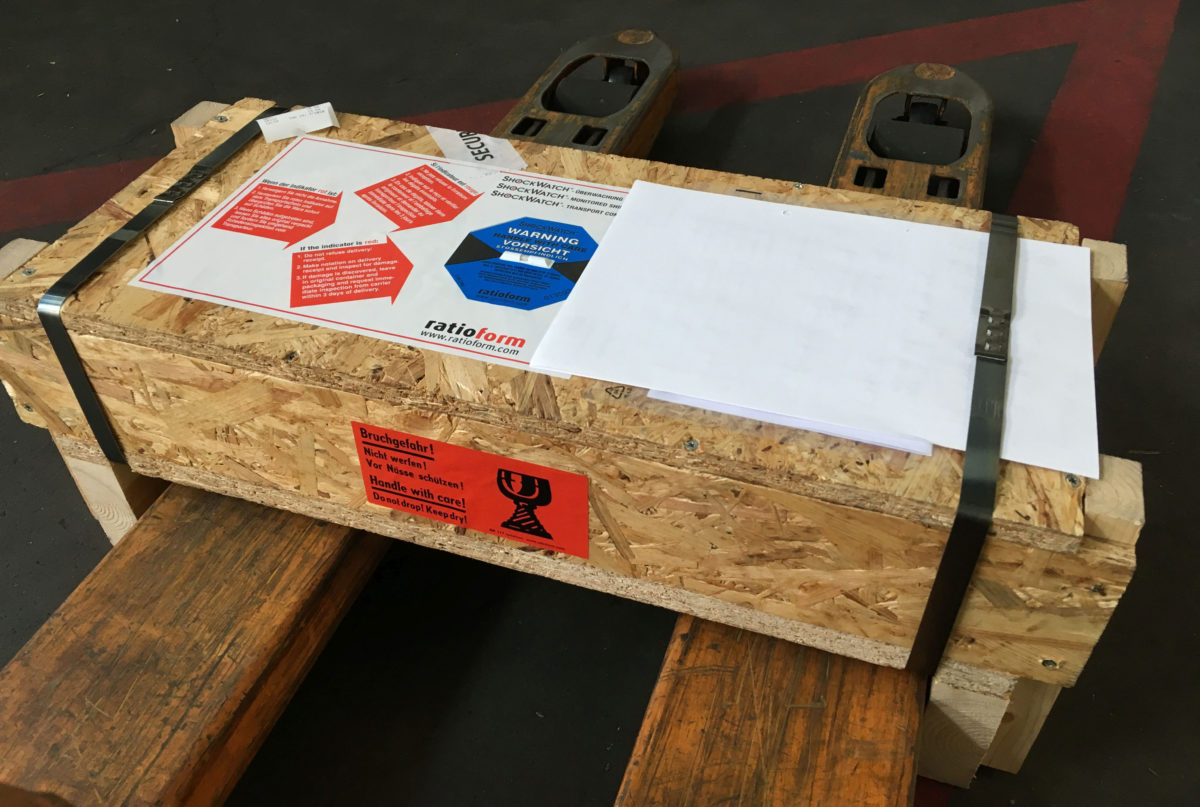
The airfreight shipping systems used Packaging must be tamper-proof, legally compliant and as environmentally friendly as possible. as possible. Suppliers of air freight packaging have specialised accordingly and also provide packaging that is structurally adapted to the cargo hold profile. Delivered individual packages are stowed in standardised special containers or loaded onto special air freight pallets.
The Load securing is carried out using either pallet nets and/or straps or tension belts. The pallets themselves are secured in the aircraft using the on-board transport and locking system. Particularly large and heavy packages are anchored to the aircraft floor with lashing straps. Special packaging and load securing measures are required for packaged goods weighing more than ten tonnes as well as pipe and bar material.
It is also important to attach the required Handling licence plate and aids on the package that help to increase transport safety. Finally, the freight documents, which are standardised for air freight shipments, must be prepared, whereby abbreviations must be internationally understandable.
Dangerous goods as air freight
PortGround GmbH's range of services also includes Packaging solutions for hazardous goods in accordance with the IATA Dangerous Goods Regulations (DGR). The individual airlines can make these regulations more restrictive, but not more generous. PortGround employees receive regular training on the content of the DGR, which contain all important information on labelling and marking, documentation, handling, maximum quantity, weight limits, packaging and prohibitions and are revised annually.
Their area of responsibility also includes the assessment, repackaging or repair of hazardous goods shipments and their proper disposal. This requires both storage authorisations for all hazardous materials and a connection to functioning safety processes in the airport infrastructure.
Once the dangerous cargo has been stowed in the aircraft, the pilot is given the emergency documentation, which must comply with the ICAO-TI regulations for the carriage of dangerous goods by air.