In co-operation with various manufacturers of linear motors and system integrators, system provider Vahle relies on wear-free inductive technology, as modern production and packaging processes are becoming increasingly complex and require flexible and low-maintenance systems.
29 October 2021
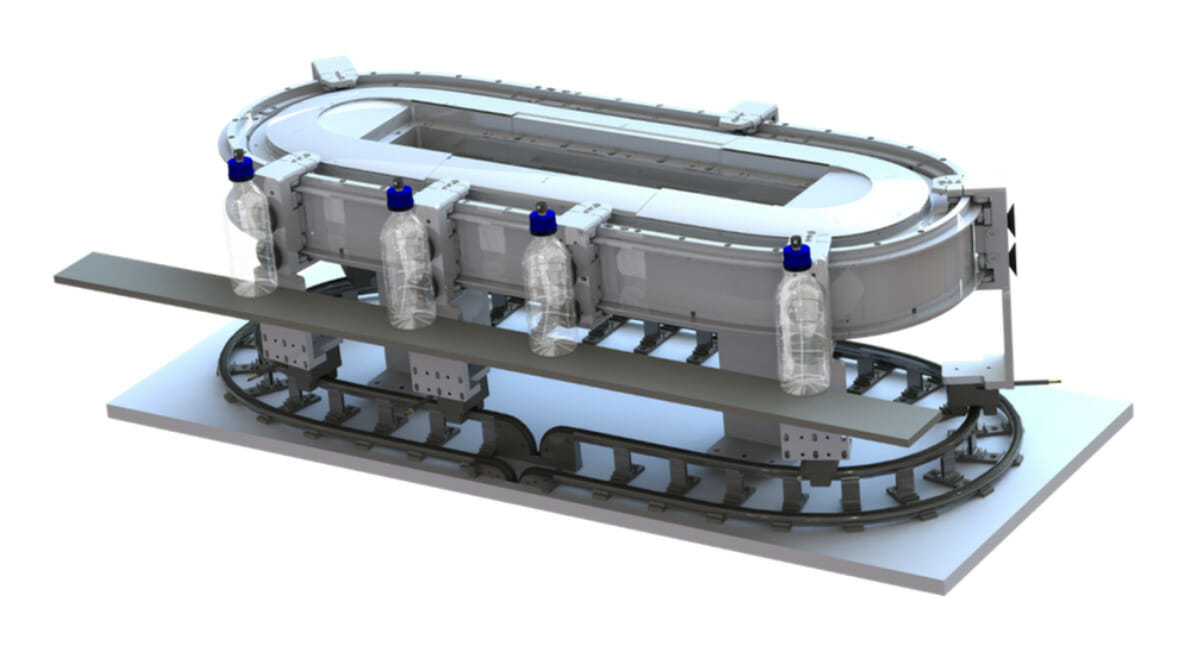
Vacuum pumps, grippers or other actuators on the mobile carriers ensure safe and simple gripping processes, which increases the throughput rate of the machines. (Image: Vahle)
In co-operation with various manufacturers of linear motors and system integrators, system provider Vahle relies on wear-free inductive technology, as modern production and packaging processes are becoming increasingly complex and require flexible and low-maintenance systems.
For years, there has been a trend in the packaging industry towards increasingly customised solutions and special formats. The number of variants is increasing at almost every company, while at the same time the batch size per individual packaging unit is decreasing. Modern machines must therefore a high degree of flexibility and enable quick and easy, ideally on-the-fly format or mould changes. And this must be done as smoothly as possible, for which a reliable energy supply is essential.
The Paul Vahle GmbH & Co. KG is on Energy and data transmission for mobile industrial applications specialised. The Kamen-based company is now increasingly focussing on contactless systems.
Display
(Image: Vahle)
"Our inductive solutions are designed for high-speed systems and avoid the generation of carbon dust, which is not permitted in the food industry. Conventional busbar and slip ring technology is not up to these requirements." Marc DetweilerHead of Product Management at Vahle
Less is more
The decisive advantage of the Contactless power supply (CPS) technology is that it ensures a continuous supply of energy on the mobile side. "This allows the individual carrier vehicles to be equipped with grippers, vacuum pumps or control elements." The actuators and sensors enable the mobile participants to securely hold different products, materials, shapes and sizes in place, making form-fit fixtures and frequent mould changes for format changes completely unnecessary. "With the significantly simplified design of the mobile side, we reduce the engineering effort and realise much more flexible requirements with our customers, making the machines more independent and ultimately more cost-effective."
The number of carriers, for example, can also be reduced while maintaining the same throughput, as the gripping process, which previously required two movers in some cases, now only requires one. a single vehicle with actuators necessary. In doing so, the Slides driven by linear motors can be moved completely independently of each other. "The fixation with grippers or the suction of the vacuum pumps ensure a firm hold and counteract the centrifugal force in curves so that the elements stay exactly where they belong. This enables faster speeds and a higher throughput rate," says Detweiler.
Lightweight for maximum performance
With the high-performance Pick-up solutions sets Vahle The company favours a compact, lightweight design in order to save weight. "Conventional carriers, for example, can carry a few kilograms of additional payload. If we add electronic components to a large part of this, this massively limits the effectiveness of the machine, which ultimately offers the end customer no added value." Despite its small dimensions of just 40 millimetres long, 48 millimetres high and 60 millimetres wide, the vPOWER U007 pick-up, for example, delivers a peak output of 70 watts at an outgoing DC voltage of 24 volts. "The U007 current collector weighs just 175 grams and is therefore the most compact solution available on the market to date. The short length in particular is essential for the so-called pitch size of the mobile participants."
For systems with higher energy requirements, Vahle has developed the slightly larger U015-Pick-up with a weight of 650 grams and a maximum output of up to 150 watts. Thanks to a freely configurable cable outlet, both current collectors can be integrated into almost any system in which the necessary precise mechanical guidance is available. "This increase the efficiency and flexibility of the machines and thus achieve higher production volumes." In addition, the pick-ups can be connected in series to create an increased power output of 48 volts.
First transport robot for packaging machines
For more than ten years, Vahle and the Gerhard Schubert GmbH on joint projects. With its modular top-loading machines (TLM), which consist of standardised system components, Schubert is regarded as one of the technology pioneers in the industry. As part of the collaboration with Vahle, among other things the world's first transport robot for packaging machines developed, the transmodule from Schubert represents a special use case.
The Transmodul travels at a speed of up to 4.5 metres per second on a rail system through the various sub-machines. The cartons and products are held in place during transport with the help of a vacuum blower that generates a vacuum of 0.04 bar.
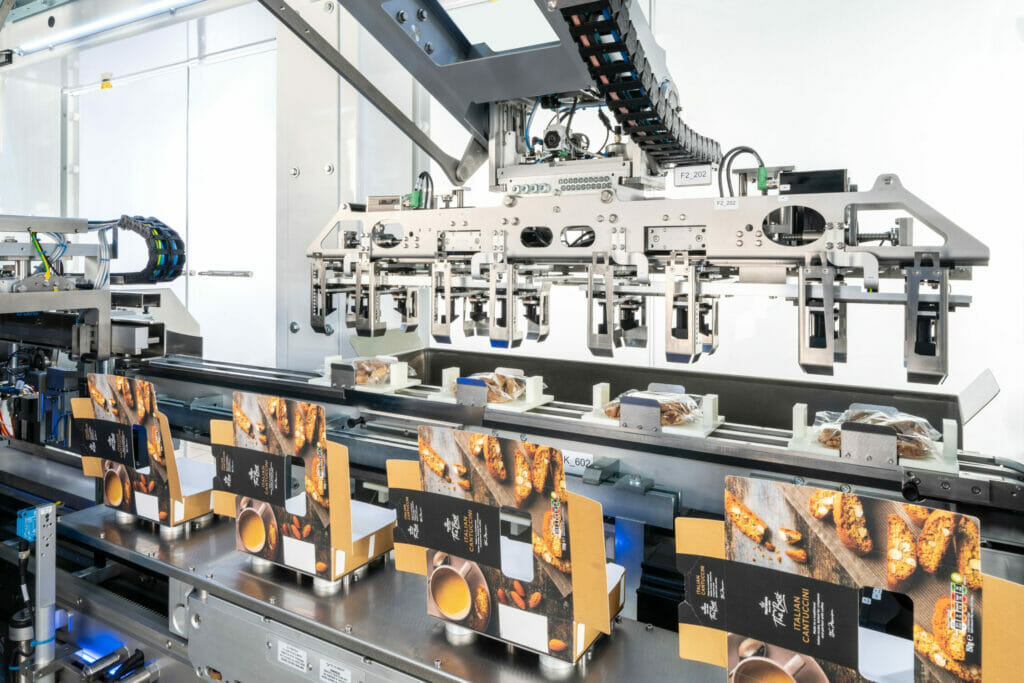
With the help of the Transmodul, which Vahle developed together with Gerhard Schubert GmbH, different product and packaging sizes can be processed in one and the same machine. (Image: Gerhard Schubert)
The transport robots are supplied with energy inductively and move through the system in a circuit. At the end of the top track, they turn 180 degrees along their longitudinal axis together with the rail element and return to their starting point on the bottom track. "To make this possible a so-called rotary transformer was developedwhich is the centrepiece of the customer solution," reports Detweiler.
The areas of application for inductive systems are diverse. In the future, Vahle expects that the range of applications can be expanded even further with new add-ons. The coronavirus pandemic has led companies to increasingly address the issue. "As in other areas of automation, we are currently experiencing a particular demand."