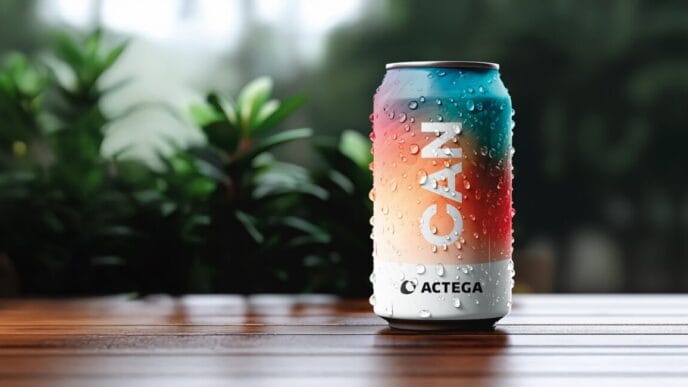
Forum Getränkedose, the association of beverage can manufacturers in Germany, points out that the demands of Deutsche Umwelthilfe (DUH) for an increase in the reusable quota to 70 per cent would drastically increase the volume of traffic in Germany according to a recent study.
According to a study by the Society for Packaging Market Research (GVM)[1] autumn 2019, an increase in the reusable can quota to 70 percent would, according to the Forum Getränkedose, lead to an additional traffic volume of 882,000 lorry tours per year and an additional burden of 218 million kilometres, with corresponding consequences for the traffic-related CO2 emissions. The output would be by 400,000 tonnes of CO2 annually.
The main reason for this is the sharp increase in individual returnable bottles in recent years, which often have to be transported back over long distances. The Forum Getränkedose also disagrees with the German environmental organisation Deutsche Umwelthilfe's claim that, unlike cans, reusable packaging is environmentally friendly per se.

„Not every reusable bottle is a good bottle in an ecological sense. Individual bottles in particular do not perform as well ecologically as beverage cans. Unfortunately, the DUH is still arguing with very old data and has so far failed to provide any support for a New, neutral life cycle assessment of all beverage packaging.“
Stephan Rösgen, Managing Director of the Beverage Can Forum
The Life cycle assessment of the beverage can has steadily improved in recent years: beverage cans in Germany are 99 per cent recycled, The wall thickness is now thinner than that of a human hair. And as packaging, the can is a real „economy can“: of 100 per cent total weight, only 3 per cent is packaging and 97 per cent is product.
Does the can have an image problem?
The fact that many consumers in Germany lack knowledge of Environmental friendliness of the various beverage containers The fact that the aluminium industry leaves a lot to be desired is shown by a recent Civey opinion poll of 5,000 respondents commissioned by the Gesamtverband der Aluminiumindustrie e. V. (GDA).
Although half of all Germans buy drinks in cans again, for example, only 42.4 per cent of consumers believe that drinks cans are fully recyclable. 7.3 percent of respondents were even convinced that beverage cans made of aluminium or tinplate cannot be recycled at all.
In fact, according to the GDA, the can, Fully recyclable and can be used again and again without any loss of quality - for example for new drinks cans or as a component in an electric car.
„The survey clearly shows that the image of the beverage can is based on ignorance and prejudice. With a recycling rate of 99 per cent, Germany is the world leader,“ says Jörg Schäfer, Head of Sustainability at GDA.
[1] GVM Study 2019 „Effects on the German market for beverage packaging with a share of 70 per cent of beverages filled in reusable packaging“. / GVM study 2019 „Market analysis of individual reusable bottles“
Sources: Forum Getränkedose / Gesamtverband der Aluminiumindustrie e.V.