In a representative survey conducted in March 2023, the German Packaging Institute (dvi) asked people in Germany about their preferences when dealing with used packaging, the topic of reusable packaging and their assessment of the environmental footprint of packaging compared to the packaged product.
For 76 per cent of people in Germany Recycling the top preference when dealing with used packaging. 49.9 per cent also voted in favour of reusable bottles and refilling. 60.6 per cent support the policy plans for More reusable packaging and are prepared to take action to achieve this. And 50.5 per cent believe that the packaging has a larger environmental footprint than the packaged product. Only 28.8 per cent correctly assess the relationship. This is the result of a recent survey by the dvi.
„The packaging industry is caught between the conflicting priorities of environmental protection and product protection. Both requirements are fundamental and cannot be played off against each other. In companies in the packaging industry, the switch to renewable energies in production and transport, the increasing use of sustainable raw materials and the development of new designs for constantly decreasing material requirements and 100 per cent recyclability have been in full swing for several years now. With this in mind, we wanted to know what people in Germany think about this topic. After all, climate and environmental protection is teamwork, especially when it comes to packaging. We can only make progress by working together, not against each other.“
Kim Cheng, Managing Director of the dvi
Display
When asked how packaging should be handled after use, 76.0 per cent of people voted in favour of recycling. 49.9 per cent are in favour of refilling packaging after use wherever possible and reusing it several times. 24.1 per cent welcome composting as a way of disposing of packaging. 15.1 per cent also favour incineration for the purpose of energy generation. Only 2.3 per cent are in favour of landfilling or burial on land.

For Kim Cheng, the result shows that „the majority of citizens are in favour of the circular economy, recycling and the preservation of valuable secondary raw materials when dealing with used packaging. The high approval rate for reusable and refillable packaging is not a contradiction in terms. Because Reusable packaging should also be recycled at the end of its life cycle and turned into new packaging. Companies in the industry are working with great success and many innovations on ever more material-efficient and recyclable packaging. In the packaging materials paper, cardboard, carton, glass, metal and plastic alone, the industry has been able to Since 1991, around 23 million tonnes of material have been saved by using lighter packaging. In addition to avoiding and reducing the amount of packaging used, the recyclability of packaging is also at the top of the list for the industry.
The problem is that the EU Commission's proposal for the new EU Packaging Regulation at the end of last year stipulates that all packaging must be recyclable or reusable by 2030, but does not define the specific design requirements for recyclability.“ So-called „delegated acts“ are planned for this purpose. However, no timeframe has been set for when these will be adopted, nor is it clear whether they will be based on the European packaging industry's Design for Recycling guidelines, which have been developed over many years. Kim Cheng: „Companies have to invest a lot of money in new, sustainable packaging solutions. The minimum requirement would be planning security. But that is not given.“
Acceptance of reusable packaging - but there are conditions
Both the European Union and German politicians want to significantly increase the proportion of reusable packaging. In response to the question of whether people are generally prepared to do so, return more packaging for reuse after use than before, a majority of 60.6 per cent answered yes. 19.3 per cent do not want any more reusable packaging. 20.0 per cent are currently unwilling or unable to answer this question.
In response to the question of which aspects are particularly important to people when it comes to reusable packaging Returns at as many locations as possible, regardless of the place of purchase in first place with 71.7 per cent. For 64.2 per cent, it is important that products should not become more expensive due to reusable packaging. 49.7 per cent emphasise the need for quick and easy returns. 35.6 per cent demand that used packaging should not have to be cleaned or rinsed before being returned.
According to Kim Cheng, the fundamental willingness of people to take action themselves and return more packaging after use deserves respect. „The industry is responding to this and has been introducing more reusable and refillable packaging for some time now. But it is also clear, that reusable packaging can only work in practice if it fits into people's everyday lives and realities. Long journeys or major time losses not only take away the practicality of reusable packaging, but also impair its ecological benefits. Reusable packaging is only the better ecological choice if the costs for transport, cleaning, disinfection and refilling are actually lower than when using disposable packaging that is recycled after use.“
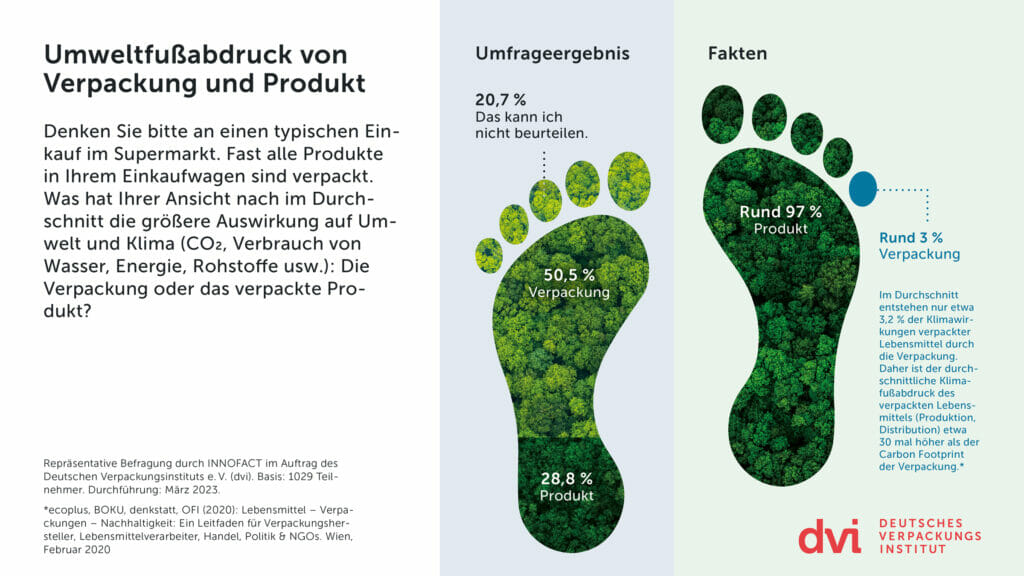
To the question, whether the packaging or the packaged product has the greater impact on the environment and climate. through CO2-emissions and consumption of water, energy and raw materials, 50.5 per cent of citizens cite the packaging. 28.8 per cent named the packaged product. 20.7 per cent are unable to answer the question in their own opinion.
According to Kim Cheng, the results of the survey show that many people massively underestimate the environmental impact of the product and massively overestimate the impact of the packaging. „What is almost more striking in our eyes: As a result, many people also underestimate the ecological benefits of packaging! Because the real ecological damage occurs above all when the food is damaged or spoilt. Then all the resources and effort we have put into it are wasted. With comparatively little effort, packaging ensures that this doesn't happen.“
Source: dvi
dvi - More news


Top Ten 2025: German Packaging Award 2025 - These are the winners

dvi bids farewell to Winfried Batzke on his retirement

Dresden Packaging Conference 2025: Ways forward

EU relaxes PPWR requirements for load unit securing