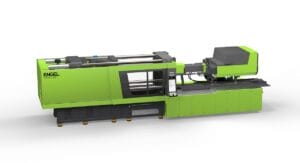
For the first time, thin-walled containers can be produced directly from PET in just one injection moulding process step. At K 2022, Engel will be demonstrating the processing of rPET on its e-speed injection moulding machine with a newly developed injection unit.
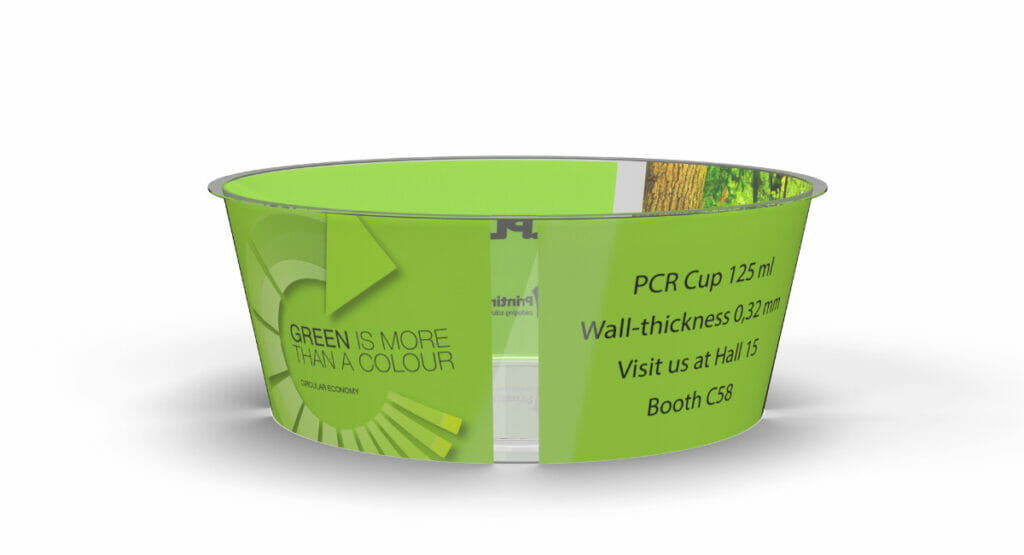
Presented at the K 2022 Angels together with its partners Alpla Group, Brink and IPB Printing, will show how thin-walled PET containers can be produced directly by injection moulding in just one process step. With a wall thickness of 0.32 mm The transparent 125 ml round containers are representative of a whole range of packagingespecially in the food sector. Thanks to integrated in-mould labelling (IML), the containers leave the production cell ready for filling.
The speciality of this application lies in the material. The Thin-walled containers are produced directly from rPET in just one processing step. Until now, PET could only be processed into thick-walled parts, such as bottle preforms, using injection moulding. The final packaging shape was achieved in a second process step - for example by blow moulding.

Aiming for bottle-to-cup and cup-to-bottle
According to the European Plastics Pact, all plastic packaging should contain 30 per cent recycled content and be 100 per cent recyclable by 2025. Typical materials for packaging food in thin-walled containers are polyolefins or polystyrene. According to experts, these materials will not be able to achieve the stated goals. In addition, the European Food Safety Authority (EFSA) has not yet issued a positive assessment of the recycling streams.
rPET offers a way out here to avoid penalties and special taxes. Despite the current high price of PET, this material is becoming an economical alternative. The EFSA has approved numerous recycling processes for PET, making the material available in Europe.
PET offers the advantage that there is already a closed recycling loop. PET is currently the only packaging plastic that can be reprocessed into food packaging as a recycled material on an industrial scale. The company partners are paving the way with this innovation, that packaging products other than bottles no longer have to be downcycled, but can actually be recycled or even upcycled. This would significantly expand the range of applications for PET and rPET. In addition to the bottle-to-bottle cycle, the establishment of bottle-to-cup or even cup-to-bottle recycling is also conceivable.
Inject at 1400 mm per second
The modified rPET processed at the K comes from beverage bottles produced in the packaging and recycling specialist's plants. Alpla Group headquartered in Hard, Austria. Other partner companies involved in the trade fair exhibit are Brink (Harskamp, Netherlands) for the mould and IML automation and IPB Printing (Reusel, Netherlands) for the labels.
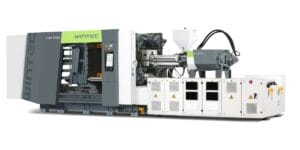
At the heart of the production cell is an Engel e-speed 280/50 injection moulding machine. The hybrid machine with electric clamping and hydraulic injection unit was developed specifically for the high performance requirements of thin-wall injection moulding. Engel has once again increased the performance of this machine series for K 2022. The new high-performance injection unit achieves injection speeds of up to 1400 mm per second at maximum injection pressures of up to 2600 bar when processing small shot weights and extreme wall thickness/flow path ratios. This makes it one of the world's most dynamic injection units on the market.
For the processing of rPET, Engel combines the new injection unit with a plasticising unit specifically designed for the processing of recyclates from our in-house development and production. During plasticising and injection, the viscosity of the PET is adjusted for thin-wall injection moulding. The new Engel e-speed enables the processing of any recyclate content up to one hundred per cent rPET.
Different label trends taken into account
Presented at the K a tool that can process different labels at the same time. The partners are thus addressing the different global trends in in-mould labelling, which in the EU are coordinated with the EPBP and Recyclass recommendations, among others, as well as with the specifications of the Association of Plastic Recyclers (APR) for the USA.
For the American market and its requirements, washable colours are processed on inmould labels, as the label and application are to be recycled for this market. A different technology will be shown for Europe: an in-mould label that floats in the recycling processThis means that the colours with the label can be easily separated from the PET.
Source: Engel
Engel at the K 2022: Hall 15, Stand C58
Engel - More news


Engel supports upcycling research at the TH Rosenheim

Solutions for efficiency and sustainability

Thin-Wall Packaging Day: Engel presents solutions for injection moulding companies

Engel part finder: The spare parts scout for your trouser pocket