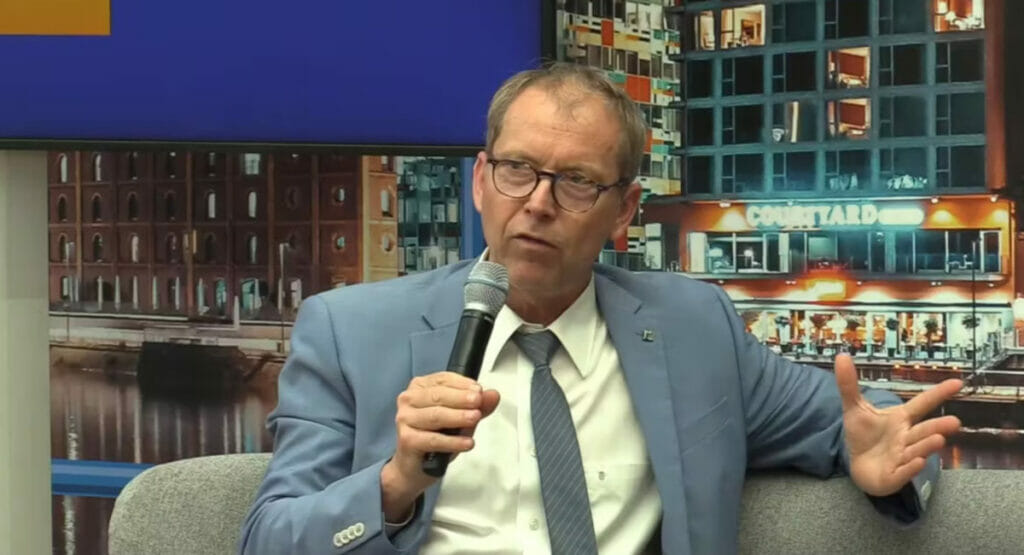
As part of its European Green Deal, the EU is pursuing ambitious plans to optimise the sustainability of packaging. This is also reflected in the new draft of the European Packaging Regulation (PPWR), which must be implemented by the member states once it has been adopted. On Tightly Packed TV Live at interpack, we spoke to Dr Wolfgang Trunk from the EU Commission about the current status.
If the European Commission has its way, the Reduce packaging waste, develop a circular economy for packaging in a cost-effective way and promote the use of recycled materials in packaging become. This is provided for in the new draft of the European Packaging Ordinance (PPWR), which still has to pass the EU Parliament and Council.
„The issue of packaging affects everyone, European consumers as well as the entire economy. Everyone is confronted with it, the issue is right at the top of the agenda,“ says Dr Wolfgang Trunk, policy officer at the EU Commission in Brussels and team leader in the Environment Directorate-General's unit. The EU official was involved in the drafting of the legislation from the very beginning. „The starting point was the question: what problem do we want to solve and why do we need this new legislation?“ In the current case, it was quite obvious: „The current directive has not achieved its goal of reducing packaging waste in Europe and making packaging more sustainable. It was therefore time to think about further steps to improve the situation.“ It was not easy, but it was an important aspect to make such a proposal, especially in times of the Russian war of aggression and in times of high inflation rates, when many have to watch their budgets and spending. „However, we are convinced that a European packaging regulation will bring major economic benefits.“

The current EU Packaging Directive has given the member states a great deal of leeway in how they develop their national systems within this framework. This has led to different situations within Europe. „We have realised that there is a there is a large discrepancy between the Member States in terms of achieving their targets. In addition, the industry is confronted with national systems that cost a lot of money. It also means a huge administrative burden to deal with all the scattered legislation in the 27 Member States.“ It is therefore It has become important to harmonise the rules via a regulation. „I call it a change in philosophy in that we are overcoming the level of the Member States and going to the product level with the regulation. This changes the rules of the game, because we are approaching the economic operators directly with our requirements. This is an important part of the new proposal.“
„I would like to issue a big warning to all those who want to wait and see. It's better to establish all the necessary structures at an early stage - and to do so holistically. It's not just about using recyclates, it's not just about recyclability. The whole package is important.“
Sonja Bähr, packaging consultant at Tilisco in a Tightly Packed TV Live interview at interpack 2023
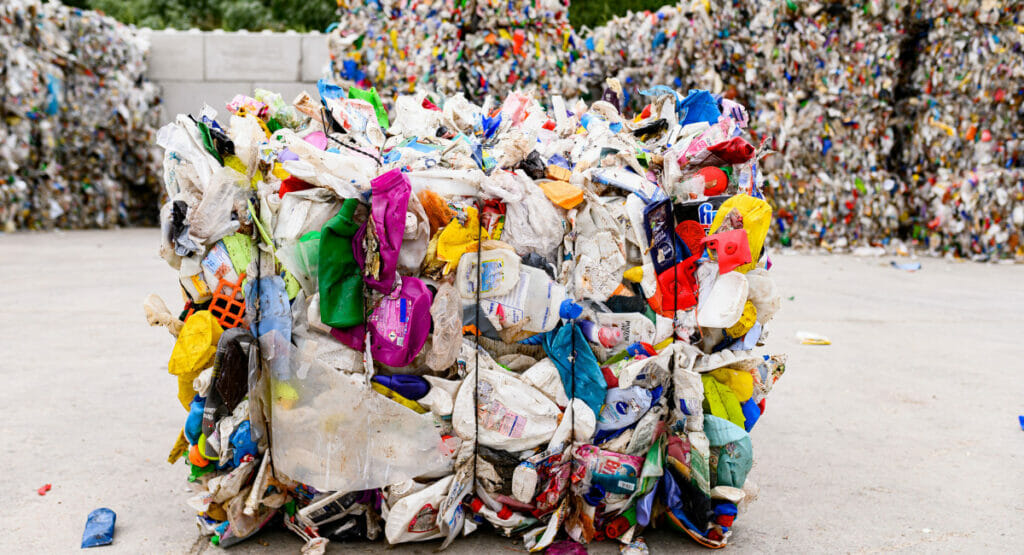
With its planned regulation, the EU Commission wants to the entire life cycle, from packaging design through to recycling. „Packaging design plays a special role when it comes to bringing valuable raw materials back into the cycle at the end of their use.“ The draft of the new PPWR contains a number of requirements and changes, for example in Reference to the recycled content in plastic packaging. „We know that plastic is something like our Achilles' heel, because we have too low a collection rate and too low a recycling rate for this valuable plastic packaging, which is often produced using a lot of fossil raw materials. What's more, the quality of the recycled plastic is often poor, which means we are effectively downcycling. That is why our New proposal Minimum requirements for the recycled content of plastic packaging. I am convinced that this will make a real difference and we can already see the impact the announcements will have on the entire recycling value chain. Getting plastic waste into high-quality recycling is one of the most important points of the proposed legislation.“
„The PPWR will apply immediately and directly and must be implemented. Pressure is being built up and the EU is determined, which we very much welcome. Keyword introduction of recyclates. There was initially a huge outcry that polyolefins could not be used in contact with food. Maybe not today, but we now have to pave the way to be able to fulfil the quotas by 2030.“
Sonja Bähr
Labelling is also harmonised
The new proposal also provides for a Harmonised labelling system for packaging before. Many companies had complained about the different national labelling regulations. „The harmonised system will probably be based on pictograms. So you don't even need a language,“ explains Trunk. „The respective In future, the pictogram will not only be displayed on the packaging, but also on the collection containers. This will finally put an end to consumer uncertainty, as they will be able to see at a glance where packaging should be disposed of properly.“ This will also have major benefits for the downstream value chain, because only with the right sorting in households will the recycling streams become more efficient, the quality of the recyclate better and the required quantities of recycled material achieved.
The planned Packaging Ordinance also regulates the Handling of biodegradable, compostable packaging. „There's a lot of greenwashing going on at the moment. With the new law, we are overcoming the grey areas, because in future it will be clearly defined what belongs in the biowaste stream and what belongs in material recycling.“ Pictograms will also provide consumers with guidance in this area.
„We all live together in the EU and we need rules. That's why the planned European packaging regulation is the right approach, but now we need to get down to the details. The VDMA had invited more than 50 EU politicians to present the challenges and solutions of the mechanical engineering industry in this context. Not one of them turned up.“
Christian Traumann, CEO of Multivac and board member of the VDMA Food Processing and Packaging Machinery Association on Tightly Packed TV Live at interpack 2023
„After all, our political decision-makers announced in 2022 that all packaging must be recyclable by 2030. We are aware that there is currently a lot of packaging that is very difficult to recycle. In future, we will therefore divide packaging into different categories. The lowest category will then be completely banned from the market. This will give us a kind of ranking for each packaging, according to which it will be categorised according to its recyclability. The least recyclable packaging will then no longer be allowed on the market.“ This is intended to Create incentives, for example, to improve composite materials in beverage cartons to such an extent that, until the required recyclability is achieved.
It is also important that, within the framework of extended producer responsibility (EPR), the producers have to pay a fee for collection and later for end-of-life treatment, which is closely linked to recyclability. „If someone brings a mono-material onto the market that is easy to recycle, the fee is lower than for packaging that is difficult to recycle.“ In this way, the encourage the entire industry to further increase the recyclability of its packaging.
„Has the PPWR announcement caused an uproar? Yes, but not yet strongly enough. Individual associations from the plastics sector have spoken out, but I'm missing the outcry from the other associations. Many people don't yet realise the scope of what's coming. This affects not only the companies that produce packaging, but also their customers. In some cases, we see cluelessness and even an ostrich policy.“
Sonja Bähr
Keep the helicopter view
„According to our rules for better regulation, we have involve all stakeholders, non-governmental organisations, European associations, national associations and large companies in the work from the outset. They were involved in the impact assessment and the drafting of the legislative proposal, because we need their data and a comprehensive view, not just the influence of individual interest groups. We have to keep a helicopter view, so to speak, and try to filter and process all this information.“
A total of 519 interest groups and consumer organisations responded to the call for feedback on the EU Commission's draft and made constructive suggestions for changes and improvements. „We improved the draft once again with their help and were overwhelmed by the flood of feedback. The Commission's proposal is now finalised and in the hands of the co-legislators. We as The Commission is now only a moderator, facilitating the negotiations between the European Council and the Parliament. accompanied.“
Support from the industry for the new approach has been strong, says Trunk. Industry and member states are aware of the importance of the new regulation.
„This is a big step forward. And it will change the national circumstances in the Member States. In the future, they will be the ones, with their market surveillance authorities, who will have to monitor our new rules and ensure that companies fulfil all sustainability requirements. We believe that the industry is aware of the economic benefits and savings that will come with the new regulation. We are still open to further fine-tuning. But the baseline should be to get the regulation through within this parliamentary term of the current European Parliament.“
Wolfgang Trunk
More news from the magazine


Packaging machine manufacturer in flow

Powerful automation for mills

Decentralised signal processing with the Schmersal Safety Fieldbox

One hundred years blue tin