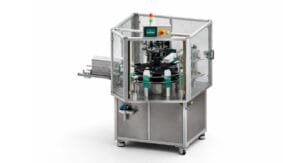
Labelling solutions for the wine and beverage industry
At Austro Vin Tulln, Bluhm Systeme will be presenting its labelling technology specifically for the requirements of the wine and beverage industry.
The trade magazine for the packaging industry
For the study "Strategies for the German food machinery industry 2035", Munich Strategy and the VDMA analysed how the industry will change by 2035 and how companies can adapt to this.
The study is the second part of the VDMA Future Business Study "German Food Machinery Industry 2035 - Industry Vision for Machinery and Plant Engineering" published in May 2020. The new study is based on the four visions of the future developed in the study and uses them to develop six strategic directions that should make food machinery manufacturers successful in 2035.
The VDMA Future Business Study is based on four equally valid visions of the future of food machinery manufacturing in 2035, which show significant changes compared to the world as we know it today:

In 2035, the economic balance of power will have changed drastically to the detriment of western industrialised countries. They will lose their traditional leading role to China - with far-reaching consequences for the business environment of mechanical engineering.
The economic blocs are separating themselves from each other and seeking salvation in bilateral economic agreements that largely exclude the harmonisation of environmental and social policy framework conditions.
In this vision of the future, the topic of sustainability is firmly anchored in society. Enlightened interest groups are driving politics and business forward - with far-reaching consequences for consumer behaviour and production structures.
Politics, business and interest groups are pulling in the same direction. As in the "Consumers exert pressure" vision of the future, standardised framework conditions prevail worldwide, but with pluralistic characteristics.
For each future scenario, it was determined how the requirements of food manufacturers will change and what this means for the food machinery industry. From this, possible target images were derived that describe the positioning options for companies in 2035.
In order to achieve the target images, the authors of the study have identified six overarching strategic directions with which machine manufacturers can adapt to the new framework conditions and the requirements of their customers. They are relevant for each vision of the future, albeit with different weightings.
The authors of the study recommend that companies analyse their own initial strategic situation and decide on a likely future scenario and the relevant directions in order to develop their success strategy for 2035. To take account of the different company sizes and industry segments, the study presents examples of two types of company that are best equipped to meet the requirements of 2035: the "agile niche professional" and the "glocalist".
"Anticipating what the food machinery industry of the future will look like is the first step. For entrepreneurs, however, the most important thing is to align their own actions with clear strategic initiatives and thus chart the path to 2035. "I am delighted that our study provides a concrete approach for this."
Richard Clemens, Managing Director VDMA Food Processing and Packaging Machinery
The complete results of the study can be viewed here become.
Source: VDMA Food Processing and Packaging Machinery

At Austro Vin Tulln, Bluhm Systeme will be presenting its labelling technology specifically for the requirements of the wine and beverage industry.

Pharmaceutical packaging in transition: digital technology, smart labels and recyclable materials characterise the next generation of pharmaceutical packaging solutions.

Belgian frozen vegetable producer Greenyard Frozen has achieved significant savings in product loss and energy consumption by using smart checkweighers from Mettler-Toledo.

Ulma Packaging will be showcasing sustainable and high-performance packaging solutions for fresh produce and convenience food at Fruit Logistica 2026.

Sick bringt mit der W12 LED NextGen die vierte Generation Lichtschranken für die Objektdetektion in industriellen Anwendungen auf den Markt – mit technologischen Innovationen im Hinblick auf Digitalisierung, Vernetzung und Detektionssicherheit.

Mit einem neuen Sensor bringt Igus eine smarte Lösung für Industrieroboter auf den Markt, die Energiekettensysteme aktiv überwacht und bereits bei der Inbetriebnahme durch Condition Monitoring unterstützt.