Beverage manufacturer Fläming Quellen has modernised its palletising system for mineral water drinks with the help of BMS Maschinenfabrik. The new gantry palletiser achieves an output of up to 171 layers per hour. The new system even offers a capacity reserve of 30 per cent.
Mineral water and soft drinks containing mineral water in the Tetra Pak are becoming increasingly popular. In order to respond appropriately to this trend, the Fläming Quellen GmbH from Wiesenburg in Brandenburg into an ultra-modern portal palletiser from the BMS machine factory from the Bavarian town of Pfatter. The flexible solution for soft packaging replaced an outdated system and now palletises the Tetra trays from three filling lines synchronously onto either Euro, Düsseldorf or industrial pallets.
On the machine side, the scope of delivery from BMS included the Palletising system „Unipal 106 L B-III“, the „Unitrans P“ pallet transport system including pallet magazines, pallet control and transfer carriages as well as the „Unitrans G“ container transport system. Operator training was also part of the order.

The portal itself has three parking spaces. These storage locations can be loaded with two pallet types at the same time. However, the same pallet type can also be processed on all three storage locations. The pallet formats that can be used are stored in the system control. The configured formats are Euro pallet 800 x 1,200 millimetres, Düsseldorf pallet 400 x 600 millimetres and the Industrial pallet 1,000 x 1,200 millimetres. All pallets can be loaded in accordance with the CCG1 and CCG2 standards up to a height of 105 centimetres and 190 centimetres respectively.
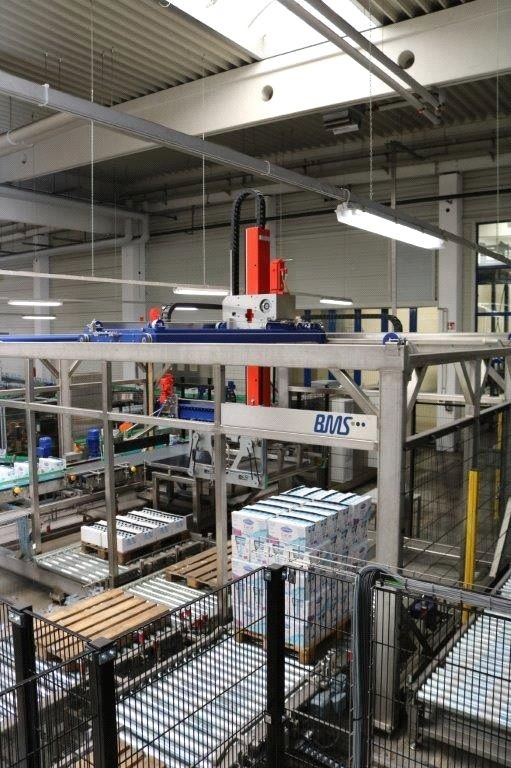
System from BMS Maschinenfabrik automatically determines position geometry
The trays of the three filling lines enter the portal palletiser from two sides via conveyor belts. The respective layer formats are formed one after the other. Specifically, the system processes carton trays with 24 half-litre Tetra Paks, twelve 0.5-litre Tetra Paks and twelve one-litre Tetra Paks. Once the layers have been formed, the Portal robot the storage spaces according to waste and requirements. The one-litre trays are twice as high, but only half as wide as the trays with the 0.5-litre containers. For safe Handling of soft packaging With such different layer geometries, the gantry robot was equipped with a proven roller head.
The fully loaded pallets then pass through a Foiling station and are finally High-bay warehouse transported. When transporting pallets, the particular challenge was to take into account that soft packaging allows lower loading speeds than would be possible with crates, for example. The transport of the Düsseldorf pallet was also critical. Due to its smaller footprint, it is less stable. The system reacts to this on the control side and mechanically by regulating the transport speed very sensitively. At Fläming's request, energy-efficient „Moviegear IE4“ drives from SEW were installed throughout the container transport system. This saves up to 50 per cent energy compared to the old system.
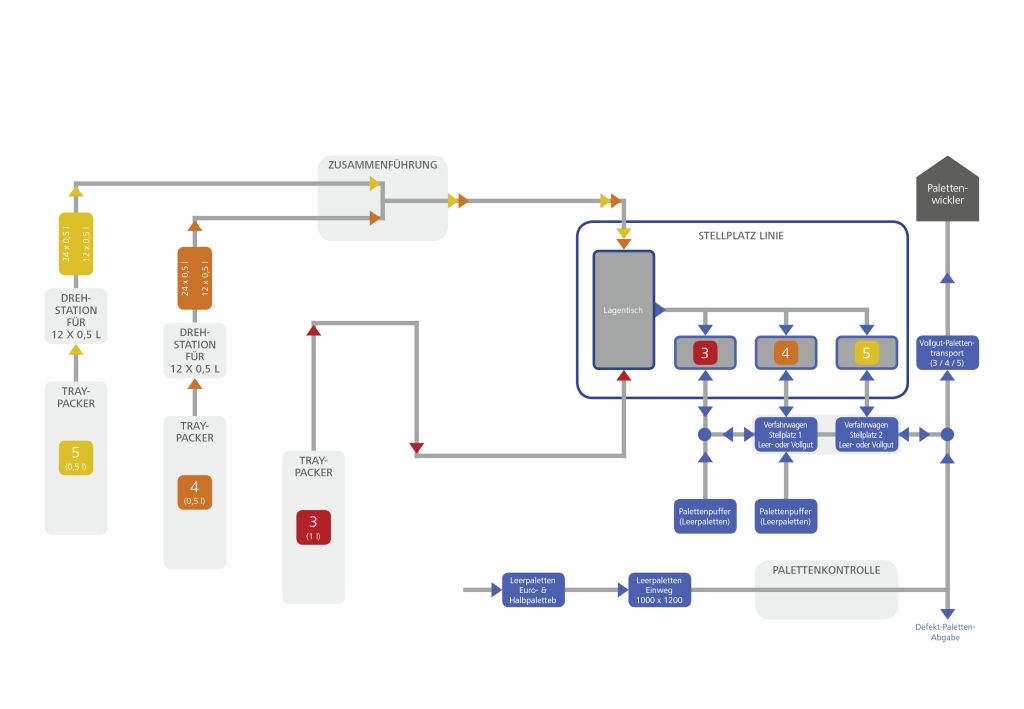
Gantry palletiser handles up to 171 layers per hour
The specified output of the gantry system in relation to the Euro pallet is 57 layers per hour and line. This means that a total of 171 layers per hour are possible with three lines. Compared to the output originally requested by Fläming, this corresponds to an increase of 30 per cent. The beverage manufacturer therefore has sufficient capacity in reserve for future increases in output.
With the new portal palletiser, Fläming has gained flexibility and efficiency in palletising. It can also cope with a possible increase in packaging variety. The gantry robot processes an almost unlimited range of pallets, layer patterns and packaging. For example, it would be possible to add a further packaging variant with trays consisting of two times twelve 0.75-litre carton packs and palletise them on one of the three specified pallets. In this case, BMS would first develop the layer pattern internally and test it using simulation. The finished programme would then be sent over the weekend via Remote maintenance to the portal palletiser.
[infotext icon]The Fläming Quellen GmbH
Fläming Quellen GmbH is part of the Bielefeld-based family business Gehring-Bunte Getränke Industrie GmbH. The group also includes Teutoburger Mineralbrunnen GmbH and Rheinisch-Bergischer Mineralbrunnen GmbH from Erkrath. The group's best-known and most successful brand is Christinen-Mineralwasser. In addition to the large product portfolio, the Group's success factors include its packaging policy with different packaging materials ranging from glass and cardboard to PET and with packaging sizes from 0.25 to 1.5 litres in disposable and reusable containers. However, a supplier must also be increasingly variable when it comes to pallets. Fläming therefore looked for and implemented a palletising solution that can map everything that is relevant to the market in terms of packaging and pallets[/infotext].