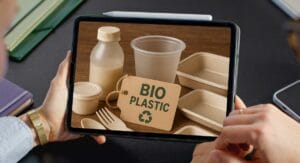
Environmental organisation Deutsche Umwelthilfe has taken a look at the advertising claims for products made from bioplastics. Many of the claims about composting, environmental compatibility and plastic avoidance are greenwashing. The DHU is now calling for a ban on advertising the compostability of bioplastics.
Many retail companies and brand manufacturers - including Edeka, Kaufland, Lidl, Dallmayr, Nestlé and Pampers - are mislead consumers with dubious advertising slogans about single-use bioplastic products and undermine real climate and environmental protection. This is the result of an investigation by the German Environmental Aid (DUH). The environmental and consumer protection organisation Advertising claims regarding the environmental compatibility and disposal of a total of 29 bioplastic products scrutinisedfrom coffee and tea capsules to take-away and food packaging, hygiene products and even shoes.
"Bioplastics are booming on supermarket shelves, in drugstores and in the to-go sector. Many people are consciously choosing bioplastic products in the hope of protecting the environment and climate. Labels such as 'environmentally friendly', 'compostable' or 'plastic-free' may sound promising, but the green appearance is deceptive! These are often disposable products that are either completely unnecessary or for which more environmentally friendly reusable alternatives have long been available. The disposal of almost all bioplastic products in the organic waste bin is prohibited for good reason: An experiment we conducted at a representative industrial composting facility at the end of last year showed that products advertised as 'compostable' only partially decompose or do not decompose at all and can contaminate the compost with plastic residues. Bioplastics do not solve problems, they create new ones. We are therefore calling on Consumer Protection Minister Lemke to introduce a ban on advertising the compostability of bioplastic packaging and products. This would put a stop to the bioplastic advertising lie most frequently used by the industry!"
Barbara MetzDUH Federal Managing Director
Display
According to the DUH, retail companies are primarily focussing on bioplastics in order to continue the mass sale of unnecessary disposable packaging and short-lived single-use products under a green guise. However, just like the supposed compostability of bioplastic packaging and products, their production from renewable raw materials is not an environmentally friendly solution. Often Production of "plant-based" bioplastics Crops from agricultural monocultures used.

"Consumer acceptance of disposable plastic products is increasingly dwindling. Many manufacturers are therefore replacing their fossil-based plastic packaging and products with those made from bioplastics and advertising them as 'plant-based' or even 'plastic-free'. This applies, for example, to completely unnecessary tomato packaging at Kaufland or disposable nappies from market leader Pampers. In chemical terms, however, bioplastics remain plastic. What's more, not one gram less waste is produced. Environmentally conscious consumers should not be fooled and instead avoid waste wherever possible and use reusable alternatives."
Thomas FischerDUH Head of Circular Economy
DUH has already launched a protest e-mail campaign to Environment and Consumer Protection Minister Steffi Lemke to stop greenwashing with bioplastics.
Source: DUH

Further news on bioplastics


Biomaterial from Hamburg in the final: traceless nominated for German Future Prize

EU project converts agricultural waste into bioplastics

AIMPLAS researches new processes to improve bioplastics for packaging

Bio-based adhesive for sustainable folding carton production