Start-up Mr Fred packs dog food in Tetra Paks

The start-up Mr Fred packs dog food in Tetra Paks. To keep the high-quality pet food fresh and long-lasting, it all depends on the packaging. A visit to the production facility.

Dog food like home-cooked. With this claim, two experienced entrepreneurs have embarked on a completely new business adventure. Beate Rank and Tobias Kobier had to learn quickly: To keep their Mr Fred dog food fresh and long-lasting, the right packaging is essential. A visit to a start-up that wanted to do everything right from the start.

One hand holds the Tetra Pak with Mr Fred dog food and the other hand pulls open the cap.
Compact packaging for pet food: the start-up Mr Fred opted for Tetra Pak. (Image: Mr Fred)

The walls are white, the floor has been scrubbed and the machines are spick and span. When we enter the production hall of the F&F Pet Food GmbH near Bamberg, an elaborate image film is currently being produced for the Mr Fred dog food filmed. The film team has already produced an entire series with Frank Thelen and for his food start-up. This is another sign that the founders leave nothing to chance on their journey.

This applied to the search for investors as well as to the development of the food, the construction of the production facility, shop system, merchandise management and social media presence. Scalability was and is always taken into account. Beate Rank and Tobias Kobier have been thinking big right from the start. Especially when it came to packaging.

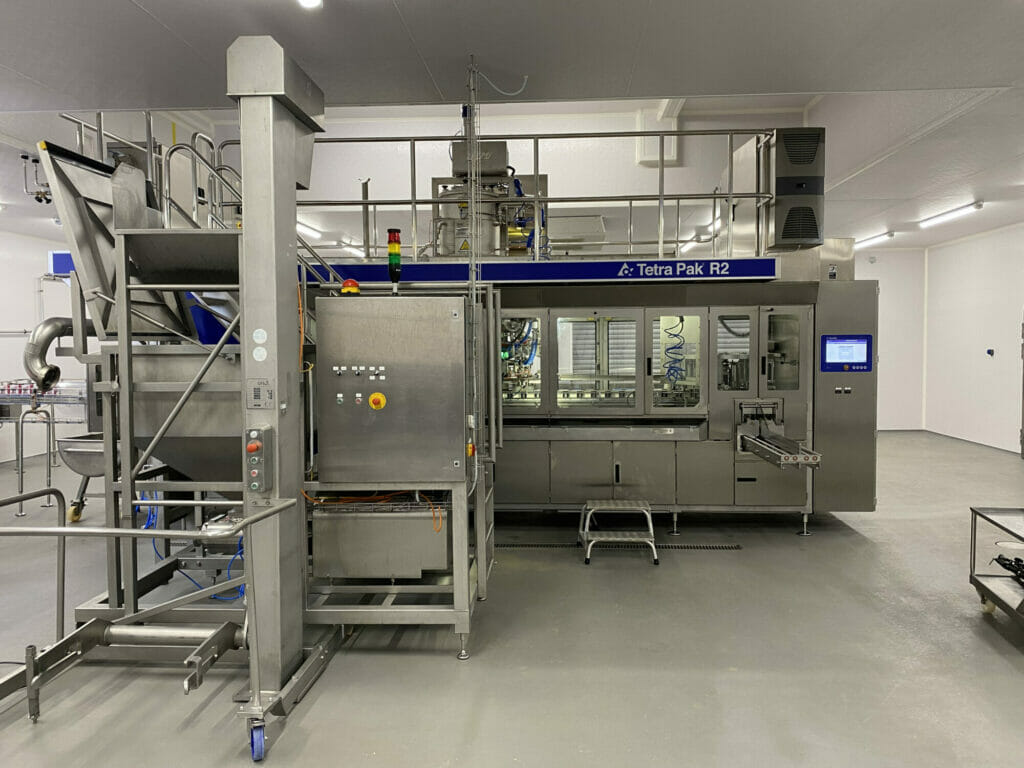
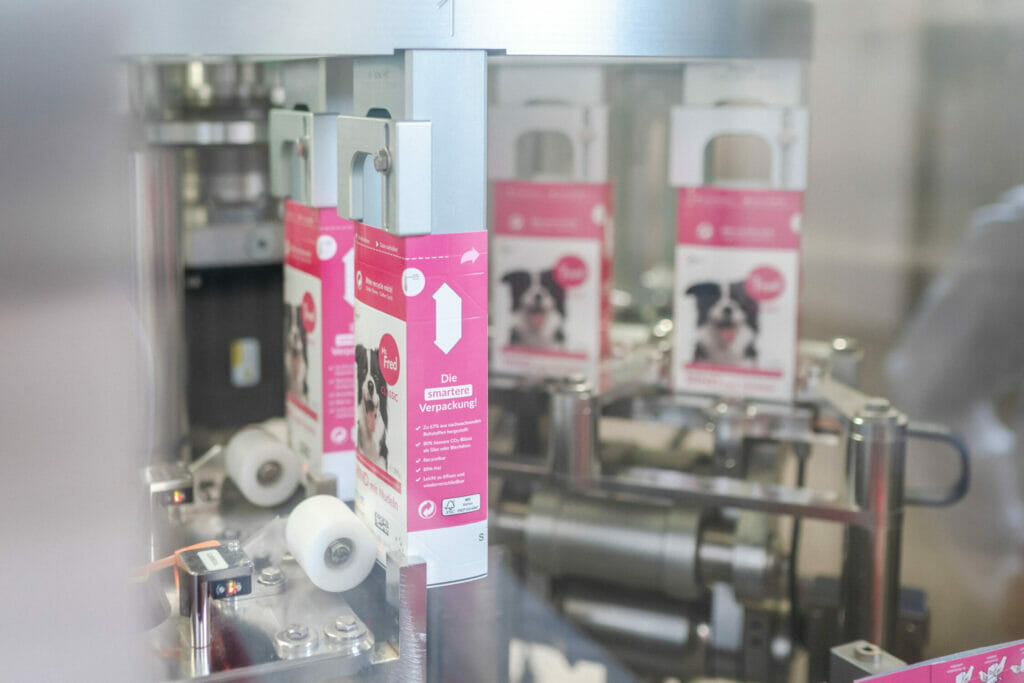
Because the film team is here, the production halls can be entered today without any special protection. What immediately catches the eye is the Tetra Pak logo on the large machine in the centre of one of the halls. In fact, the dog food from Mr Fred does not come in cans, but is rather small, compact and rectangular, like a small carton of UHT milk. And indeed, the „H“ for „long-life“ was a decisive reason for choosing this technology.

Display

While the founders had initially cooked their food in vacuum-packed bags at low temperatures, it soon became apparent that this concept had serious disadvantages. The cold chain had to be maintained and the goods had to be delivered to the customer by express. This made the product extremely expensive and production was only possible on a maximum of three days a week.

Large white room with a metal Tetra Pak machine.
Not only convinced the founders in the test lab: with the Tetra Pak filling machine, the start-up has set the course for further growth. (Image: packaging journal)

Tetra Pak: The right packaging for Mr Fred

In the search for alternative packaging methods the founders quickly came Tetra Pak. „We were invited to the Tetra Pak test lab in Sweden. There we were able to prepare our recipes together with a chef and fill and cook them in a real environment in the machines in the test lab,“ says Tobias Kobier, his eyes still shining today. And the result surprised both of them:

 „In contrast to sterilisation in a can, where the feed usually loses its colour or often has burnt edges, the feed after steaming in the Tetra Pak had virtually no loss of quality in terms of colour, consistency and smell compared to the feed initially cooked in the boiling bag.“ The only serious difference: Now the Mr Fred food suddenly has a shelf life of 15 long months.

Starting with inexpensive semi-automatic equipment, as is the case with cans or sausage rolls, was out of the question for the founders. And while there are plenty of providers for third-party filling for the production of cans, there are just three in the whole of Europe for Tetra Paks in the pet food sector. This is another reason why they wanted their own large packaging machine.

As convincing as these arguments are, the challenge for the young company was huge. A start-up that equips itself with a large machine park right from the start is, after all rather a rarity.

Founders Beate Rank and Tobias Kobier stand in the production area and hold the finished products in their hands.
The two founders Beate Rank (left) and Tobias Kobier (right) had set three core requirements for the packaging of the pet food: Quality of the food in the packaging, environmental friendliness and e-commerce suitability. (Image: Mr Fred)

Who is behind Mr Fred?

Beate Rank and Tobias Kobier actually come from the e-commerce sector. Back in 2007, they started their company Tradoria.co.uk into the online business. Four years later, they successfully exited the business by selling it to the Japanese company Rakuten. But even the best entrepreneurial experience and the most precise planning do not make founders become packaging and machine experts overnight.

Tobias Kobier remembers the first few weeks well. „Above all, our demand for chunkiness and consistency of the product cost us a few nerves at the beginning during the filling process,“ he says. „Tetra Pak However, his team gave us excellent support in the initial phase on site.“

The far more difficult part was then keeping the machine running in daily operation, carrying out maintenance, cleaning, conversions and process optimisations. The founders learnt from this and brought a qualified machine technician into the team.

This gives the founders time to concentrate on the essentials: growing their brand through consistent communication of their advantages. Above all Sustainability plays a decisive role here.

Customers are consistently informed about the packaging.

Close-up of the filling machine. The pink Tetra Pak packages and the machine can be seen.
(Picture: Mr Fred)

Sustainability with Mr Fred

Almost 70 per cent of the Tetra Pak are made of renewable raw materials, paper from trees grown in sustainably managed forests (FSC-certified). The remaining 30 percent are thin aluminium and PP layers, to protect the product.

However, if the packaging is disposed of in the dual system Fully recycled. Tetra Paks are also delivered folded to the production site. This means that approx. ten times more Tetra Paks on a lorry than cans.

In addition, the start-up also endeavours to Designing sustainable processes. The shipping cartons are tailored precisely to the sizes of the Tetra Paks in various gradations in order to avoid unnecessary air space - and thus additional filling material.

The shipping cartons are also uncoated brown, very light and thin, as the Tetra Pak does not require any additional protection against denting. All shipping material - carton, filler, adhesive tape - is made of paper.

Founder Tobias Kobier stands smiling with his arms folded.
(Picture: Mr Fred)

„We had specified three core requirements for the packaging of our feed: quality of the food in the packaging, Environmental friendliness, and E-commerce suitability. Tetra Pak really did fulfil all the requirements perfectly.“

Tobias Kobier, founder Mr Fred

Beate Rank and Tobias Kobier are pursuing a clear growth strategy for the future. On the way to break-even, they are focussing entirely on their own brand.

Within the next two years, the company will not only develop its own Dog treat series The company's goal was not only to launch a new product line, but also to build a second production line with an additional logistics hall, expand beyond the borders of Germany and Austria and launch a full range of products for cats on the market. All packed in the large, spick and span machine, which was anything but oversized for this start-up.

http://www.mrfred.de

Published in packaging journal 7/2021

Special Fachpack:
Trends and news about the trade fair

The future of packaging at Procter & Gamble
Interview Jürgen Dornheim:

Packaging, packaging materials:
Start-up Mr Fred packs dog food in Tetra Paks
Minimum standard for assessing the recyclability of packaging updated
New virgin fibre paper with water-based coating
Live talk on the question: Plastics - quo vadis?

Sustainability:
Efficient packaging for biscuits and waffles
New materials
Studies: How environmentally friendly is silphie paper?
More circular economy for plastic packaging

Labelling:
Company-wide labelling solutions are in demand
Linerless technologies

Packaging technology:
Practical report on automatic pallet stabilisation

Automation:
Practical report on new degrees of freedom despite standardisation

German Packaging Award 2021:
A selection of the best packaging of the year

One hundred years blue tin

Since 1925, the Nivea cream can has borne its deep blue colour, white lettering and round shape - a design that has remained stable over generations, markets and crises and is now celebrating its 100th birthday.
Read more "