On aeroplanes, many drinks are served to passengers in pre-filled cups sealed with a film. Together with a customer, Albis Plastic GmbH has developed an oxygen-absorbing film that keeps the drinks fresh for a long time. This has now been scientifically proven.
Oxygen is the building block of all life. However, it shortens the shelf life of packaged foods. Oxidation also often changes the appearance of food or drinks. Active packaging that absorbs the residual oxygen contained in a product has advantages over other, non-active solutions. Hamburg-based Albis Plastic GmbH offers Shelfplus O2 a particularly powerful, so-called Oxygen scavenger on. The fact that Shelfplus O2 is particularly suitable for wine packaging has now even been scientifically proven.
The idea behind Shelfplus O2 is obvious: an oxygen-absorbing film is used to reduce the amount of oxygen in the packaging. This means that the freshness and quality of food can often be maintained even without refrigeration. The oxygen scavenger, which the manufacturer refers to as an "additive batch", can be processed in common polymers such as PE, PP, PA and EVA and incorporated into rigid packaging and flexible films. It reliably absorbs oxygen that penetrates from the outside and any residual oxygen present in the product. Since this year, Shelfplus O2 has also been used in the inner film of the popular "bag in box" packaging for wine.

An important target market for Shelfplus O2 is the Catering in aircraft. This is where the advantages of the product pay off particularly well. Wine and fruit juices are offered in pre-filled, highly transparent multi-layer cups that are sealed with an oxygen barrier film. This consists of five layers. The first layer of PP has a seal-peel effect. This is followed by the PP film with Shelfplus O2, a third PP layer, an OPA layer and finally a PET-SiOx layer on the outside. The cups are lightweight and easy to stack when empty. In addition, the beverage does not need to be decanted into another container before serving.
Beverages in airline catering have to withstand a lot
But what about shelf life and product quality in view of the special conditions in airline catering? After all, the drinks are stored at room temperature and travel through all the climate zones of the world. A shelf life of nine months is required. To find out how Shelfplus O2 performs under these challenging conditions, Albis Plastic GmbH commissioned the Hochschule Geisenheim University with an investigation.
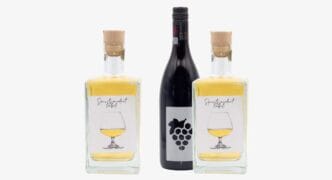
The research team at the Hessian institution filled white Rheingau wine into three different types of packaging and analysed various parameters. The grape juice was bottled in glass bottles, cups with a Shelfplus O2 film and cups with a film without an oxygen scavenger. The test objects were stored for nine months - one batch in a cool place at a constant 15 degrees Celsius, another at a constant 20 to 25 degrees. After the storage period - and previously after three and six months - four indicators were tested: the sulphurous acid content in the beverage as an indication of the oxygen tightness of the containers, the packaging tightness using a visual assessment, comparative colour measurements and standardised taste tests by a panel of tasters.
The results are now available for the refrigerated versions. Conclusion: Sealing films with Shelfplus O2 are superior to those without this material and in many cases can also compete with glass bottles. None of the packaging analysed showed any leaks after the test period. The colour test of the wine also revealed no abnormalities. The transparent Shelfplus-O2 film used specifically for the test situation, however, showed the expected brown colouration because the conversion of the absorber from iron to iron oxide had taken place.
Drinks in cups with scavenger film were significantly fresher
The scavenger film also proved its worth when testing for sulphurous acids. At the start of storage, the free sulphurous acid content in the wine was 29 mg/litre. For the total sulphurous acid, 134 mg/l were determined. A reduction in the sulphurous acid content was to be expected as a result of the reaction with oxygen. This also occurred in the cup variants with foil, while the values in the glass bottle remained almost constant. It was found that the cups with scavenger film lost considerably less sulphurous acids than the normally sealed objects. In the case of free sulphurous acid, this means that the content after nine months was still 14.4 mg/l on average for the samples with Shelfplus O2 and 11.4 mg/l for those without Shelfplus O2.
Flavour changes are expected when the proportion of free sulphurous acid in the beverage falls below 10 mg/l. In the sensory test, the 22 testers came to a clear conclusion. The test was carried out using a ranking procedure in accordance with DIN 10963 and ISO 8587. The paired sample comparison at a significance level of 99 % showed "that the wines bottled in glass bottles and in cups with scavenger film were rated as significantly fresher than the wine bottled in cups without scavenger film".
For Albis Plastic GmbH, the study confirms that with Shelfplus O2 it is on the right path to a more sustainable packaging solution for food. Roland M. Schultz, Director Global Marketing Packaging, summarises this as follows: "The use of Shelfplus for the storage of wine is a contribution to the avoidance of ,Food Waste'."