packaging journal TV Talk: Better recyclability - lower licence fees?

The topics of recycling and the use of recyclates are being discussed extensively. We spoke to Jörg Deppmeyer, Managing Director Sales at Der Grüne Punkt Duales System Deutschland, about current developments in this area and the extent to which manufacturers could benefit from sustainable packaging.

Jörg Deppmeyer
Managing Director Sales at Der Grüne Punkt Duales System Deutschland

The topics of recycling and the use of recyclates were discussed at length at the German Packaging Congress. We spoke to Jörg Deppmeyer, Managing Director Sales at Der Grüne Punkt Duales System Deutschland, one of the partner companies at this year's event, about current developments in this area and the extent to which manufacturers could benefit from sustainable packaging.

Jörg Deppmeyer has been Managing Director Sales at Der Grüne Punkt since 2018. (Image: Der Grüne Punkt)

Mr Deppmeyer, your topic is of course: How do we get plastic packaging into a cycle? A simple question that is so important for everyone who packs and produces packaging materials. So, can recyclability be planned?

In principle, this is the beginning of the circular economy, because it depends very much on the input material. And ideally, we would like this to be as little complex as possible. Whenever possible, we are a big fan of mono-materials. This means as little complex packaging as possible, less multi-layered packaging made from different materials. It's always a good starting point if you can initiate great recycling processes with the material that the consumer throws into the yellow bag or bin at home and get high-quality material that we can make available to our customers and partners again at the end of the day. So: Design for Recycling is the word of the hour.

Design for recycling means starting very early to make your life easier.

In any case. Design for recycling means nothing other than adhering to this principle as far as possible in terms of design and the composition of materials. For example, when it comes to printing inks, we appeal to our customers to use inks that can be washed out as easily as possible so that they do not hinder recycling processes later on.

But it's not just the packaging design that plays a major role. In the end, the consumer also has to play a part. Ultimately, they have to dispose of it at home, ideally in the correct container. Packaging belongs in the yellow bag, there is a lot you can do with it. Anything made of paper should go in the blue bin. And organic waste in the organic waste bin. And then there's the famous residual waste bin, where a lot of things end up today, some of which would actually be packaging and would actually be better in the yellow bag or the yellow bin.
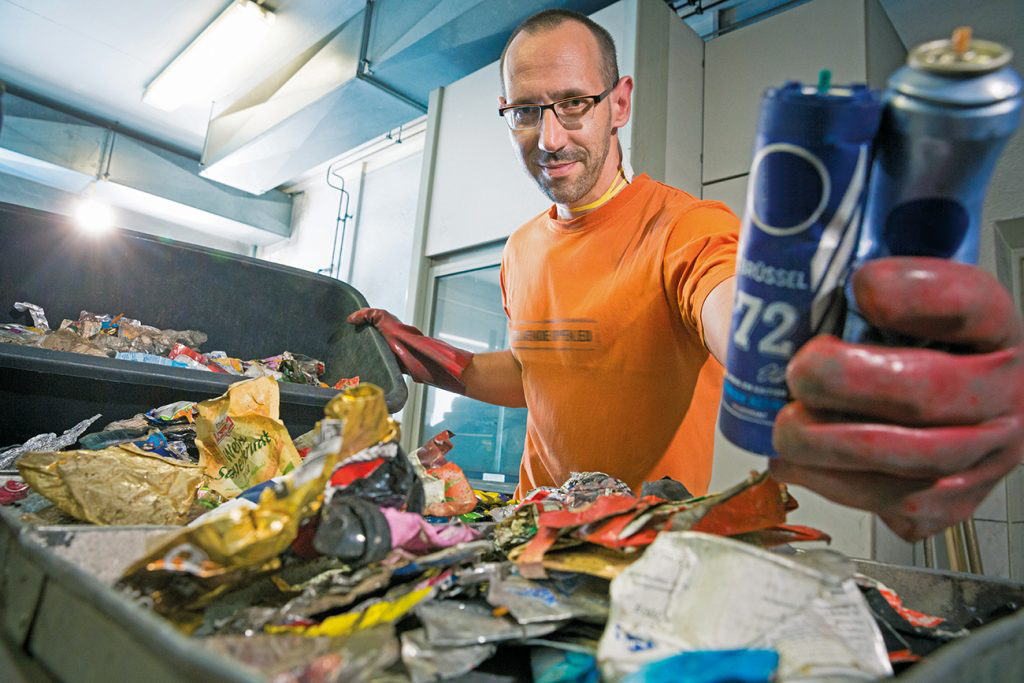
Waste has been separated in Germany since 1992. (Image: The Green Dot)
Germans have been separating their waste since 1991. (Image: Der Grüne Punkt)

You have already internalised this. But is there anything the packaging industry can do to make it easier?

The packaging industry is best focussed on removing as much complexity as possible from packaging. The simpler, the more monostructures, the better. That is already a very important indication. Think of mono plastic packaging made of polypropylene, for example, which is excellent for recycling. Today, we often have multilayer packaging made from different types of plastic for reasons that sometimes don't even have to be there. This makes sense if, for example, the food is to be protected or food waste is to be prevented. But in many, many cases, the packaging can actually be simplified and complexity removed without much effort.

The whole interview in the packaging journal TV Talk

A lot has happened in terms of monomaterials, including the topic of labelling. Where do we stand right now? Is the industry well enough positioned?

In theory, yes. The question of what I actually gain from endeavouring to reduce complexity is where things start to fall apart. If I try to reduce and simplify packaging, are there also financial incentives? There are some points in the Packaging Act that are well-intentioned but not fully thought through or implemented. The responsible authorities in Berlin are now also aware that regulatory improvements are needed. As an industry, it is of course easier to change something if there is perhaps a small reward at the end of the tunnel.

Which could look like what?

Actually in the form of refunds. Paragraph 21 of the Packaging Act, for example, provides for a bonus-malus system. It states that those who make a special effort when it comes to design for recycling should be penalised. And those who make less effort, i.e. use more complex packaging, should be penalised with a penalty. The idea behind this is not new, but unfortunately the Packaging Act has remained stuck in theory: Ultimately, it lacks the levers to really get to implementation there. In my opinion, the legislator has recognised this and the Central Agency Packaging Register never tires of pointing this out. In this respect, I am confident that the next amendment to the Packaging Act will correct the situation. This means that in future, those who position themselves accordingly in terms of design and the composition of the packaging material will ultimately be rewarded with lower licence fees for placing their packaging on the market.

Which is an interesting approach. Because especially when you talk about regulations and have now also explained a few things, many in this industry suffer from them. Could this perhaps be improved and mitigated a little?

In any case. We see that in other places too. If I really want to recycle something, it's not just that I have to start with the input, something also comes out after the recycling process. We are used to using both waste paper and waste glass in everyday life. We don't even question the fact that the pickle jar contains a proportion of used glass. Whereas we have an even harder time with plastics. And here I would like to see the market and demand in particular pick up much, much more. We really are only at the very beginning here. And you know, there are enough park benches and similar items made from old plastic in Germany. Now it's about actually thinking from ‘shelf to shelf‘. In other words, in an ideal world, what was on the shelf as packaging yesterday will be back on the supermarket shelves tomorrow - and then made from used plastic. This is the next big task ahead of us.

Absolutely. And this ideal world is how far away?

It's not that far away. Numerous industry partners have already demonstrated what is technically feasible in completely different product groups. Just think of certain applications such as shower gel, to name one area that I consider to be relatively sophisticated, i.e. demanding. This use of used plastic already exists there. Shampoo and the like are conceivable. So we are already very, very close to mass-produced items, even in the food industry. Although it has to be said: When it comes to the requirements for primary packaging for foodstuffs, it is actually not yet conceivable to use recyclates that come from a mixed household goods collection. There are still clear limits and barriers set by the legislator. But in the area of secondary or tertiary packaging, the food industry can enter the field of using recyclates in the same way as is already common practice for many in the non-food sector. But there is much, much, much more to it.

Published in packaging journal 2-3/2021

Also in this issue: 

Sustainability: packaging made from our own recyclates in vogue

Packaging technology: entry threshold for automated solutions is falling

Display

Marketing, design: New concepts for new products

More from Der Grüne Punkt