Creative packaging with contour: sachets made from mono material
The consumer encounters sachets in various forms, and more sustainability is also required here. At Lohn-Pack Wolf GmbH, a specialist in contour and multi-packs, multi-layer composite films have now been replaced by mono films.
26 July 2021
Contour sachets for promotional campaigns - functional and eye-catching. This is a two-chamber solution that can be used to pack two portions of one product, but also different products. (Image: Lohn-Pack, Frank Baumhammel)
Who hasn't seen them, the sample packs in magazines, the sachets of face cream on the skin cream bottle, the individual sachets of windscreen wipes and, above all, the currently much-used hygiene wipes in disposable packaging: we are talking about sachets - and about service providers who produce them even more sustainably, for example from monofilms.
The small sealed pouches come in a variety of forms. They are available in standard square formats as magazine sachets, which have to meet special requirements, and also as multiple sachets consisting of two or more compartments, for example with day and night cream or disc wet and dry wipes. Especially Extraordinary and attention-grabbing are sachets in the form of neck hangers, which can be attached to existing products, or customised contour sachets, e.g. in the shape of a butterfly. In short: with sachets, the imagination is the limit. Almost no limits set.
Various sachet shapes for the cosmetics, healthcare and pharmaceutical markets. (Image: Rebernig Brand Design)
In line with the versatile requirements for side-sealed pouches, these can be produced in various sizes from 40 x 40 millimetres to 120 x 240 millimetres, for example, and with contents from 0.5 to 100 grams.
Display
Co-packing partners in demand
But hardly any company can realise all of this in-house. This is where they prefer to outsource and rely on the expertise of specialists. One such specialist is Lohn-Pack K. A. Wolf GmbH & Co. KG in Florstadt. Especially in the area of Multiple and contour sachets and in the Production of small quantities This is where the company's particular strengths lie. Thanks to a specialised machine park with existing and available tools, a wide range of customer requirements can be met.
Comprehensive advice is provided from the very first enquiry. The short decision-making processes in the family business offer a high degree of flexibility, and the rapid processing of an order within a few weeks is no problem.
Sustainable challenge
Ecological action is also required in the production of sachets. It was therefore an inspiration for Lohn-Pack when suitable mono films finally became available that could fulfil this requirement. Because until now sachets usually made of multi-layer composite films manufactured. As the product in the sachet should neither diffuse to the outside nor be exposed to environmental influences such as moisture, there is a so-called barrier layer in the centre. This is usually made of aluminium. The top layer, which is then printed with the customer's motifs, is usually made of polyester. On the inside of the film there is a so-called sealing layer (e.g. polyethylene), which is not heat-resistant.
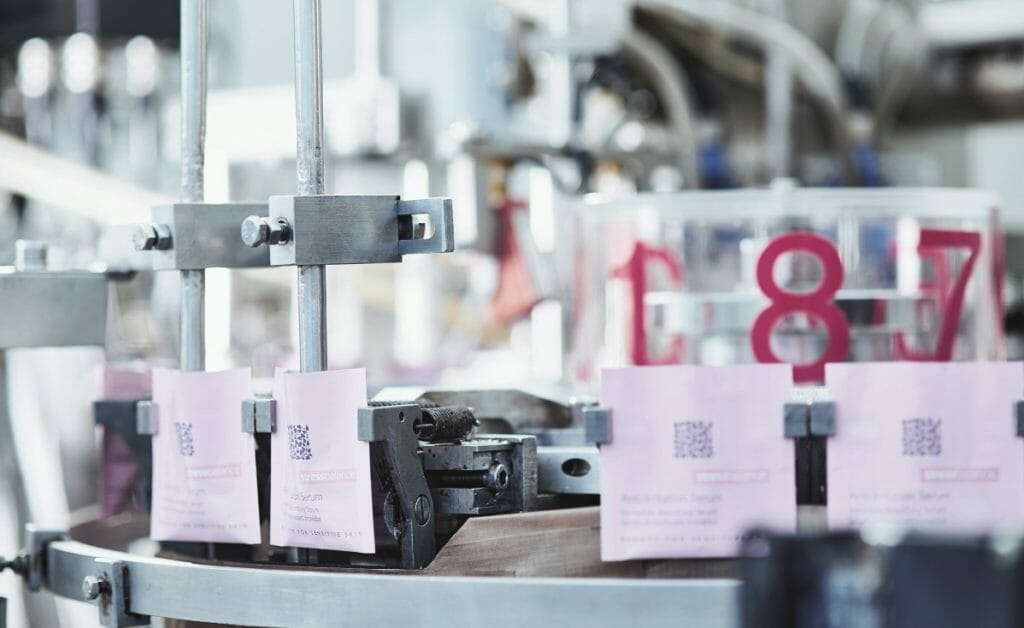
Small sealed pouches with skin cream samples are produced on a rotary machine. (Image: Lohn-Pack, Frank Baumhammel)
When the sachets are produced, the inner sides of the films are placed on top of each other and these sealing layers are then fused together by heating using sealing jaws. As it is no longer possible to separate such composites of different layers from each other, the Recyclability not given.
Sachets made of monomaterial - Sealing of monofilms
The major challenge for film manufacturers with monomaterial is that the inner layers must also be fused by sealing. At the same time, the hot sealing jaws must not destroy the outer layer, which is made of the same material. Monofilms are therefore also made from at least two layers, whereby the layers must each have different physical properties due to their manufacturing process. The difficulty for material production lies in a very low tolerance range of the sealing jaw temperature. A further challenge is that these sachets are only one layer thicker than the usual composite films. Very thin barrier layer have.
Great response for new films
Lohn-Pack immediately started with the first tests for the machinability of the monofilms and their suitability for various customers. Even during this phase, enquiries about the „new sustainable films“ were received and many orders were produced with the new wrapping material within a very short time. The first sachets were Rectangular sachets, that contained a shampoo, but in the meantime, for example, the Contour sachets in tube form with a hand cream on the market.
Monofilms currently account for around five per cent of the company's total production volume. The costs for sachets made from mono material vary depending on the application. But the average ten per cent higher financial outlay is worthwhile for the environment.
In addition, Lohn-Pack is currently carrying out tests for a very well-known company in the household hygiene sector that is concerned about environmental compatibility. The sachets are to be used as Refill bagl are packaged in appropriate film in order to combat packaging waste. The tests for this are being prepared and carried out in the company's own laboratory. As a further component, Lohn-Pack is hoping for good results from the current tests with another innovation on the packaging market: a Compostable film is intended to give sustainability a new boost in the right direction.
Tradition leads to success
The Company Lohn-Pack has built up its specialised expertise over more than 50 years of practice: its customers come from the cosmetics, healthcare and pharmaceutical markets as well as the chemical industry. Founded in 1968 by Karl Alfred Wolf, who started out as a tinkerer and mechanical engineer, the company grew steadily. The founder's children, Sabine Petermann and Lars Wolf, soon joined the company and took over after their father's death.
(Image: Lohn-Pack, Frank Baumhammel)
„We are constantly on the lookout for new sustainable solutions for sachets and face up to special challenges such as processing innovative monofilms.“ Sabine Petermann, Managing Director of Lohn-Pack K. A. Wolf GmbH & Co. KG
Since 2013, Nina Petermann has been the third generation in the area of key account management. She is currently restructuring the company and gradually taking on more important tasks.