In a joint project, Münster University of Applied Sciences and the company EMPAC are looking for a method to better seal pharmaceutical containers.
Sensitive chemical or pharmaceutical raw materials require hermetically sealed packaging. This is why they are filled into so-called big bags. The Emsdetten-based company EMPAC manufactures these for the chemical and pharmaceutical industries, among others. The company is now working with the team from the Laser Centre at Münster University of Applied Sciences on a new two-year project to make them even more dust-tight. It is being financed with funding from the Central Innovation Programme for SMEs (ZIM) of the Federal Ministry of Economics.
Laser to weld containers airtight
"The big bags are usually sewn together," explains Sascha Wagner, a graduate engineer at the Laser Centre in the Department of Physical Engineering in Steinfurt. However, each seam creates a hole, which complicates the pharmaceutical industry's high demands for particle-free storage of the substances. "There must be no interactions with the active ingredient." This is why the Laser Centre, headed by Prof. Dr Evgeny Gurevich, and EMPAC are now looking for a way to weld the containers airtight using a laser.

Heat is a major challenge
What sounds simple at first, however, presents the team led by Gurevich, Wagner and graduate engineer Jürgen Gröninger with a challenge: if the fabric of the big bags is heated too much, it shrinks. "That's why we have to partially heat the material thermally," says Wagner. When welding by laser, the heat radiation must be precisely controlled. In the ZIM project, the team is now looking for a way to make this possible. The big bags hold one to two cubic metres and must be able to carry five to six times their load. The fabric must not be affected in any way.
How do you seal something without heating it too much? The Laser Centre at Münster University of Applied Sciences and the company EMPAC are working on a ZIM project to seal packaging for pharmaceutical substances airtight. https://t.co/j5BtHGnkYb (cs) #FHMünster
- FH Münster (@fh_muenster) September 16, 2020
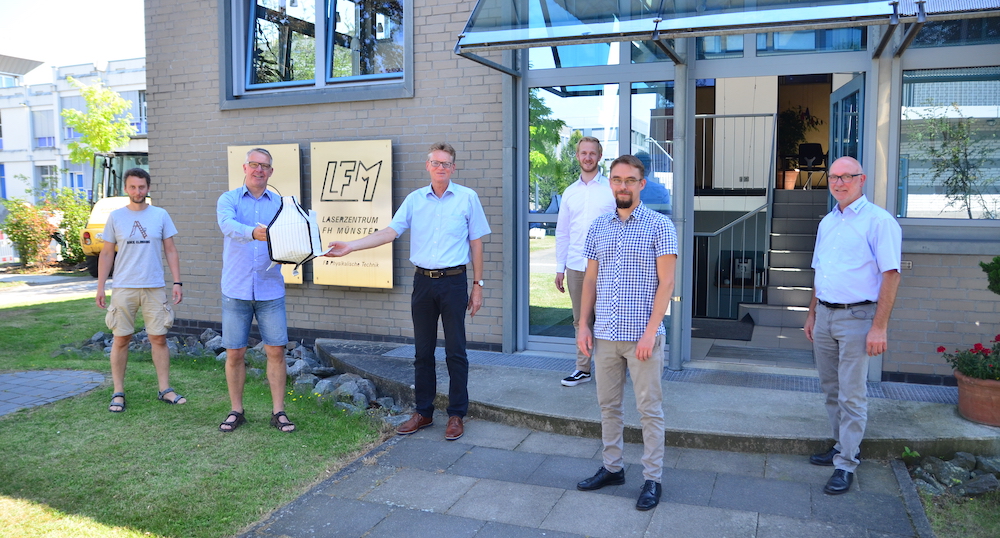
The project could also help to save additional materials: The big bags currently contain an "inliner", a hermetically sealed packaging for the materials to be stored inside the packaging. "Perhaps we can dispense with this by welding it," reflects EMPAC Managing Director Michael Hans during an on-site visit to the campus in Steinfurt.
Source: FH Münster