Ritrama has developed a multifunctional smart liner that can be utilised as a resource to make good use of waste die-cutting grids and liner materials from labels.
20 August 2019
The transparent material can be used to produce labels with a no-label look. (Image: Ritrama)
After several years of research, material manufacturer Ritrama has developed a multifunctional smart liner that can be utilised as a resource in order to make sensible use of the die-cutting grids and liner materials from labels and thus significantly reduce the amount of waste produced. Ritrama is working closely with printing machine manufacturer Omet and die-cutting machine manufacturer Spilker to develop the innovative production process.
Reducing waste is one of the biggest economic and industrial challenges facing the packaging industry. Customers and brand owners are increasingly demanding Sustainable production processes and the avoidance of waste due to the changing demands of end consumers and the requirements of public institutions and politics.
These market requirements for environmental protection are also a challenge in the production of self-adhesive labels. New solutions are required. As a rule, the printed labels are Labels on a carrier material. The contour of the labels is punched rotationally with punching tools, whereby the cutting edge of the punching tool only separates the label material without damaging the backing material.
There are minimal gaps between the individual labels. This creates a die-cut grid, which is removed and ends up in the waste. During further processing, the finished labels are then dispensed onto the respective product via a dispensing edge, which Carrier material is then also disposed of. This is where Ritrama's research comes in.
Display
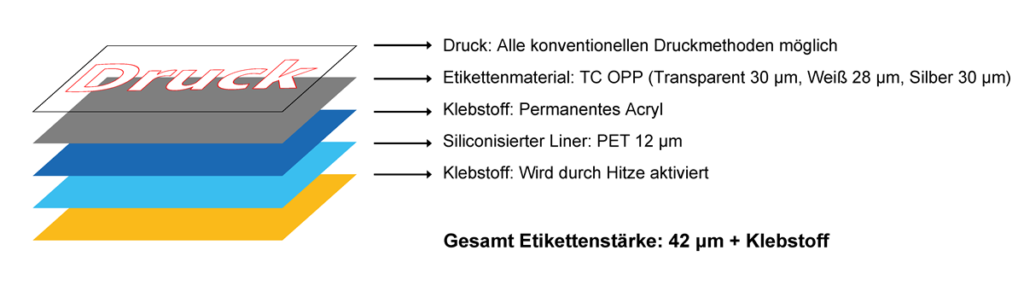
Core Linerless Solutions® material structure: The thin material thickness means that significantly more labels fit on each roll. (Image: Ritrama)
CLS: Core Linerless Solutions®
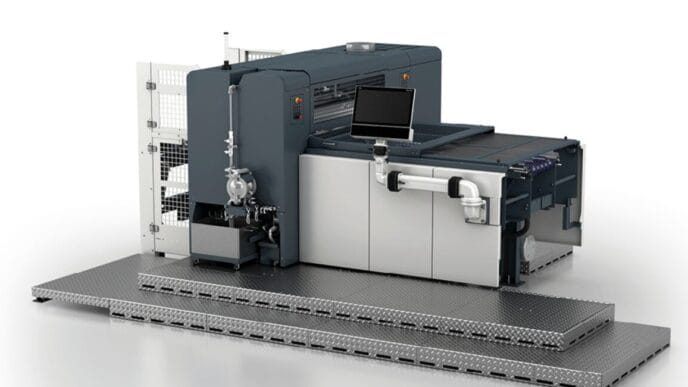
The process begins with Ritrama's self-adhesive CLS® multifunctional smart liner (polypropylene with siliconised polyester liner, see graphic for structure), which can be printed using all conventional printing processes. The printing machine can be equipped with full speed This is in contrast to inline converting, where the labels are already punched in the machine, No punching process and grid removal slows down the machine.
The so-called CLS® material is available in transparent, white and silver and is available in a thickness of 42 micrometres. Significantly thinner than conventional film material. After printing, the siliconised liner is removed in an Omet machine, the adhesive is activated by heat and the liner is laminated to the printed side of the material. In this way, the liner becomes a an integral part of the label and protects the printed image.
Converting process
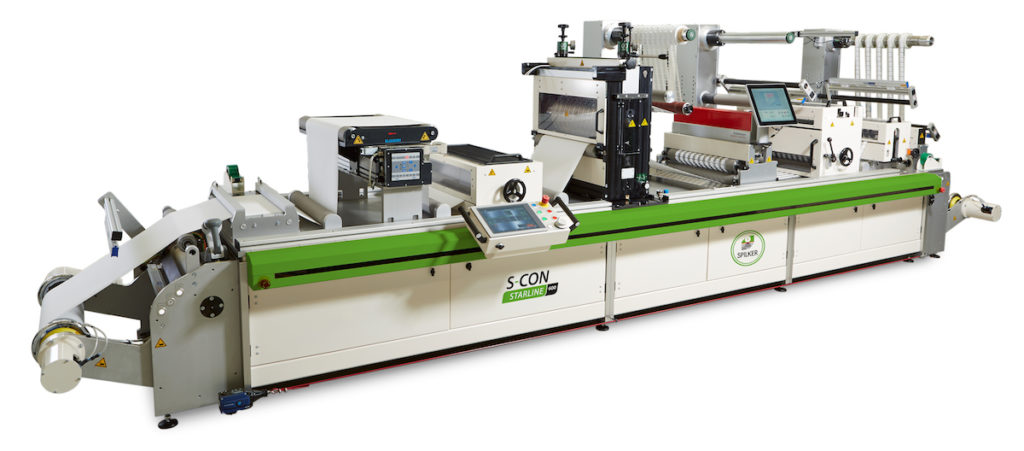
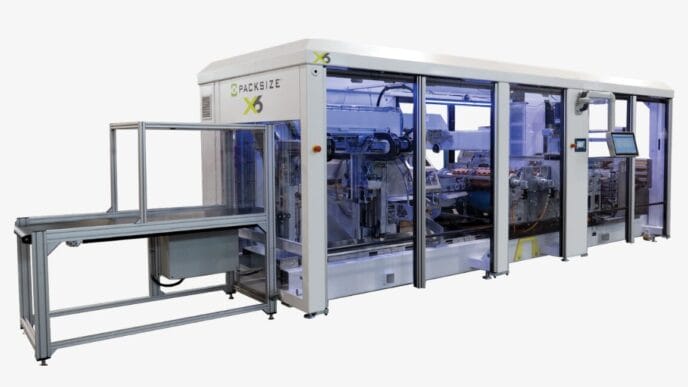
The finished labels are then die-cut and inspected using a converting machine from Spilker GmbH. The S-CON Starline CLS 500 is designed for die-cutting and inspecting printed materials at high speed. Two Vacuum pulling stations provide for Optimum web tension during processing and enable the punching of open adhesive and the processing of CLS® material.
Standard label material and CLS® material can be processed with the S-CON Starline from Spilker. (Image: Spilker)
In contrast to die-cutting standard labels, which can of course also be produced on the machine, instead of a gap between the labels a Precision microperforation punched. Thanks to the micro-perforation for separating the labels instead of a spacer, significantly more labels fit on each finished roll and there is no need to remove a die-cutting grid.
In addition to the reduced amount of waste produced, this also results in Conservation of resources in terms of raw materials, transport and handling.
Inspection system improves product and process quality
The punched perforation is checked with a camera system after punching to rule out problems during the subsequent donation process. At the same time, the Print image checked for errorst and repeat deviations that can occur with film materials, for example during printing due to stretching of the material, are recognised and automatically compensated for by the machine control system.
The Integrated tandem winders with friction shafts Finally, the Ilti Linerless labelling machine ensures optimally wound individual rolls, even with narrow labels. These finished rolls can be labelled with an Ilti-linerless labelling machine for self-adhesive labels. without carrier tape be dispensed onto the end product. The labels are separated by tearing them off at the micro-perforation. The dispensing speed corresponds to that of conventional labels.
Henrik Spilker, Managing Director of Spilker GmbH (Image: Spilker)
„Everything simply fits together in this joint project. The competences of the individual partners complement each other perfectly, and sustainable environmental and climate protection have been important corporate goals at Spilker for years.“
Henrik Spilker, Managing Director of Spilker GmbH, Leopoldshöhe
Environmental protection and cost reduction
The advantages of producing labels without a backing material are obvious: the Extremely thin material and the Avoiding the punching grid less raw material is consumed. The full speed of the printing press can be utilised during printing.
The retooling of the machines is simplified, and the result is Less downtime in the individual processes thanks to the higher number of labels per roll. Production, transport and storage costs are reduced. In addition to these economic aspects, labels produced with the CLS material contribute to environmental protection as waste is avoided.
The Italian, internationally active company Ritrama was founded in 1962 and is recognised as one of the global market leaders in the design and manufacture of self-adhesive materials. With more than 1,000 employees and 20 locations around the world, it is the largest family-owned company in the self-adhesive industry. Coating sites and research and development departments are located in Europe, America (North and South) and the Far East. The Ritrama Group has an extensive distribution network around the world to ensure „just-in-time“ delivery of products locally. http://www.ritrama.com
The OMET Group consists of five companies and production sites in Italy with more than 300 employees. Its business areas are the construction of printing machines for the label and packaging market and machines for converting tissue materials. Since its foundation in 1963, more than 1,300 successful projects have been realised worldwide. http://www.omet.com
The Spilker GmbH is one of the market leaders in die-cutting tool manufacturing and has been developing and manufacturing rotary tools and cutting dies for its international customers in the printing, labelling, automotive, pharmaceutical and packaging industries since 1963. As a specialised provider of solutions for rotary die-cutting and converting processes, Spilker also offers the Complete service of special machine construction, from the idea to the concept to the design and realisation at the customer's premises. 230 employees work at the Leopoldshöhe site in the modern machinery of the family-run company, which is represented worldwide by subsidiaries and sales partners. http://www.spilker.de