Apparently, used plastic from the Yellow Bag is hardly used in reality. Instead, according to the Süddeutsche Zeitung, the import of cheap recyclate from Asia is increasing. The company Werner & Mertz is calling for financial incentives for the use of post-consumer recyclate (PCR) and seamless laws.
The Süddeutsche Zeitung (SZ) newspaper reports that this is yet another scandal on the subject of plastic recycling: Instead of using more used plastic from the Yellow Bag, the import of cheap „recyclate“ from Asia continues to increase - without being able to check whether it is actually recycled material. „Much of it could be fake“, the SZ quotes Antonello Ciotti, Director of Equipolymers, one of the largest PET manufacturers in the EU. His conclusion: „Consumers could become victims of greenwashing when shopping.“
Reinhard Schneider, owner of the Mainz-based detergent manufacturer Werner & Mertz, confirms this statement in the article: „The risk of consumers being misled is very high here. It's like money laundering, which Origin of the PET is not transparent. It can be disguised in the blink of an eye.“

Incorrectly declared recyclate reduces recycling quotas to absurdity
But not only do false declarations pose a massive problem for consumers in their daily shopping, the cheap goods from Asia are also a major problem for the manufacturers of recycled PET in Europe - due to the massive price war. jeopardising all efforts to promote and increase the recycling rate in Europe.
Advanced Mechanical Recycling from the Yellow Bag is possible
Since 2012 Werner & Mertz has been committed to the Recyclate initiative The company, together with co-operation partners along the entire value chain, is committed to high-quality mechanical recycling from the Yellow Bag source and has shown time and again that it is indeed technologically possible, equivalent packaging made from so-called post-consumer recyclate produce: Since 2014, the PET bottles of the well-known Frosch brand have been made from 100 per cent PCR, 20 per cent of which comes from the Yellow Bag source.
The remaining 80 per cent comes from from the European beverage bottle collection (bottle to bottle). Over 450 million of these bottles have been sold to date. The company was recently able to announce another recycling success: Together with its cooperation partner Alpla, it has succeeded in increasing the proportion of recyclate from the Yellow Bag to 50 per cent.
Recyclate from used plastic from the Yellow Bag too expensive
But hardly any company apart from Werner & Mertz is prepared to pay the higher costs for recyclate from the Yellow Bag compared to virgin material. Instead, pure greenwashing is often practised, as the SZ article shows.
In addition to the origin of the supposed recyclate, SZ cites the type of recycling process as a further problem: More and more companies, including BASF, are increasingly practising So-called chemical recycling, that - so Werner & Mertz-Schneider in the article - „is more of a subtype of combustion that consumes a lot of energy and has a negative environmental footprint.“ Several European environmental organisations have therefore warned in a joint study against classifying this process as environmentally friendly.
Demand for financial incentives and seamless laws
For the manufacturing company Werner & Mertz, there are therefore several adjustments that urgently need to be made. financial incentives from the legislator for the use of PCR to reduce the amount of waste and achieve a climate-friendly plastic cycle. The company is in favour of creating a fund into which all distributors would have to pay and only those who use post-consumer recyclate from Europe would receive a refund. This could put an end to the price war.
On the other hand, there is a need for seamless laws that clearly define what can and cannot be considered a recyclate. To this end, the amendment to the Closed Substance Cycle Waste Management Act must clearly stipulate that only mechanically processed used plastic from end consumer collections is considered recyclate.
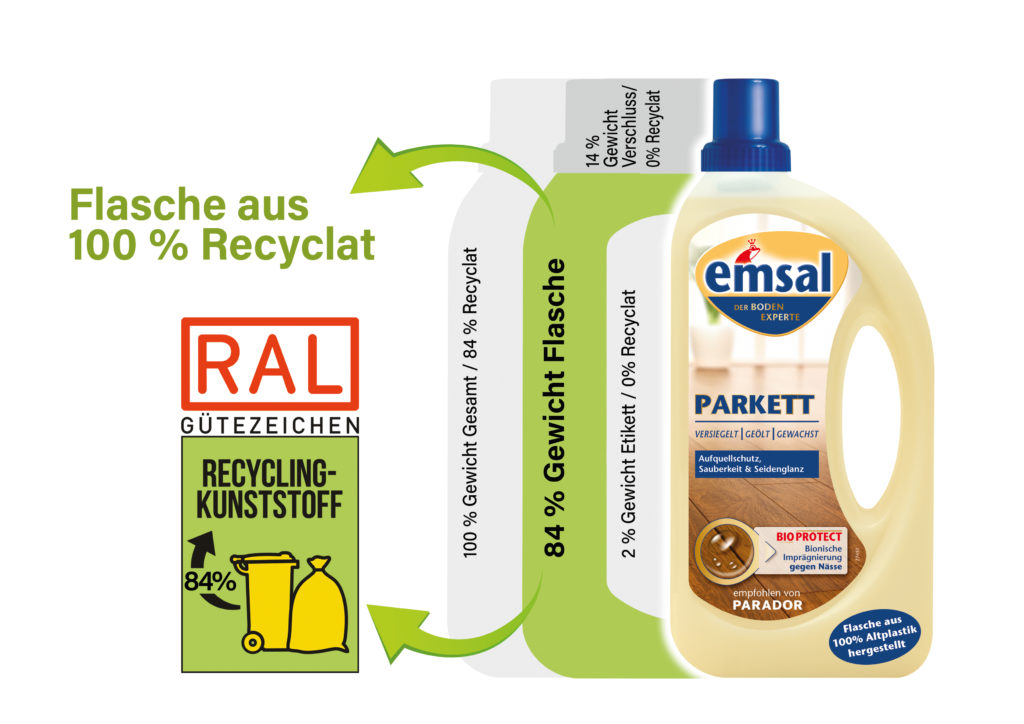
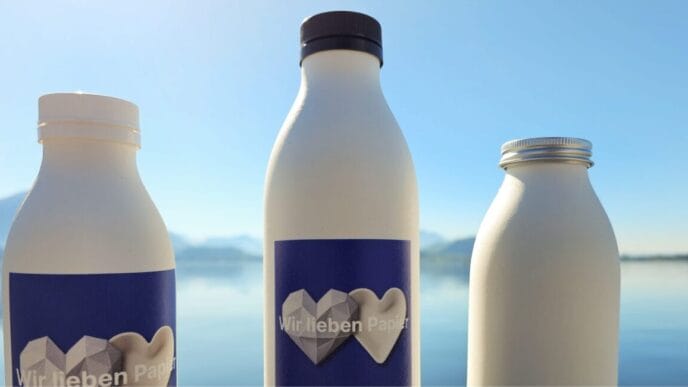
The RAL quality mark indicates the proportion of recyclate from the Yellow Bag source in the total packaging. For the packaging of emsal Parkett this results in: Bottle (100% recyclate from the Yellow Bag source) with closure and label (0% recyclate each) = 84% total proportion of recyclate. (Picture: Werner & Mertz)
Consumers have few options for verification
Unfortunately, there are very few independent seals that consumers can rely on. The RAL quality mark „% recycled plastic“ is one of them. It indicates how much recyclate actually comes from the Yellow Bag. In the process All process stages - from sorting and processing through to the use of recyclates in the individual products - is documented and all production sites are checked. Consumers can also check the bottle neck of the packaging: If it is greyish in colour, this indicates the use of recyclate.
Source: Werner & Mertz