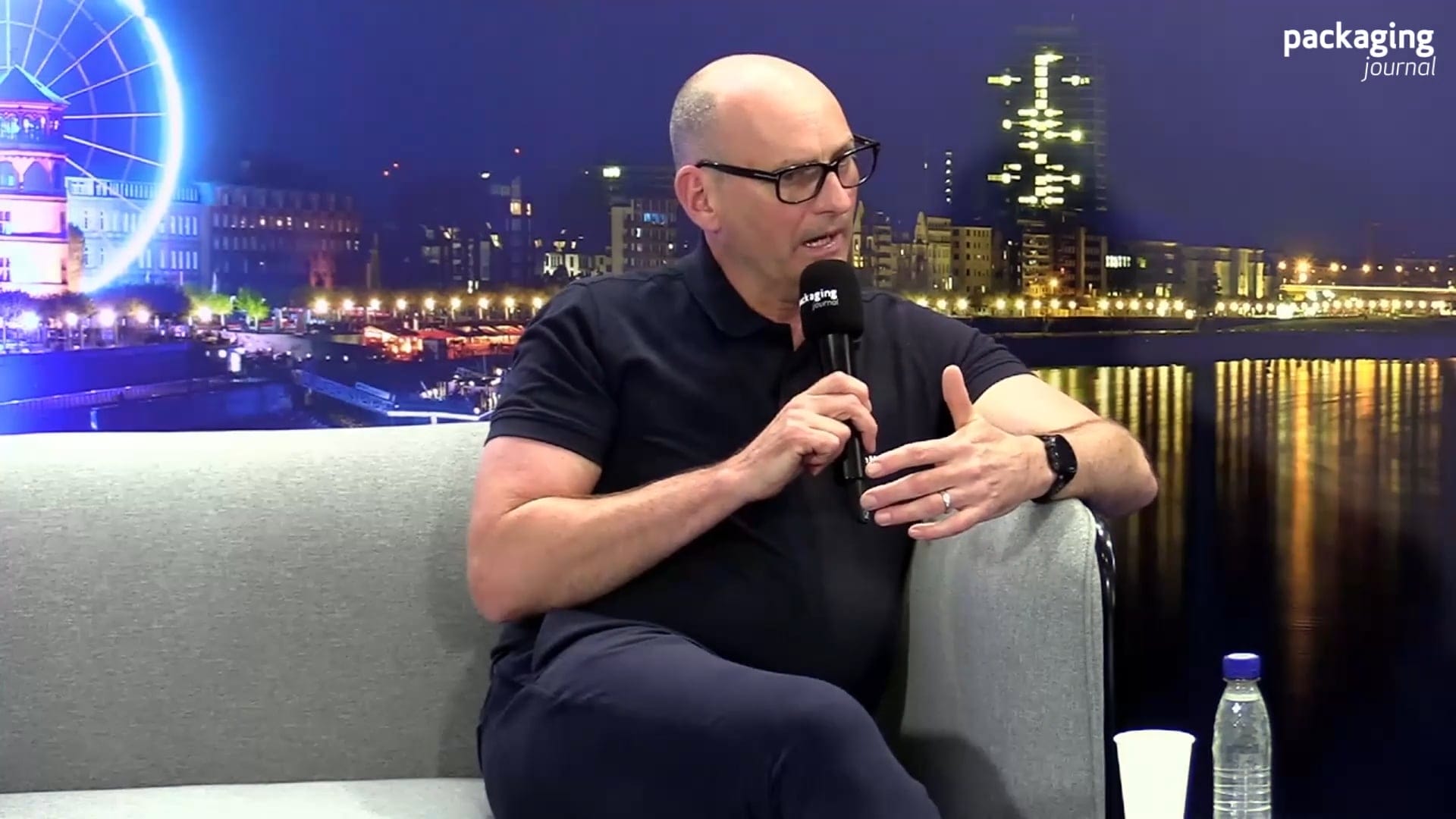
The Professional Association for Carton Packaging for Liquid Food (FKN) will be represented at interpack 2026 for the first time. Managing Director Martin Schröder is using the leading trade fair to promote his packaging solution with figures and facts – and is sharply criticising German packaging law.
Excessive reusable rate hinders innovation
The Packaging Act Implementation Act, presented in February, is viewed critically by Schröder: „We have a delta of 60 percent – 10 percent is demanded by Europe and 70 percent is stipulated in the German law.“ The reusable quota, which has existed for almost ten years, has not brought any significant successes. Currently, Germany is at 34 percent in the beverage sector, while the EU is only demanding ten percent from 2030 onwards.
Schröder's demand of politics is clear: „It must be fact-based, it must be science-based, in order to make good decisions.“ By 2029, he expects more clarity and harmonisation on the European market through the PPWR – and with it, a correction of German special paths.
78 per cent CO2 saving compared to single-use glass
„Experts have proven to us that our packaging solution is over 90 percent recyclable,“ Schröder emphasises. All three components of the carton – cardboard, polyethylene, and aluminium – are recyclable. The FKN life cycle assessment shows clear advantages: „When you look at beverage cartons compared to single-use glass, we save 78 percent of CO2 emissions.“
Consumer acceptance is accordingly high, as beverage cartons fulfil several expectations simultaneously: sustainability, practicality, and reclosability. „If you look at the different consumer expectations, the beverage carton can actually fulfil all of them,“ says Schröder.
Recycling crisis threatens circular economy
Despite the technical feasibility of recycling, Schröder sees the industry facing challenges: „We are actually dealing with a recycling crisis at the moment.“ Many plastic recyclers are experiencing problems. He is calling on the EU and the federal government to provide suitable framework conditions so that recycling companies can survive.
„No recycling companies, no recyclates,“ Schröder sums it up. This shifts the political lever: anyone who wants to make mandatory quotas for recycled content must simultaneously ensure a functioning recycling infrastructure – otherwise, the circular economy will remain a demand without substance.