The regulatory requirements for the packaging industry are growing rapidly. New regulations, global markets and increasingly complex supply chains come up against a reality in which relevant information is often hidden in unstructured, incomplete or difficult-to-access documents. This is precisely where Pyx comes in with an approach that sees artificial intelligence not as an end in itself, but as a precise tool for solving a very specific industry problem.
The start-up Pyx has been managed by the founding team of Stavros Kyriakidis and Otto Hefner, who combine decades of experience in the development and operation of enterprise software, since August 2024. This expertise ranges from scalable AI architectures and complex data pipelines to deeply integrated enterprise integrations into existing IT landscapes. However, it was clear from the outset that a solution for material and regulatory compliance can only work if technological excellence is combined with real expertise from the packaging industry. This is why the resulting Pyx solution was developed together with industry expertise right from the start, in close collaboration with Bischof+Klein. This co-development structure ensures that real industrial requirements, regulatory intricacies and technical implementation are seamlessly integrated. This is particularly important in connection with the material regulations of the PPWR.
Rethinking material compliance in the packaging industry
The solution centres on the automated extraction and structuring of regulatory-relevant information from documents - regardless of how they are available. The Pyx software processes classic PDFs as well as scanned documents, historically evolved specifications or documents with handwritten additions. It is deliberately not just about recognising text. Instead, the documents go through a large number of coordinated process steps: from OCR to layout and table analyses through to semantic context evaluation.

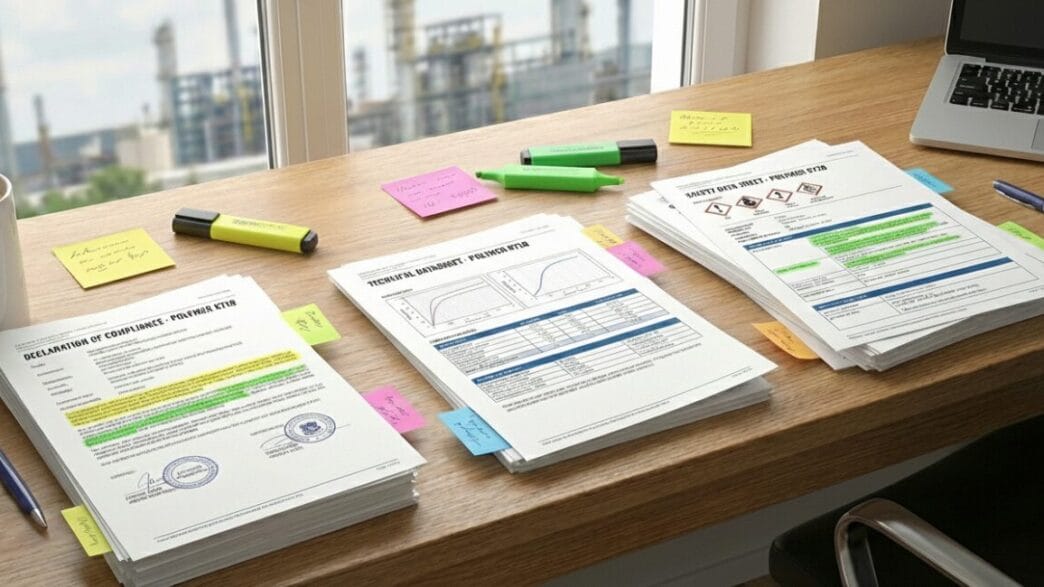
A context-sensitive layer evaluates content not in isolation, but in a regulatory context. This development fundamentally changes the traditional process of material compliance, which previously formed the basis for regulatory decisions. Where specialist departments today often spend several hours manually reviewing, comparing and interpreting extensive supplier documents, the software takes over this process automatically within a few minutes. The evaluation is not only significantly faster, but also more consistent and of higher quality than with purely manual analyses. Pyx reads DoCs, TDS, SDS, technical specifications and other relevant document types in their entirety and derives structured statements on conformity with specific regulations.
The result is valid, machine-readable data records that can be integrated directly into existing system landscapes via APIs - whether in internal databases, ERP systems or specialised compliance solutions. The development deliberately starts early in the process: with the automated extraction, normalisation and contextualisation of unstructured documents. It thus creates a reliable basis for material compliance across suppliers, document types and languages. At the same time, Pyx shifts the focus of regulatory work: instead of tying up specialist departments with the manual review and interpretation of extensive documents, the system takes over this preliminary work automatically.
This does not replace regulatory expertise, but concentrates it specifically on the technical assessment of results and exceptions. In this way, specialised expertise can be scaled for the first time.

This approach is complemented by the close partnership with MDCTec. As one of the leading providers in the downstream compliance process, MDCTec offers an established platform for regulatory assessment with ComplianceBASE. The connection to ComplianceBASE is optional and expands the stand-alone functions of Pyx into an end-to-end process chain - from unstructured supplier documents to systematic, audit-proof compliance assessments.
Lack of consistent material data
Irrespective of this, Pyx has a global design and takes into account European, US and other international regulations. The extracted material data can be used across regulatory boundaries and can be flexibly integrated into existing system landscapes via APIs - with or without a connected compliance platform. The added value of this approach becomes particularly clear in the context of the Packaging and Packaging Waste Regulation (PPWR). It is not the starting point, but the consequence of a structural problem: a lack of consistent material data along the supply chain. Hardly any other regulation will change the packaging industry so much in the coming years. Material compositions, recyclability, verification obligations and data availability are moving to the centre of corporate responsibility. However, it is precisely this information that is usually only available today in a fragmented, unstructured form and distributed across numerous documents. Pyx addresses this basic problem independently of individual regulations. At the same time, the existing material compliance analysis forms the ideal basis for systematically covering PPWR-relevant requirements - and is already doing so today. The automated preparation and normalisation of the relevant information transforms the PPWR from an abstract regulatory requirement into an operationally manageable process.
Measurable efficiency and quality gains
Testing a raw material takes an average of two to four hours without Pyx, but only a few minutes with the software. The quality of the results increases because the inspection is carried out systematically by machine and typical errors from manual processing are avoided. In addition, Pyx provides numerous workflow-facilitating functions to the left and right of the actual inspection process, so that a one-off document evaluation results in a permanently usable, centralised database. A one-off evaluation of a raw material or packaging component remains available and can be updated within the same evaluation - as a constantly up-to-date starting point for the regulatory evaluation of the packaging components. The price ratio is also advantageous: the costs of an evaluation are significantly lower than the internal labour costs that would be incurred for a comparable manual check.
Broad user group
Pyx is aimed at all players along the packaging value chain - from raw material suppliers, packaging manufacturers and converters to packers and fillers, i.e. all companies that are held responsible by current and future regulations. Instead of managing regulatory complexity manually, users receive a structured, scalable and future-proof solution.
Users are not limited to regulatory experts: quality management, packaging developers and related departments can all work with Pyx. Purchasing also benefits, as it receives reliable, structured information on material compositions, conformity statements and statuses more quickly - and can therefore make more informed and efficient decisions.
The potential is correspondingly immense because the same data can be used for different roles and the organisation as a whole becomes more capable of acting. The fact that this approach has struck a chord with the industry was demonstrated by the clearly positive response following the presentation of the solution, for example at the the Dresden Packaging Conference of the dvi 2025 and at the German Plastics Packaging Industry Association. The start-up was met with great interest from a deeply involved audience. The noticeable enthusiasm was mainly due to the fact that a previously unsolved, industry-wide problem was addressed in a practical way for the first time. The experts will soon be acting as service providers for ten companies from the packaging sector, and further negotiations are looking promising.
Pyx therefore represents a new way of dealing with regulatory reality in the packaging industry. Not as another AI tool, but as an integral part of industrial processes. More than just a prompt: a system that understands, structures and enables companies to act.