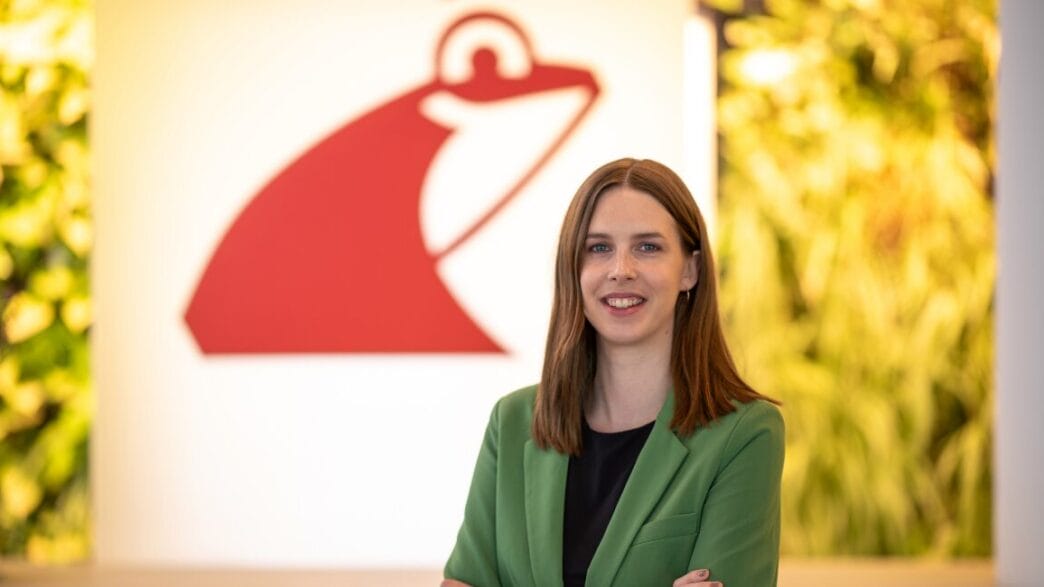
Werner & Mertz is known as the pioneer in the circular economy. For years, the Mainz-based company has been consistently implementing sustainability in all areas – from the formulation of its products and packaging to manufacturing. As a packaging developer, Julia Knobloch has been instrumental in shaping the development of sustainable packaging solutions for two years.
With brands such as Frosch, Emsal and Green Care Professional, Werner & Mertz has been established on the European market for over 150 years. The company has received numerous awards for its holistic sustainability approach. The company's philosophy has also fascinated Julia Knobloch: „I've always been interested in sustainability, and Werner & Mertz is a prime example of a company that embodies it.“ For two years, the packaging developer has been working as Deputy Head of Packaging Development for the innovative Mainz-based manufacturer of cleaning and care products.
Large development team
A job in the packaging industry wasn't her original career goal. It was only during her Bachelor's thesis in Digital Media at Ulm University of Applied Sciences that Julia Knobloch came into contact with the subject of packaging and discovered her professional passion during her subsequent Master's degree at Stuttgart Media University. „That's where I realised that packaging development is what I want to do.“ During her Master's thesis, she deepened her knowledge in the areas of fibres, cardboard, and corrugated board.

After her Master's degree, Julia Knobloch gained professional experience in packaging development at an automotive supplier and an OTC manufacturer. „It was the first time I was responsible for the packaging department, and I saw the influence packaging on the shelf has on consumers“ purchasing decisions."
Julia Knobloch now works in a nine-person team at Werner & Mertz. „The large team also shows how important the topic of packaging is for our company and how seriously sustainable packaging is being taken.“ The tasks are diverse and cover all packaging materials. However, the focus is on plastics and their integration into functioning material cycles. „We are working to continuously optimise our packaging in terms of recyclability and to use more and more recyclate from the Yellow Bag.“
From recycling to true circularity
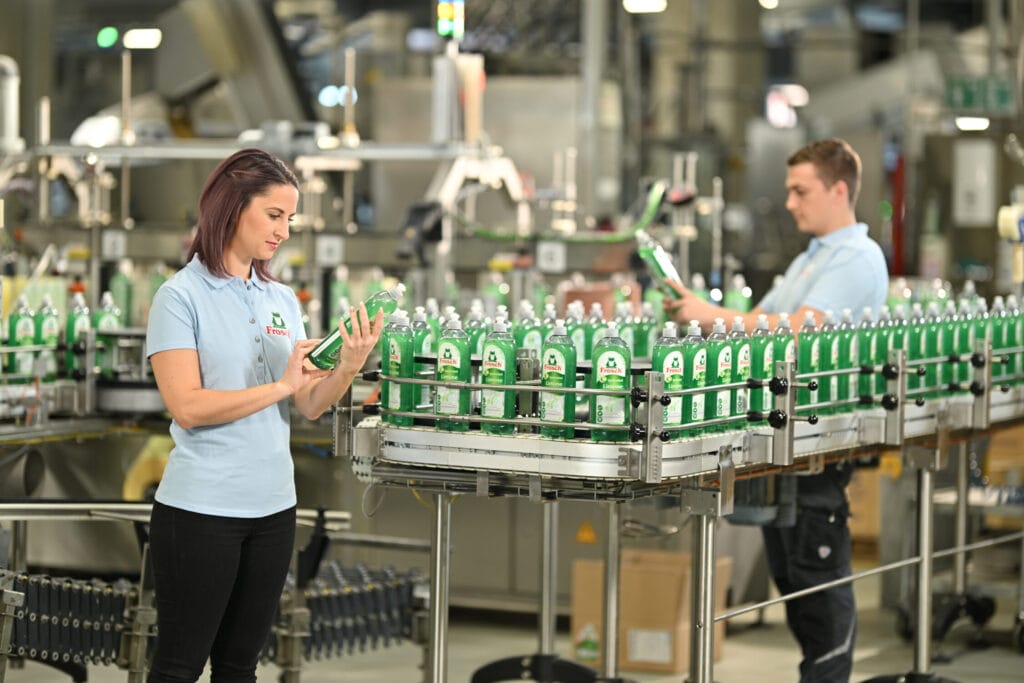
An outstanding example of the circular economy in practice are the company's plastic bottles. „We're very advanced with the bottles and can use 100 percent recycled material from the Yellow Bag or Yellow Bin.“ In 2025, the company reached a milestone: a total of one billion bottles made from 100 percent post-consumer recycled material had been launched onto the market. Close cooperation with partners such as Alpla, who manufacture the bottles directly at the Mainz production site, also enables efficient processes and reduces transport emissions.
Sustainability is in the details
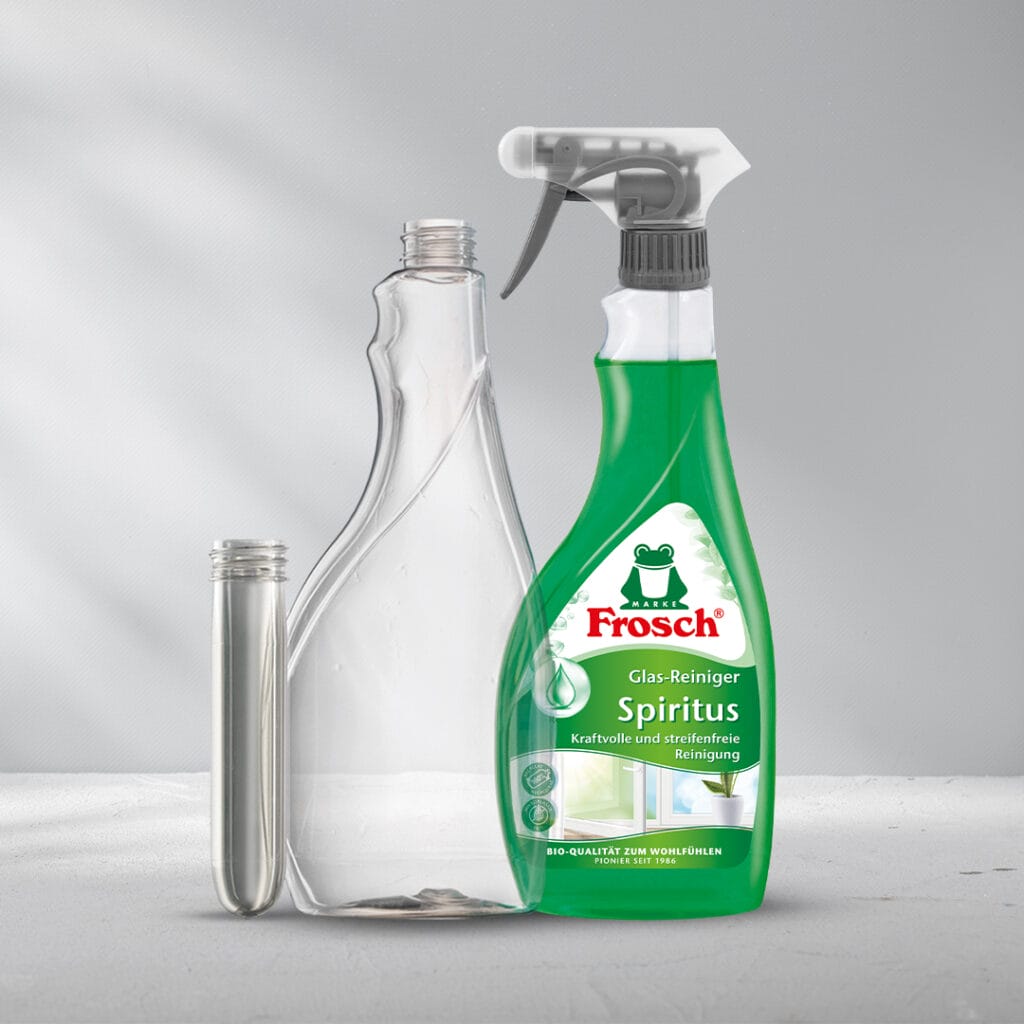
While bottle bodies are already largely optimised, major challenges often lie in the details – for example, with closures. „A complex development was the trigger we worked on together with Berry Global in 2022.“ The spray pump combines several sustainability aspects: it is around 18 percent lighter than comparable systems, is made almost entirely of polypropylene, which simplifies recycling, and for the first time features a high proportion of recycled material in the functional, internal components of the pump mechanism – a technical innovation. „However, our closures are also about material savings, as we only use as little material as is necessary.“ The result shows that even complex packaging components can be designed to be circular.
A particularly demanding field is flexible packaging, such as stand-up pouches. Julia Knobloch: „Our pouches were already fully recyclable, but last year we used recycled material for the first time, which is also technically possible in flexible packaging. However, we are currently the only company in our industry to do so.“ The fully recyclable mono-material pouch was developed in 2018 together with cooperation partner Mondi and currently contains around 27 percent post-consumer recycled material.
Challenge: The Recycling Gap
The company wants to increase its use of recycled plastic material further, however, the so-called „recyclate gap“ could also pose a challenge for Werner & Mertz. Julia Knobloch sees this not only as a supply problem but also as a demand problem: „The industry needs to stimulate demand so that sufficient recyclate is produced.“ It is often argued that recyclates are difficult to process. In reality, however, price often plays the decisive role. The packaging developer believes the solution lies in a joint commitment along the entire value chain. „Everyone together must ensure that there is sufficient recyclate available at affordable prices.“
A key aspect that the packaging developer sees is the objective assessment of materials. „Packaging, especially plastic packaging, often has a bad reputation. It's seen as bad and, worse still, as unnecessary. But we can't do without packaging. Therefore, we need companies like Werner & Mertz that think about how plastics can be kept in a circular economy and actually implement this. Because plastics are good materials, which we should use correctly. Everyone here has a responsibility.“
Werner & Mertz is well-prepared for the requirements of the European Packaging and Packaging Waste Regulation (PPWR). „However, we hope the PPWR will ensure that more happens in terms of recycling in many companies. Currently, there are still many unanswered questions surrounding the law. We are therefore intensively exchanging information in associations and working groups to find answers together.“