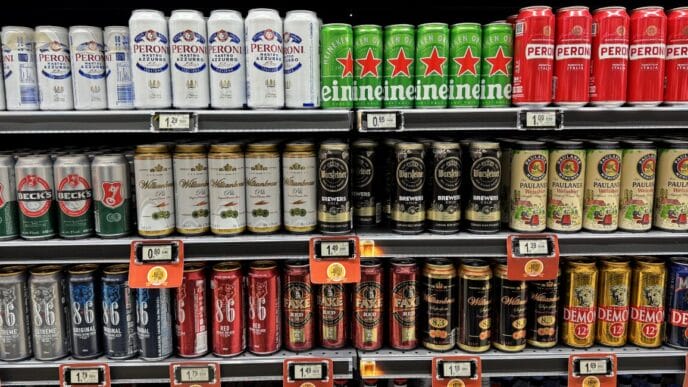

The sale of single-use beverage packaging without a deposit in so-called "Bordershops" on the German-Danish border is a violation of the Packaging Act. This was decided by the 6th Chamber (Schleswig-Holstein Higher Administrative Court) in proceedings brought by the German Environmental Aid (DUH) against the district of Schleswig-Flensburg. In the court's opinion, the district is obliged to enforce the deposit requirement against the border retailers.
The judges clarified that the sale of cans and other single-use beverage containers to end consumers on German territory is fundamentally subject to the deposit obligation under § 31 para. 1 of the Packaging Act. The exception previously practiced for border trade does not apply. The export declarations signed by the predominantly Danish customers in the border shops are not equivalent to a commercial export. The court argued that the beverages continue to be sold to end consumers, while control of individual declarations of commitment is practically impossible.
DUH relies on legal action for inaction
The German Environmental Aid had previously called on the Schleswig-Flensburg district out of court to take action against the sale of non-returnable items. After the district did not respond, the environmental organisation filed a legal challenge based on inaction, which has now been successful.

In the opinion of the chamber, there is a „flagrant violation of the law“. The district's discretion has been „reduced to zero, except for the implementation period“. The district must therefore proceed against the border traders by means of an order and ensure compliance with the deposit obligation.
The judgment is not yet legally binding. Due to its fundamental importance, the court allowed an appeal to the Higher Administrative Court. The district and the intervener dealers can lodge an appeal within one month of the delivery of the grounds for the judgment.
Deposit system controversial for years
The background to the proceedings is the long-standing shopping tourism from Denmark. Many consumers buy alcoholic beverages more cheaply in Germany because neither the Danish alcohol and sugar tax nor a deposit on cans has so far been levied there. According to the DUH, this has repeatedly led to environmental problems caused by carelessly discarded single-use packaging.
Back in 2015, the environment ministers of Germany, Denmark, and Schleswig-Holstein agreed that from 2018, Danish deposit would be levied in border trade with a corresponding deposit seal. However, this regulation was never implemented.
Legally, the issue had already been the subject of legal disputes at the EU level. The European Court of Justice had ruled in 2023 that the lack of intervention by German authorities against the sale of duty-free beer was permissible. However, the current ruling specifically obliges the district of Schleswig-Flensburg to take action.
EU packaging regulation likely to change cross-border trade
In the long term, the situation is likely to change anyway due to the European Packaging and Packaging Waste Regulation (PPWR). The regulation, which has already been passed, stipulates that deposit systems for single-use beverage packaging must be introduced in all EU member states from 2029. This would also mean that a regular deposit would apply to cans and bottles sold across borders.
For the packaging industry and the drinks trade, the ruling once again highlights the increasing importance of regulatory requirements for take-back and recycling systems. Cross-border business models, in particular, are coming under greater scrutiny from the authorities.
Source: Schleswig-Holstein Administrative Court