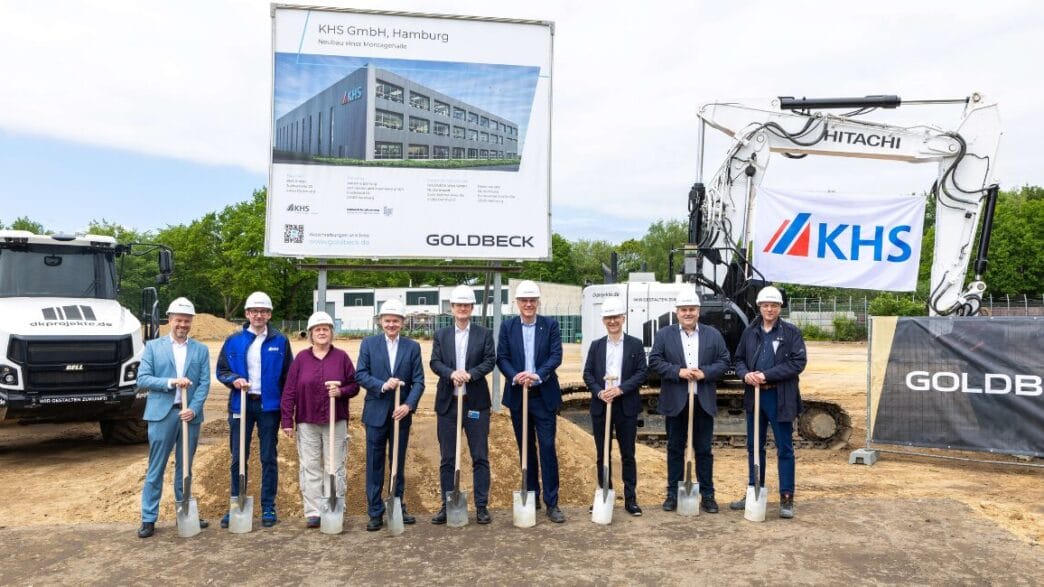
The KHS Group is expanding its Hamburg site with a new production hall for barrier technology. The manufacturer of filling and packaging machines announced it is investing more than eleven million euros in expanding its capacity for plasma coating technology. The new hall is due to become operational in spring 2027.
The new production area, covering around 4,300 square metres, is being built on the expanded factory site at Hellmesbergerweg. KHS intends to consolidate all areas of its Plasmax technology there in the future. The company states that the background to this is the strong increase in demand for machines in the Innopet Freshsafe series.
„Our barrier technology is a significant growth driver for the business success of the entire KHS Group. Demand for our InnoPET FreshSafe series machines has quadrupled in the last five years,“ said Kai Acker, Chairman of the KHS Management Board, at the groundbreaking ceremony.

According to KHS, its PET technology competence centre is consolidated at the Hamburg site. This is where stretch blow moulding machines, filling systems, and coating systems with Plasmax technology are produced, among other things. PET bottles are coated with a thin layer of glass to protect beverages from oxidation and loss of carbon dioxide. This is intended to improve shelf life and product quality.
Expansion of production capacities
Up until now, the product centres for stretch blow moulding and barrier technology have shared three halls. However, according to KHS, these are now reaching their capacity limits due to growth. The new hall is intended to organise manufacturing and assembly processes more efficiently.
According to the company, individual machine modules will be pre-assembled in parallel in the future and then merged. KHS aims to shorten lead times and speed up delivery. Laboratory and storage areas will also be reorganised. Among other things, an automated paternoster system for storing bottle batches is planned.
Focus on CO₂-neutral operation
KHS is planning the new hall for fully CO₂-neutral operation, according to its own statement. Among other things, it is intended to use green electricity, a photovoltaic system on the roof, and heat recovery from the coating machines' cooling circuits.
Source: KHS