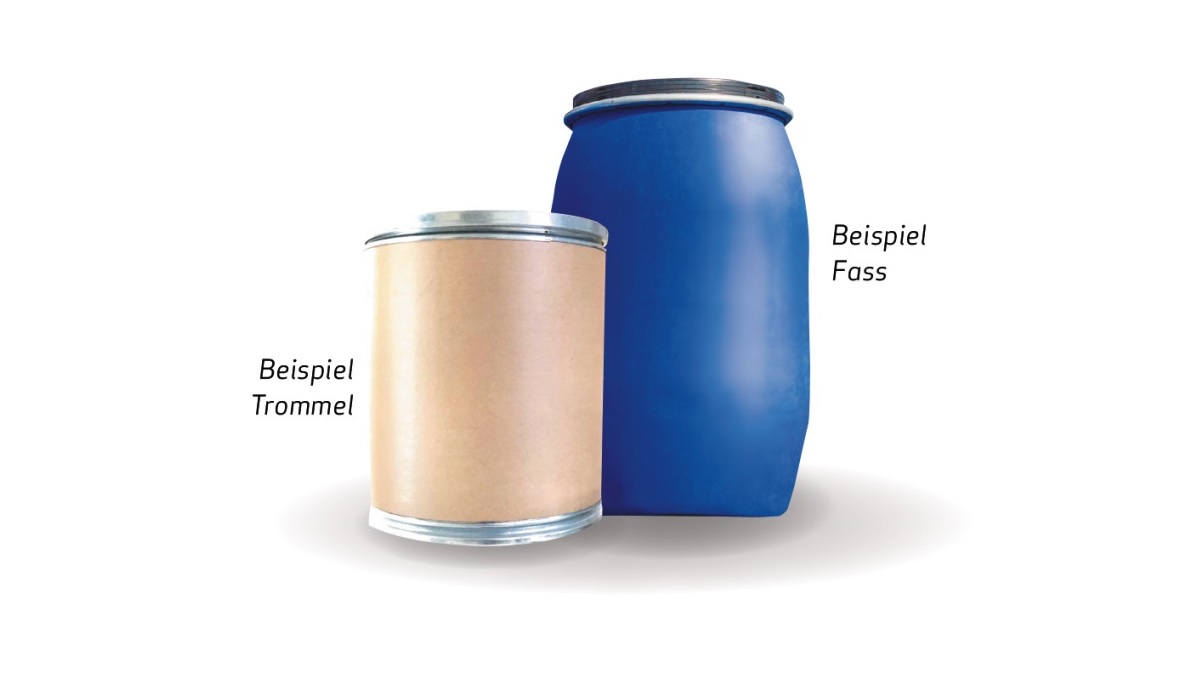
While several terms such as „cask“, „barrel“, „keg“, „tun“, „vat“ or „drum“ can be used for the packaging materials „barrel“ and „drum“, DIN 55405 „Packaging - Terminology - Terms“ contains definitions that differentiate between the two types of packaging.
The barrel
Under no. 10.247, for example Barrel is a „usually bulbous or cylindrical packaging made of metal (steel, aluminium), cardboard, plastic, wood or another suitable packaging material“ with a flat or curved base. Drums are mainly used as transport packaging and should be rollable and stackable. The vertical boundary surface is referred to as Hull or jacket In the case of the so-called stave barrel, this consists of pre-machined barrel boards, the staves. Metal hoops are driven onto the barrel to hold it together.
Metal drums have Reinforcement Longitudinal and/or transverse grooves or tyres made of profiled steel (roll hoop drums). Plastic drums are usually made of PE. Drums for liquids usually have a bunghole and stopper or screw cap. Drums with push-in lids or removable lids and clamping rings are used for pasty and pourable goods.

The likewise standardised term Bung barrel refers to a keg with filling and emptying openings, the base of which is firmly attached to the shell. Small kegs made of tinplate, which are mainly used for drinks and have a capacity of five litres and a tapping device, are referred to as cask cans (No. 10.248).
Transport packaging drum
One Drum (No. 10.873) is also a transport packaging with up to 250 litres capacity. According to DIN, it is a „cylindrical drum made of several layers of long-fibre paper wound on top of each other and glued together. The lid and base are made of solid cardboard, wood, plywood or sheet steel“. The base is usually joined or glued to the shell with a metal band.
If the packaging is used for hazardous goods, there may be deviations from the definitions given in DIN.
The hobbock
To round things off, the Hobbock (No. 10379). This describes a „cylindrical or conical, non-rollable packaging material of a volume up to about 60 litres, with or without foot tyres, with a removable lid or hinged lid as top floor and two side drop handles at the top of the body or a lid handle“.
[infotext icon]In our series "Standardised terms" we take a closer look at some (frequently misused) technical terms in the packaging industry.All articles in the series:
Packaging standardisation - development and application
Standardised terms - Part 1: Bag or pouch?
Standardised terms - Part 2: Carton or box?
Standardised terms - Part 3: Can or tin?
Standardised terms - Part 4: Steige or Stiege?
Standardised terms - Part 5: Crate, box or harass?
Standardised terms - Part 6: Drum or barrel?
Standardised terms - Part 7: What actually is a "tray"?
Standardised terms - Part 8: What is a blister pack?
[/infotext]