Plastic packaging is the focus of pad printing at VID Völker Industrie Drucke. This technology can be used to print on smooth as well as concave or convex surfaces.
23 June 2020
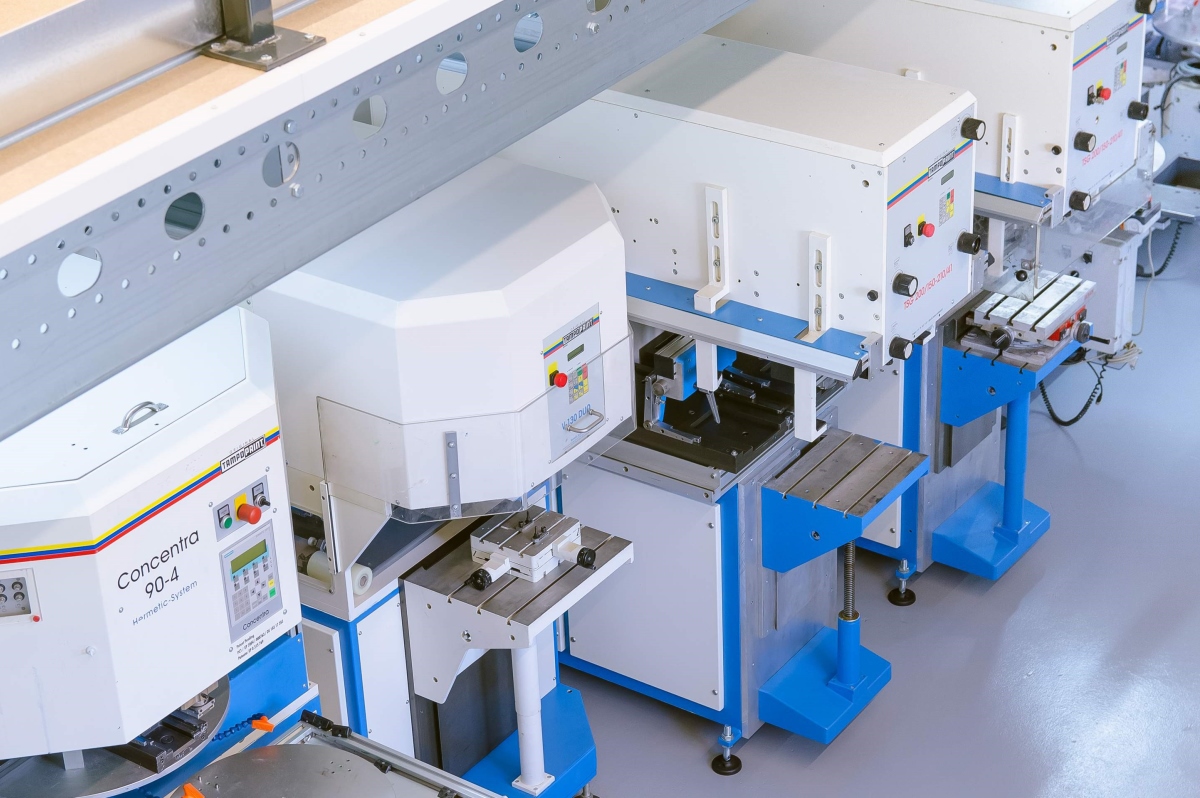
The Tampoprint Concentra 90-4 can print up to four colours with a maximum print image size of 90 millimetres. (Image: VID)
Not only medical devices and parts, but also their plastic packaging are the focus of pad printing at VID Völker Industrie Drucke, Heilbronn. Packaging with a smooth, concave or convex surface can be printed using this very special technology.
The company prints for over 40 years a variety of products made from different materials using pad printing. From small rotary knobs to seat cubes - many unusual customer requests have already been realised. Many years of experience with this printing process enable the family business to adapt innovatively to new developments.
Well equipped
Today, the demands on pad printing are constantly increasing. The Geometry of the parts becomes more complicated and the pressure on plastics must extreme chemical loadswithstand. In order to realise this, the company has increasingly focused on pre- and post-treatment as well as new printing ink systems.
ISO 9001:2010 certification was also introduced in 2014. Pad printing machines with closed ink systems and the latest technology were also purchased. Today, products can be Printed with up to five colours become.
The Pressure on curved, grained, smooth or recessed products is possible in the company. The general print parameters are a print width of up to 350 millimetres, a line thickness from 0.2 millimetres, print image diameters of one to 170 millimetres and a moulded part height of up to 400 millimetres.
The machinery in Heilbronn. The machines can print one to four colours. (Image: VID)
Technical background
Pad printing is a process for Transferring a 2-D image to a 3-D object. As an indirect printing process, the use of an etched plate (cliché) and a pad is required to transfer the image.
In the first step, a matte film is created from a graphic template using the respective print motif which serves as the basis for producing the cliché. This cliché is then mounted on the machine and filled with an ink cup, which also acts as a seal with an integrated doctor blade.
The cliché now moves back and forth under the (squeegee) pot and ensures that only the required colour into the indentation (print motif) of the cliché reaches the substrate. The pad, which is made of elastic silicone, then absorbs the ink from the cliché and transfers it to the substrate.
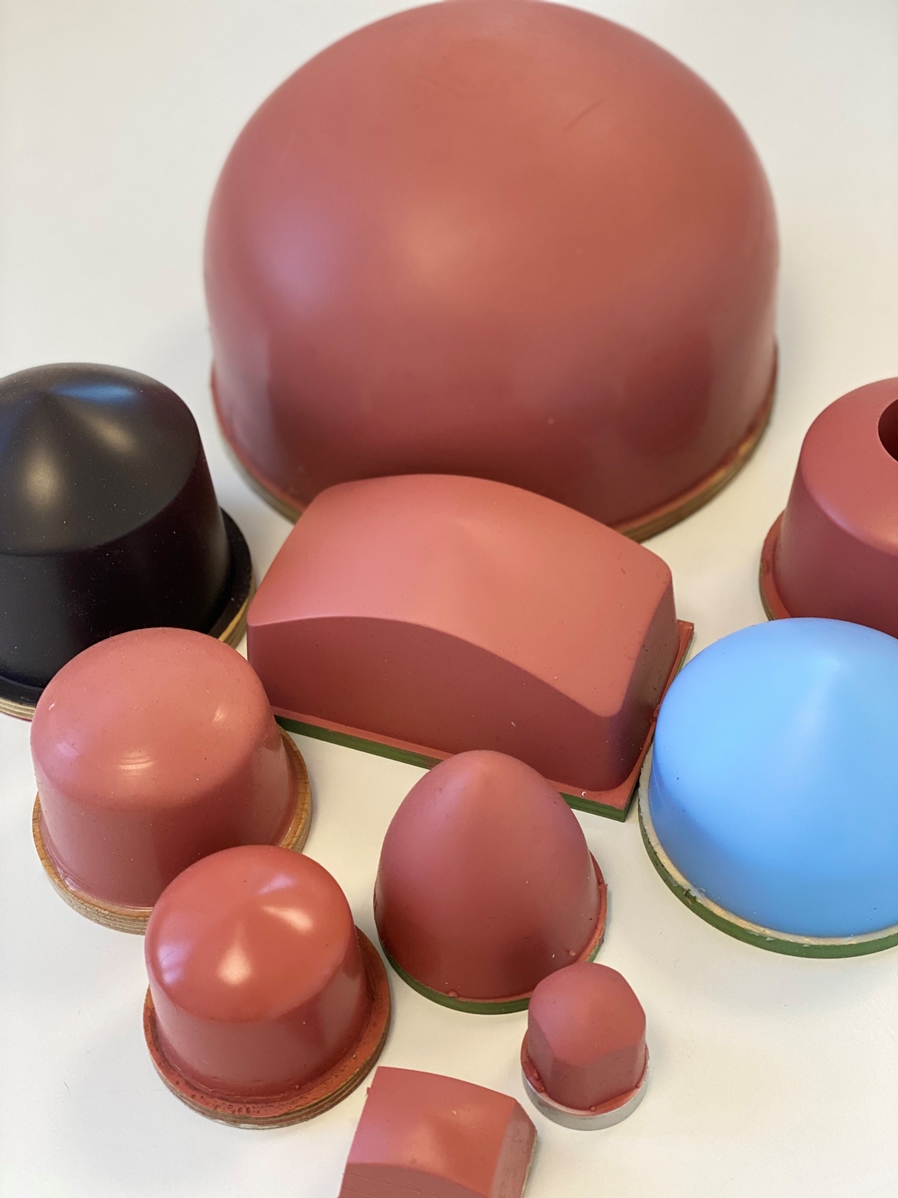
The flexible silicone pads are available in various Shore hardnesses and sizes. This enables optimum adaptation to the respective substrate. (Image: VID)
Thanks to the high flexibility of the silicone, the elastic pad can adapt perfectly to the fabric to be printed. Of course there are also Pre- and post-treatment proceduresn available in order to long-lasting print quality to ensure that.
A large number of different machine types have been developed over the last 40 years - from single-colour desktop machines to robot-guided printing. The printing process is often used for Objects with complicated three-dimensional geometries or irregular shapes and for structured surfaces used.
Objects printed using pad printing can be found in a variety of industries, such as aviation, medicine, automotive, promotional items, household appliances, toys and sporting goods. But also in Packaging area this technology is picking up speed.
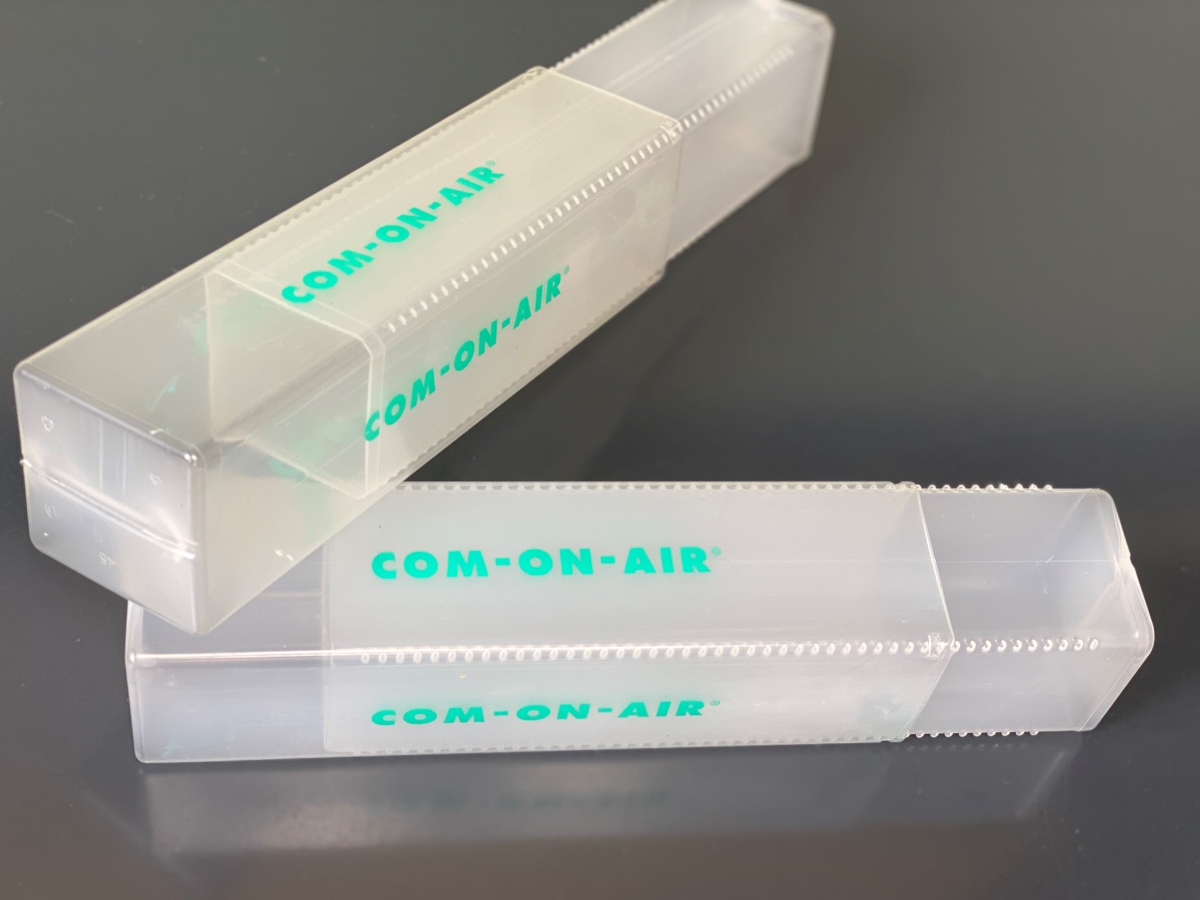
Tube„ packaging, l PP pre-treated with a primer, printed with a Tampoprint Vario 90/10 (Image: VID)
The challenge of plastic packaging
Directives and standards in the field of medicine require expertise in the printing process. With printing inks that are always individually matched to the product in question, impressive results can be achieved even on the most difficult materials, which Resistant to a wide range of chemical stresses are.
But what exactly does this mean for plastics? Due to their composition, many base materials can be printed without pre-treatment, such as ABS, polycarbonate (PC), PMMA or polyester. Plastics such as polyamide (PA), polypropylene (PP), Boltaron, Lexan or polyethylene (PE), on the other hand, must first be made printable through appropriate pre-treatment.
[infotext]
Example of printing in the medical sector
Pre-treatment - Shortly before printing, the surface is cleaned to obtain a grease and lint-free surface.
Printing colour - A selection is made according to the chemical stresses of the product.
Pressure - the object is printed in two print passes on the front and back with a defined distance.
Final inspection - After the printing process, the adhesion and appearance are checked to ensure 1001TP3 quality.
[/infotext]
VID has experience with different packaging variants, These include multiboxes for pipette tips, packaging for polishing sets in the dental sector, cover wax for maxillofacial surgery and packaging for long-term sample archiving, so-called tube rack systems.
Man instead of machine
What has always been in the foreground at VID is the Expertise of employees and production in-house. Thanks to the continuous improvement process with trained personnel, ideas and innovations can be developed together. In addition, the four-eyes principle and visual inspection of every part are applied, which means that the Zero-defect philosophy be pursued with determination.
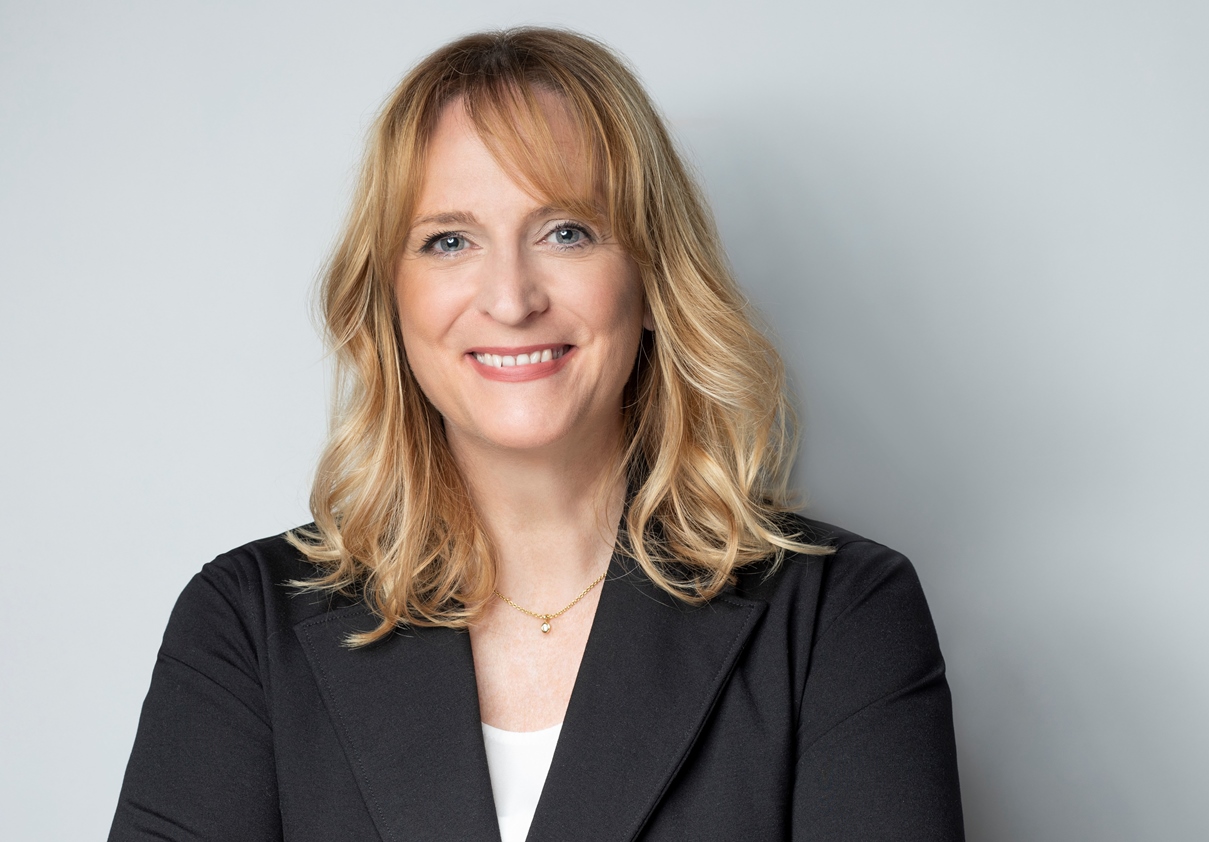
Angela Völker, CEO & Product Management VID Völker Industrie Drucke (Image: VID)
„We have been realising the most diverse customer wishes with commitment and determination for over 40 years. Without exception, the customer, product and innovation are at the centre of our daily work,“ emphasises Angela Völker.
The advantage of a medium-sized company is the Short response time, with which new challenges can be met. Small paths and good agreements as well as the in-house production of the clichés guarantee Quality and agile working methods.
Interview with Angela Völker
After 30 years of steady growth, Angela Völker, the Daughter of the founder Willi Völker, successfully took over the management of the family business ten years ago.
pj: Mrs Volker, how did you actually get into pad printing?
Angela Völker: Even as a small child, I was allowed to watch my father at work and later work with him. I was fascinated by the variety and diversity that this industry brings. We come into contact with countless printed products every day. Whether it's the plane seat on the way to a holiday or the thermos flask we've just filled with tea. Printing technology has therefore already Fascinated from an early age.
pj: And how did it start 40 years ago?
Angela Völker: VID actually started out as a promotional products wholesaler in Oberstenfeld in Baden-Württemberg. Out of the need to find an inexpensive and high-quality printer, VID was born. Willi Völker in 1977 in contact with the developer of the first pad printing machine, Wilfried Philipp. Part of the warehouse was cleared out and the first printing trials with the company's own pad printing machine began: The foundation stone of a family business with tradition was laid.
pj: Who were the first customers?
Angela Völker: My father recognised the great potential of contract printing early on. The product portfolio quickly expanded from the printing of promotional items to the printing of household appliances, and parts for the automotive industry soon followed. The wholesale of promotional items was discontinued and from then on the company focussed exclusively on the printing of promotional items. Printing of industrial parts.
pj: So your father relied entirely on pad printing?
Angela Völker: That is correct. Although pad printing was still in its infancy, he spared neither time nor effort to further develop the Printing on convex and concave parts to push ahead. There was no support as we know it today, and self-taught skills were required.
pj: Willi Völker and his wife Margit Völker made a name for themselves in the industry and, as orders increased, more pad printing machines were purchased. How did and does it continue?
Angela Völker: As the space in the premises became too small, the company moved to new premises in Steinheim an der Murr in 1985. The printing portfolio expanded to include products for the electrical and medical industries.
After production space became scarce there too, the company moved to Ilsfeld in 1992 and expanded its production facility there. Thanks to the improved transport links and the larger storage area, products from aviation companies could also be printed. We have been based in Heilbronn am Neckar since 2010. In the meantime, the focus is also on Printing on plastic packaging in the industrial and medical sectors.