Industry talk: The right strategy for green packaging
packaging journal TV Live. This is our new digital format in which you can not only follow discussions on current industry topics live, but also contribute your opinions and questions. The premiere focussed on the perennial topic of „sustainability“.
17 May 2022
(Image: ella Verlag und Medien GmbH)
packaging journal TV Live. This is our new digital format in which you can not only follow discussions on current industry topics live, but also contribute your opinions and questions. At the premiere in March, we started with a perennial favourite, namely the topic of "sustainability". Industry representatives Carolina Schweig (packaging consultant), Timothy Glaz (Head of Corporate Affairs at Werner & Mertz) and Dominik Bröllochs and Ulrich Burkart (Optima Packaging Group) joined our moderator Jan Malte Andresen for a live discussion.
For a recent study, the German Packaging Institute recently asked consumers whether they perceive that packaging has become more sustainable. 44 per cent of respondents stated: Yes, packaging is more environmentally friendly today. So have retailers and manufacturers done everything right? Do they already have the right sustainability strategy?
"The awareness is there, but it will still take time to implement," says packaging consultant Carolina E. Schweig. "We can see that the Retail chains are driving the issue very strongly and communicate a lot. There is a movement that is being recognised by consumers." Nowadays, no company can afford not to invest in sustainability. However, Carolina Schweig does not believe that "afford" is the right approach. "This is about an economic principle. Companies should realise that they benefit when they invest in sustainability, also in an economic sense." The argument that sustainability only causes additional costs is therefore more evidence of a lack of sustainability strategy. The packaging consultant first recommends a precise process analysis. "Start at the beginning, analyse, try to optimise - then the investment in sustainability very quickly becomes a savings project that is not associated with additional costs."
One German company has been implementing its sustainability strategy more consistently than any other for years. Werner & Mertz was recently honoured for this in the ranking of the 50 most valuable German brands with a Special prize for the holistic and sustainable approach excellent. And rightly so, according to the packaging consultant:
(Image: C.E.Schweig)
"Werner & Mertz's strategy is very coherent - from the appearance of the owner Reinhard Schneider to the printing inks used. People can feel that. But the Schwarz Group is also consistently moving in the direction of sustainability with the reorganisation of the Group and its own waste disposal company. The Rewe Group is now making an intensive start in this area, as are a number of branded companies and hidden champions, who are also beginning to analyse and optimise processes in a strategically sound manner. We realise that it is starting everywhereand we will see many more positive new examples in the next six to nine months." Packaging consultant Carolina E. Schweig
Sustainability pays off
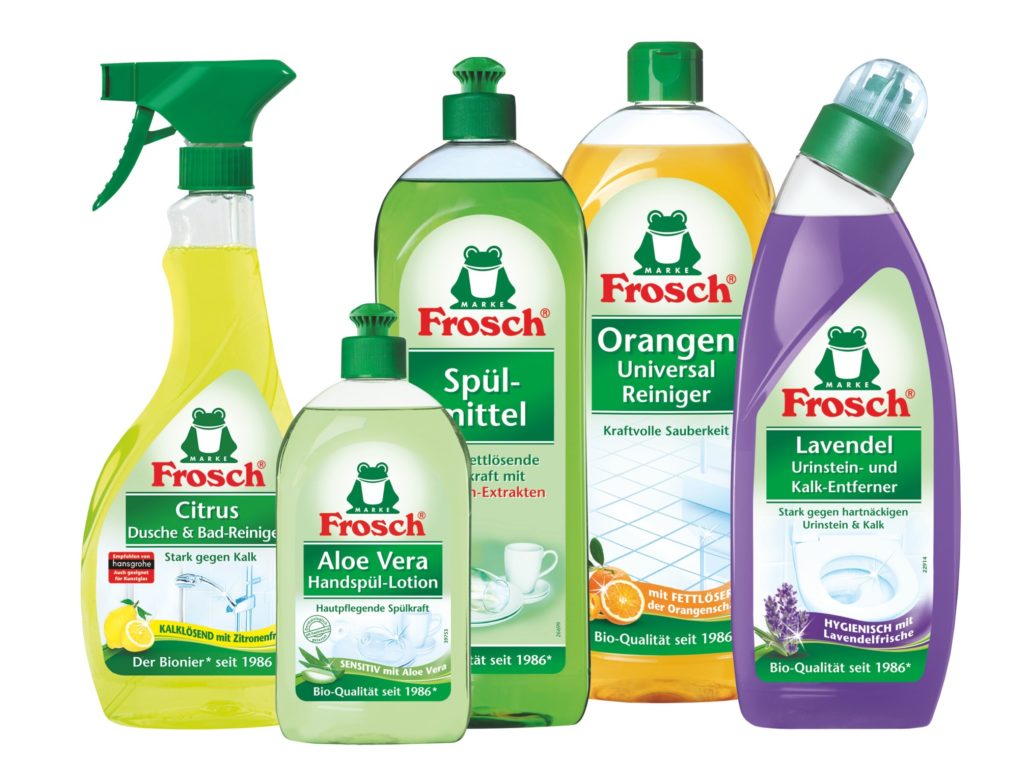
Werner & Mertz's long-term sustainable orientation has paid off. Market share is growing steadily and increased significantly again last year. Timothy Glaz, Head of Corporate Affairs at Werner & Mertz, reports that this was only partly due to corona and the consumer's need to clean more. "We have turned over every stone in the company since 2013, so to speak. Especially in the area of packaging, but also in the recipes of our products, because as a Cradle-to-cradle companies both parts belong together for us. Consumers today want the solutions we offer them, and packaging is an essential part of this. We take a holistic approach to this topic for our entire range."
(Picture: Werner & Mertz)
The Mainz-based manufacturer has already brought around 450 million packs onto the market, which made from 100 per cent post-consumer recyclate (PCR) exist. So far, not a single consumer has complained about the appearance of the packaging. "You can actually see a slight difference compared to conventional PET packaging."
From an entrepreneurial point of view, it was an ambitious endeavour to make the entire company consistently sustainable - and of course it also entailed additional costs. "We pay extra for recyclate because virgin material is dirt cheap given the price of crude oil." The additional costs also relate to recycled plastics from packaging waste from the Yellow Bag.
(Picture: Werner & Mertz)
"We have here a source of 1.5 million tonnes of plastic packagingthat have not yet been produced to a high standard. We absolutely have to get to grips with this. That's why we as an industry need to take a much closer look at these material flows, because incineration is not an option." Timothy Glaz, Head of Corporate Affairs at Werner & Mertz
Werner & Mertz recently launched bottles on the market with a PCR content of 50 per cent from the Yellow Bag. Timothy Glaz: "I must first make it clear that we use 100 per cent recyclate in our PET bottles, but this comes from deposit bottle recycling and not from household collections. Theoretically, however, we could use 100 per cent material from the Yellow Bag. It will only be difficult with the colour, because our coloured liquids no longer look as attractive in such recycled bottles. But that's also a question of marketing. That's why the 50 per cent is currently the upper limit for the quality we need for the desired transparency.
Another aspect is the cost. In most companies, the use of recyclate is rejected at the latest when it comes to the additional costs. Yet the Packaging is not the price driver. We're talking about really small sums here."
We can only do it together
Sustainability is a topic for the future where the course is being set today and overarching strategies are required, according to the experts at the Optima Packaging Group. The filling and packaging machine manufacturer also takes a holistic approach to its business and supports its customers from the product idea through to successful production and throughout the entire machine life cycle.
(Image: Optima Packaging Group)
"We see the topic of packaging in direct connection with the machine, as completely new packaging solutions can also be developed using appropriate technologies. Networks are becoming more and more important, because nobody can tackle the major issue of sustainability alone. Today, you need partners and allies to create new solutions together with the technology and the material." Dominik Bröllochs, Group Sustainability Manager, Optima Packaging Group
Ideally, suppliers of recycling technologies should also be at the table for sustainability projects. Optima recently entered into a strategic partnership with Voith, the leading supplier of paper machines and recycling systems for paper. The aim of the partnership is to develop sustainable paper packaging solutions. How and whether the newly designed packaging can be recycled in the paper stream will be assessed from the outset. Optima is already working on the development of packaging and has already presented its first sustainable packaging solutions.
(Image: Optima Packaging Group)
"Sustainability is one of the major challenges and must become an exciting business area in the future that will simply be part of a company's survival. This requires change: Traditional mechanical engineering no longer works the way it used to. In future, we will have to work together much earlier - from the packaging material to the machine and its entire life cycle. This also includes machine recycling. It must become a closed cycle. This is exactly what our customers are now demanding of us. That's why we have already built up a good network and have already been able to significantly shorten project times, minimise risks and improve results because all the experts were sitting at the same table at an early stage." Ulrich BurkartGroup Sustainability Manager, Optima Packaging Group
Getting the circular economy right
For companies, the sustainability strategy also includes making processes and materials recyclable. According to the experts, it is crucial to look at what is already available in the cycles, utilise it as often as possible and recycle it to the highest possible quality. Carolina Schweig: "We try to communicate this to our customers, that the raw materials they use are their material, which they should get back if possible. This would create a completely different interest in influencing the flow of recyclable materials. In the 1980s, large companies such as Unilever had their own packaging plants because it wasn't just about the product, but also about the packaging material. They took responsibility for this, also in terms of product liability. This changed in the 2000s and responsibility was transferred to the Green Dot, for example. But this is not the way to achieve a good flow of recyclable materials. We need to rethink that these materials have a value. Over the decades, beverage producers have always seen their crate material as their investment and reused the material as often as possible, i.e. new crates were produced from old ones. We need this kind of loop thinking much more today. Responsibility is also part of sustainability."
Facilitate recycling with monomaterial
According to Dominik Bröllochs, we will be packaging more in future, not less. We therefore need optimised packaging that is easier to recycle. One possibility is the Use of monomaterials for packaging. Using nappy packaging as an example, Bröllochs presented a solution that does justice to both marketing and ecology. Here, a paper sleeve is inserted into transparent PE mono-material bags with the nappies in a fully automated process. Only the paper is printed. When the consumer disposes of the nappies, the film and paper separate almost automatically, and even if the consumer does not separate the packaging, it can be separated using existing sorting technologies due to the lack of material bonding.
It also became clear that plastics today achieve a quality that is in no way inferior to the original material through pure recycling. "We are of the opinion that there is no single packaging material that is particularly ecological," says Bröllochs. "It is, for example It does not make sense to switch everything to paper. Nevertheless, there are many more sustainable packaging options thanks to the use of paper."
(Image: C.E.Schweig)
Sustainable approaches exist worldwide
Europe likes to see itself as a pioneer when it comes to sustainability, the circular economy and recycling. But there are various strategies around the world. "We can see that even China is now starting to invest heavily in sustainability," says Carolina Schweig. There are also a number of approaches in Australia, New Zealand and the USA. "It's just not present here, and we see this as more ideal for Europe than it is. Many countries have their own priorities, and the understanding of sustainability varies greatly around the world.
Green packaging instead of greenwashing
Sustainability is also an overused term these days, as hardly any company does not claim to be sustainable. It is therefore not surprising that greenwashing has also become a major issue that is increasingly confusing consumers. Companies should therefore protect themselves if they call their packaging sustainable. "There is a clear legal situation and also a draft from the EU: Greenwashing is anything that a company cannot prove. Anyone who says they are sustainable must also prove exactly what they are sustainable in. Companies that advertise sustainability would do well to provide clear evidence of this," says Carolina Schweig.
Finding the right sustainability strategy is therefore not easy. The packaging consultant recommends that companies develop their own strategy. "There's no point in adopting a competitor's sustainability strategy. It is important to look at what you can do, what can be implemented within the company and what you are seen for. All implemented measures should be measurable so that they can be used for the award and it becomes clear whether the desired goals have been achieved at all. Then you are well on the way to the right sustainability strategy.