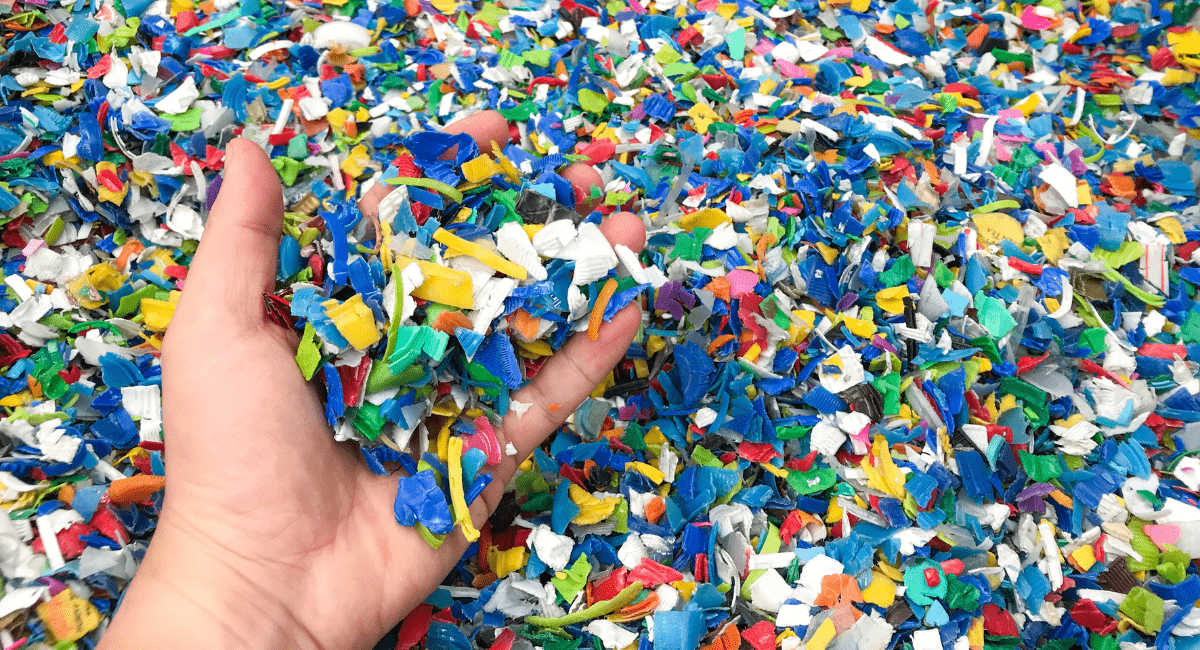
With a new process, Engel can process plastic waste directly after grinding as flakes in injection moulding. This completely eliminates the granulation process step.
The innovation increases the Cost efficiency in plastics recycling, according to the Austrian company. On its live e-symposium 2021 from 22 to 24 June, Engel will be presenting the new two-stage process to trade visitors for the first time and demonstrating its potential. The new process also offers advantages for the production of very large and thick-walled components with high shot weights.
Plastic flakes from post-consumer collections
The key to shortening the recycling process is the division of plasticising and injection into two independent, well-coordinated process steps. In the first stage, the raw material, for example plastic flakes, is plasticised and from post-consumer collections are melted in a conventional plasticising screw. The melt is transferred to a second screw to be injected into the cavity in the second process stage.

The two-stage process makes it possible to integrate a melt filter and a degassing unit on the injection side of the injection moulding machine, so that also from contaminated plastic flakes products with a consistently high quality.
With this innovation Angels make a further contribution to the development of a circular economy for plastics. Granulating the recycled regrind is an energy-intensive process that also generally requires logistical effort. If this step can be dispensed with the CO2-Balance sheet improved, and recycling costs are also significantly reduced.
More efficiency even for very large components
As an alternative to an injection screw, the plasticising screw used for melting can be combined with a piston unit. In this variation, the two-stage process is also suitable for the Processing of very heavy shot weights up to 160 kg with a comparatively low injection pressure requirement. The two-stage process enables a more compact system design and lower unit costs than is possible with a conventional single-stage plasticising and injection process.
Engel has developed a new plunger design to eliminate the usual disadvantages of plunger injection units when changing materials. The rheologically optimised plunger tip supports uniform flushing around the plunger and thus enables a quick material and colour change.
Typical applications are Containers, pallets or even large fittings. Processing efficiency increases significantly from a shot weight of 20 kg due to the splitting of the plasticising and injection process.
[infotext icon]Engel is one of the leading companies in plastics machinery manufacturing. Today, the group of companies offers all technology modules for plastics processing from a single source: injection moulding machines for thermoplastics and elastomers and automation, whereby individual components are also competitive and successful on the market in their own right. The Group has nine production plants in Europe, North America and Asia (China, Korea) as well as subsidiaries and representatives in over 85 countries. [/infotext]
SourceAngel