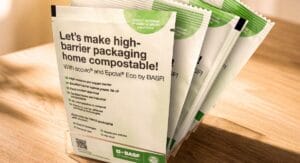
There is no getting around the issue of sustainability, whether as a consumer or a producer. The packaging industry is also concerned about the sensible use of raw materials. But where do you start? Carolina E. Schweig, a graduate engineer and packaging consultant, knows. For our focus section, she has analysed the topics of sustainability and green packaging.
If you search the internet with the keyword „green packaging“, you will find a list of results. On closer inspection, most of the mentions turn out to have dubious ecological benefits. With terms such as „compostable“ or „plastic-free“, companies and brands want to give the impression that they are actively addressing the environmental impact of their packaging. Regardless of whether the products are actually „plastic-free“ or compostable and whether these claims are in any way effective. This approach stems from a profound lack of understanding of sustainability, namely that of an outwardly „green veneer“. However, if sustainability is understood in its original sense, it offers future viability through economic efficiency!
In view of the current tensions on the commodity and energy markets and the associated shortages and price rises, it is time, Discovering sustainability in its true form and applying it to your own company.


Sustainability is the approach to maintaining our supply of raw materials and energy in the coming years. Let's remind ourselves briefly: The concept of sustainability, which originated in forestry, aimed to utilise only as many trees as would not endanger the function and existence of the forest itself. Applied to today's world, it is therefore about the responsible handling of raw materials and therefore also packaging materials and their reuse. This includes sorting and processing technology that is geared towards the high-quality reuse of the raw materials obtained. However, this also includes looking at the extraction of raw materials and the yield or loss of raw materials and energy across the entire value chain.
Yes, the term „sustainability“ has arrived in the centre of society. „Consumers“ generally expect products and companies to be „sustainable“: according to the latest figures from GfK (Growth from Knowledge), more than two thirds (68 per cent) of Germans demand that companies behave as environmentally consciously as possible, for example by using environmentally friendly materials. This supposedly clear market pressure is often followed without reflection and without a fundamental strategyGood recyclable plastic packaging is replaced by virgin fibre-based „paper“ packaging or advertising claims from market competitors are copied from „100 % recyclate“ or „100 % recyclable“. But:
Economic sustainability works differently
The basis is a customised sustainability strategy that is geared towards the company's own brand, the expectations of its own customers or target group and its stakeholders. Even large international companies have already caused a shitstorm with isolated, supposed sustainability campaigns, even though they had invested a lot of money and enthusiasm in them. First comes the strategy, from which actions, packaging and packaging materials are ultimately derived.

Work on the strategy begins with the so-called materiality matrix. The focus here is on the specific company situation (local, national, occupational safety, gender issues...) on the one hand, and the expectations of stakeholders with regard to sustainability on the other. No generalisations, please! Well-intentioned but completely exaggerated sustainability ideas fuel mistrust, a bad currency in the area of sustainability. Companies that have previously been perceived as rather „problematic“ due to their products should avoid appearing as world saviours at all costs. This is not very credible for customers, market competitors and NGOs and is more likely to lead to rejection.
Economic sustainability is based on measurable and assessable data
The sustainability goals for companies are then broken down for the brands from the materiality matrix. Certain objectives may be weighted differently for different brands, sales structures and target groups.
As we all know from our personal annual appraisals, goals must be achievable and measurable within a defined period of time. This also applies to sustainability goals. In order to achieve the targets set, „measures“ are defined, sometimes referred to as criteria or sustainability KPIs. To make these measurable, they need a unit. Climate targets can be linked to the CO2-equivalences, e.g. in the unit [g CO2/unit]. Resource use or savings are often measured in [g/unit] or over a year in [tonnes]. Ideas for suitable measurements and units are provided by GRI (Global Reporting Initiative) or the SDGs (Sustainable Development Goals). However, since the ecological criteria alone are very contradictory - Paper uses a lot of water, but has a lower carbon footprint, while plastics have the opposite effect. weightings must be defined.
Coherence is important when translating the defined sustainability goals into concrete evaluation matrices. There is always a preliminary stage that has to be taken into account. Where does a raw material come from, how high is the risk, for example, that the pulp used was produced using child labour or through „black deforestation“?
Economic sustainability regularly reviews compatibility with the defined targets
At a number of companies, the sustainability criteria are queried in the gates of the IT-supported Ideation Innovation Funnels and thus included in the systematised evaluation. The same applies here as for other product attributes: If the sustainability offered does not meet the specified requirements and therefore does not contribute to the sustainability strategy, this must be recognised as early as possible so that adjustments can be made. Or the approach must be discarded. Incidentally, the review of sustainability criteria also applies to the achievement of objectives. If, for example, the plastic littering of oceans and land is to be prevented, it must be checked whether the proposed „bioplastics“ actually fulfil these objectives and do not possibly exacerbate the problem.
It is important to deal realistically with the relevant certificates, standards and realities. For example, the well-intentioned use of rPET in thermoforming trays and trays leads to a transfer of a raw material from a closed (disposable PET bottles) to an „open“ material flow (fruit, vegetable and meat trays made of PET/rPET).

Closed material flows are the order of the day! Such „diversions“ of raw materials are partly responsible for the considerable price increases in the secondary raw materials market and are therefore also detrimental to profitability in the long term. These well-intentioned ideas without systematic review and measurement are increasingly becoming a problem, and not just financially. This is because there are already ideas in the European Union as to what can be legally cautioned as greenwashing: anything that cannot be proven! Meaning: In terms of brand value, it is also important to be able to substantiate the sustainability claims made in advertising with facts and figures.
Back to the beginning: economic sustainability helps to achieve goals that support the company and the brand. It helps precisely to fulfil customer needs and then to receive the appropriate remuneration for this, and it protects against misleading statements and the danger of appearing as a greenwasher. Economic sustainability sets the course for the future viability of a company!
More news on the topic of green packaging and sustainability


Sturdy bags with recycled polythene

Metsä Board plans Packaging Design Studio in Milan
European Court of Auditors: Strengthening recycling markets in the EU

IFCO returnable crates in the fresh food area at Norma