Create tactile labels with screen printing

A comparatively inexpensive way to create raised, legible or decorative elements is to produce tactile labels using the screen printing process. If all technical specifications and empirical values are taken into account in their design and manufacture, these labels can be used functionally and can add tangible and visible value to any product.

A comparatively inexpensive way to create raised, legible or decorative elements is to produce tactile labels using the screen printing process. If all technical specifications and empirical values are taken into account in their design and manufacture, these labels can be used functionally and can add tangible and visible value to any product.

There are an estimated 1.1 billion people with visual impairments worldwide. Of these, around 43 million are blind. Labels with tactile elements enable them to perceive texts in Braille and raised symbols. However, tactile elements can not only be used to convey important content, but also to increase user attention.

Wide range of applications

Tactile elements are needed in many areas. Braille and warning symbols are particularly familiar from the pharmaceutical industry, where they are used to label nasal sprays, eye drops and medication for visually impaired people. However, tactile warning triangles can also be found on cleaning agents, fertilisers and many other products in the chemical industry. In logistics, they are used for labelling hazardous goods, and in plant engineering, Braille can be found on guidance systems, intercoms or lifts and in vending machine construction. The tactile information is also helpful and sometimes indispensable for labelling on buses, trains and ships.

"Tactile labels protect, inform and decorate."
Christos Emmanuil
Head of quality management at robos-labels

Haptic elements can also have a decorative function to enhance products and are produced according to the same principle as warning and Braille labels. As a uniform tactile grid of dots, tactile elements can not only look stylish, but also provide more grip, such as on the battery labelling of a well-known power tool manufacturer.

Display

Warning signs are mandatory

Products that are labelled as very toxic, toxic, corrosive, harmful, highly flammable or highly flammable in accordance with Directive 1999/45/EC must also be marked with a tactile warning sign in accordance with ISO 11683. The tactile elements can either be printed directly onto the outer packaging or they can be printed onto a self-adhesive, transparent label that is subsequently applied to the finished product. They are highly resistant to contact with chemicals and solvents, exhibit high abrasion resistance and adhere reliably even to problematic substrates, which may be oily, greasy, rough, low-energy, pre-treated or siliconised.

One detail in particular is important for visually impaired people: the sufficient height of the structures. The symbol size must also comply with legal requirements and the label must be placed in the correct position on the product. For example, no other embossed signs that could cause confusion should be placed in the immediate vicinity of a warning triangle. The labelling with the warning must not peel off and should be applied without air inclusions so that these additional protrusions are not irritating.

Tactile elements in screen printing

Screen printing is the only technology that enables a very high, raised colour application, which is why there is no sensible alternative for such tactile elements. The company robos-labels has been working with this printing process since the 1960s: You could say that in certain respects it even stands as their origin. The challenges that raised elements pose to the processor are therefore very well mastered here thanks to many years of experience. It is important to use the right screen structure with the right mesh sizes and thread thicknesses, combined with a UV-drying relief varnish, and to set the machine parameters precisely.

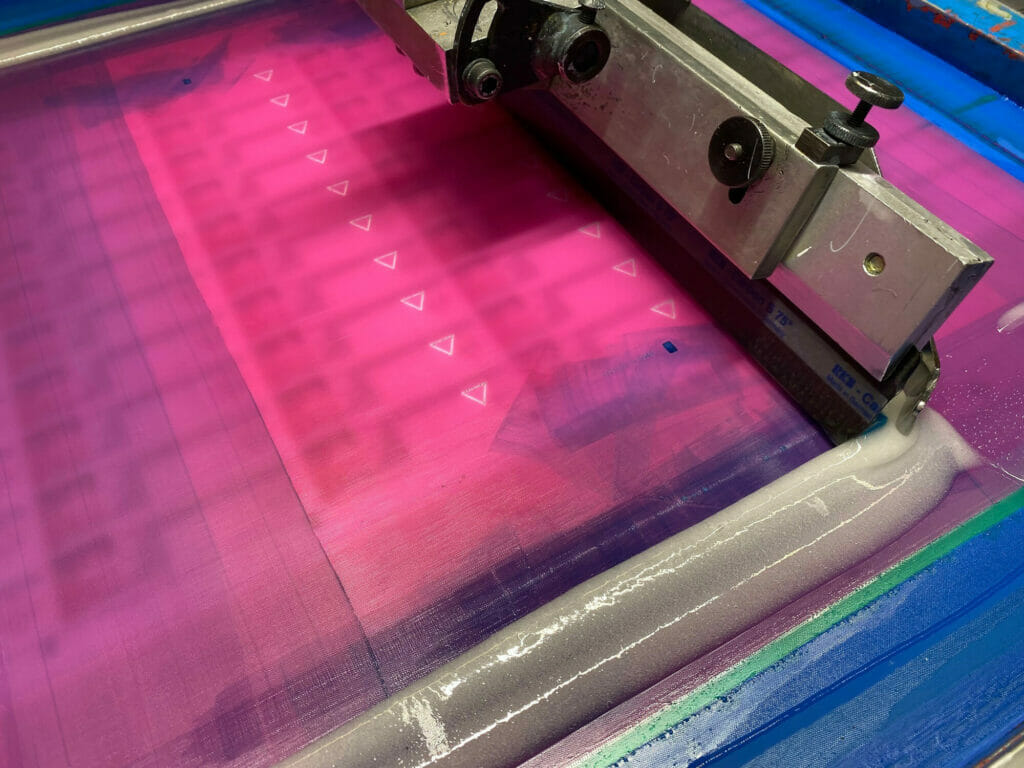
Tactile warning triangles are printed on labels using screen printing with relief varnish: the print motifs here are small warning triangles. (Image: robos-labels)

The raised design elements are produced by screen printing using a relief varnish suitable for this technology. This is a high-build and therefore tactile UV contour varnish layer, which can be matt or glossy if it is to be used as an optical finish. As an alternative to blind embossing, relief varnishing offers the advantage that the reverse side of the substrate is not deformed and therefore remains free for the design. Relief varnishes are only suitable for one-sided coatings.

A coarse screen mesh is used for printing. A rubber squeegee moves over the screen with firm pressure and presses the viscous relief varnish through the permeable white areas. The entire height of the perceptible pressure must be produced in one print pass, as it is not possible to produce another print pass with a precise fit. The varnish would run off the side of the first printed element. Drying and curing take place under UV light. The labels are wound onto the roll and also stuck onto products or other labels at the customer's premises.

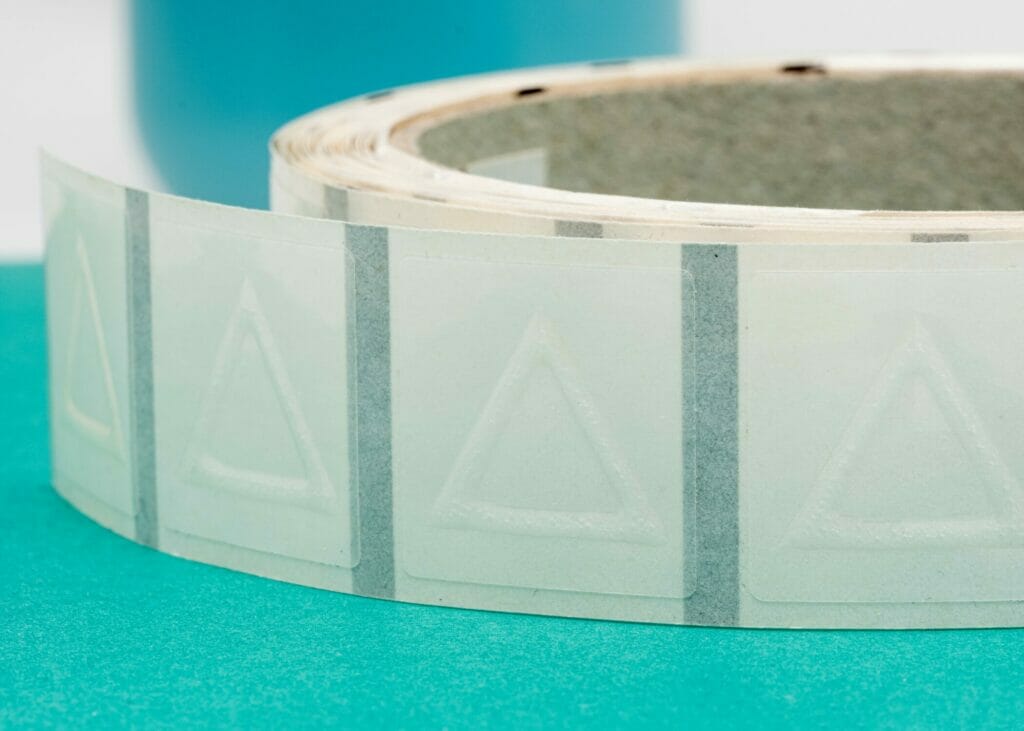
Labels with tactile warning triangles were printed with relief varnish on a transparent labelling material. (Image: robos-labels)

Christos Emmanuil is Head of Quality Management at robos-labels and is very familiar with the requirements for the production of Braille labels and labelling with tactile elements. „Particularly in the complex production of tactile labels, it is important to work very precisely and cleanly„, he emphasises.

Possibilities and limits of relief varnish

The labels are higher than normal labels due to the thick coating. Therefore, the knife contours on the die-cutting plates or die-cutting cylinders must be significantly raised and a larger gap dimension is required on the tool. The labels are made of PET, polycarbonate (PC), PE or PVC film, although the latter three plastics cannot be processed with a laser cutter, as PC yellows at the punching contour, PE melts and PVC would release toxic vapours due to the high temperatures. However, tactile labels can also be punched out of paper with the laser punch.

Due to the screen structure to be selected, elements that are too fine cannot be displayed. It goes without saying that texts cannot appear negative. A homogeneous surface is not guaranteed, even on larger surfaces. On a white substrate, the relief varnish layer may have a yellow-greyish colour. The varnish motif must be applied outside of cutting, creasing and punching lines. Due to the relief structure, care must be taken to ensure that the labels are not crushed during roll processing.

http://www.robos-labels.com

More news on the topic of labelling and marking