The packaging world is undergoing profound change. Regulatory requirements are increasing, supply chains need to become more resilient, and consumers are paying more attention than ever to how sustainably, intuitively, and safely packaging functions. How are three megatrends shaping the industry, and why is smart design decisive for success today?
Brands are also faced with the question of how to meet all these current demands without jeopardising profitability or compromising on quality and convenience. What was previously considered an additional ecological option is now a fundamental requirement for market survival.
Three trends are currently setting the direction particularly clearly. They influence strategic decisions, investments, and product developments in almost every packaging-intensive market. And they impressively show that innovation doesn't have to be louder, but smarter.

Trend one: Supply chain optimisation
Efforts to optimise the supply chain are not new. However, the current challenges in global supply chains lend the topic a completely new urgency: its optimisation is considered a lever for efficiency and sustainability. Unforeseeable disruptions, rising transport costs, fluctuating energy prices, and new requirements for climate reporting are forcing companies to question every stage of the value chain. Packaging is often viewed as a secondary concern, but it can be a central lever.
The efficiency of a supply chain depends directly on how well products can be stacked, stored, transported, and presented. Optimised geometries reduce transport volumes, simplify trade logistics, improve the utilisation of refrigerated space, and conserve storage and transport capacities. This trend affects not only manufacturers and retailers, but also households. What is efficient in logistics is usually also efficient in the refrigerator or pantry.
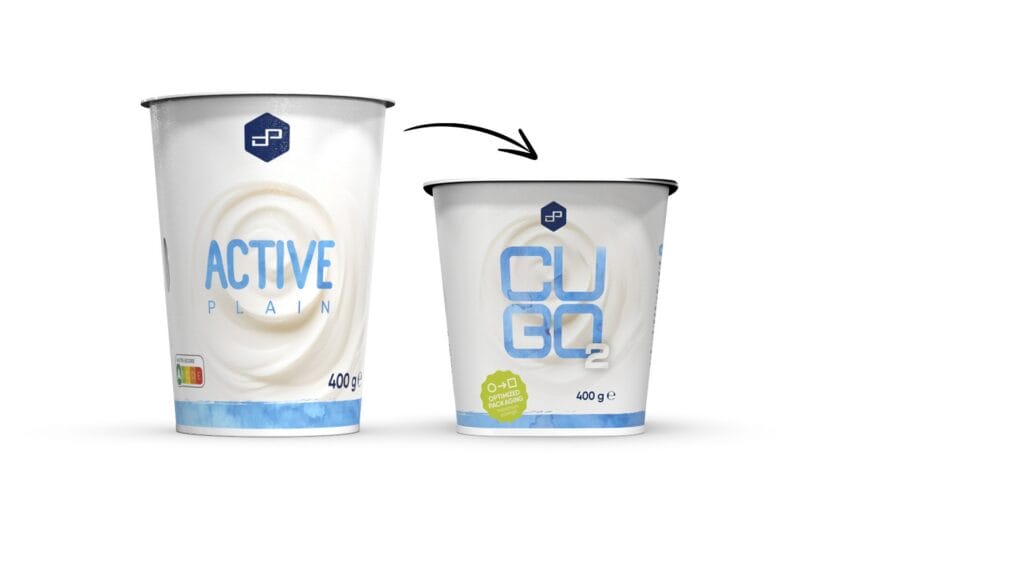
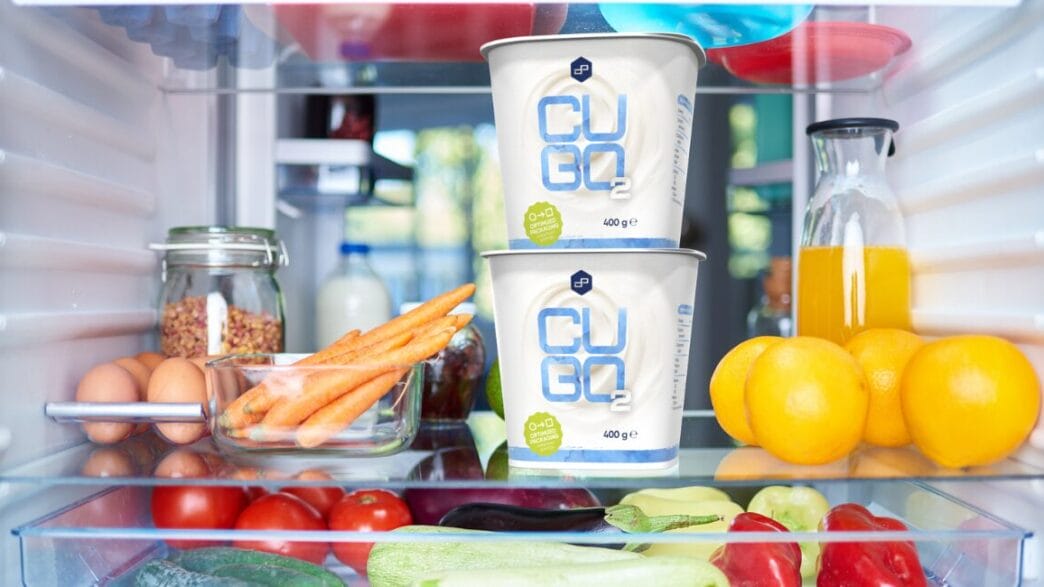
One example of how this trend is being implemented in practice comes from Greiner Packaging. With CUBO, the company has developed a cup solution that demonstrates how much the shape of a packaging can optimise supply chain processes. Instead of the traditional round format, CUBO uses a square geometry, the advantages of which are immediately apparent. Because the empty spaces between the cups can be filled better, up to 35 percent more units fit onto each pallet. This means fewer transport journeys, lower costs, and significant CO2 savings. Retailers also benefit noticeably. Pallets can be stacked better, shelf space is used more efficiently, and handling in the warehouse becomes easier.
Round cups have a small but crucial disadvantage: they tend to spin. As a result, the branding disappears from the customer's view. The CUBO puts a stop to this, always showing itself from its best side. In the home, square cups are easier to organise in refrigerators or pantries. The advantages are thus evident at every stage of the value chain.
Trend Two: Mono-material Solutions
Hardly any trend is currently influencing packaging development as strongly as the focus on mono-materials. Experts see them as the key to a circular economy.
The backdrop to this is the sharp increase in requirements for the recyclability of packaging. Packaging made entirely from a single material is easier to identify in sorting facilities, process efficiently, and recycle. This improves the quality of recyclates and makes it easier for brands to comply with specifications and reduce EPR costs. For manufacturers, this means a better environmental footprint and more planning security regarding regulatory requirements.
Consumers are also looking more closely at packaging. More than half prefer simple packaging formats that signal environmental responsibility, and 57 percent, according to the Global Consumer Survey from GlobalData in Q3 2024, prefer plain, simple packaging solutions. Packaging must therefore clearly show how it can be returned to the recycling loop.
Regulatory developments are further driving the trend. European requirements demand packaging that can be processed in existing recycling infrastructures. Designs with clearly defined material types significantly facilitate this and are considered a practical way to combine recyclability and economic feasibility.
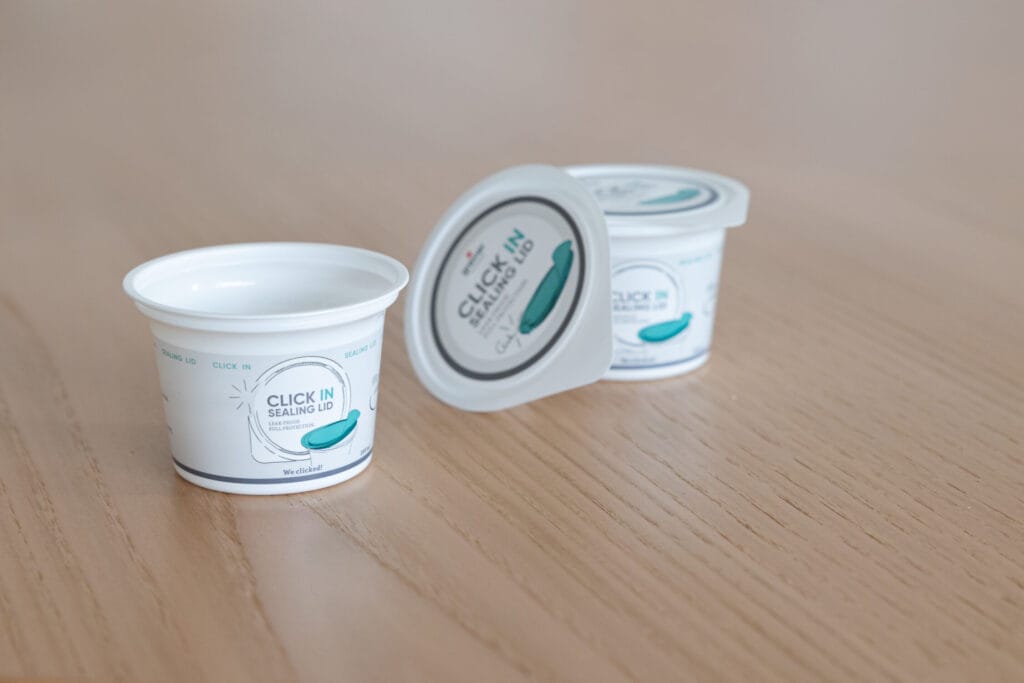
How this approach can be concretely translated into industrial packaging solutions is demonstrated by Greiner Packaging's Click-In sealing lid. It replaces the classic three-component system of cup, aluminium sealing foil and lid with a two-component system consisting only of the cup and lid. Both components can be made from the same material, which significantly simplifies the material structure. The result is significantly improved recyclability. In addition, this leads to less material usage and lower energy consumption during production and transport.
For brands, this means clearer material flows and more efficient processes. For consumers, it results in an intuitive, securely resealable packaging that loses none of its functionality. For the circular economy, in turn, the click-in seal lid offers a single-material input with clear advantages in recycling.
Trend three: CO2 reduction
CO₂ reduction is no longer just an environmental goal, but a central driver for strategic decisions in the packaging industry. Companies are under pressure to design their packaging in a way that requires less energy, less material, and less transport volume, without compromising on product protection or functionality. Intelligent designs and optimised geometries contribute directly to lowering emissions across the entire value chain, while simultaneously improving costs and operational efficiency.
The development of CUBO demonstrates how the packaging design itself contributes to CO₂ reduction. Its square cup shape allows for significantly denser pallet stacking compared to round cups. Up to 35 percent more units can fit on a pallet, which, for an annual production of 25 million cups, can save 160 lorry journeys. Fewer transportations mean less fuel consumption and significantly lower emissions throughout the entire supply chain. More efficient storage in cold chains also reduces energy use, further improving the CO₂ balance.
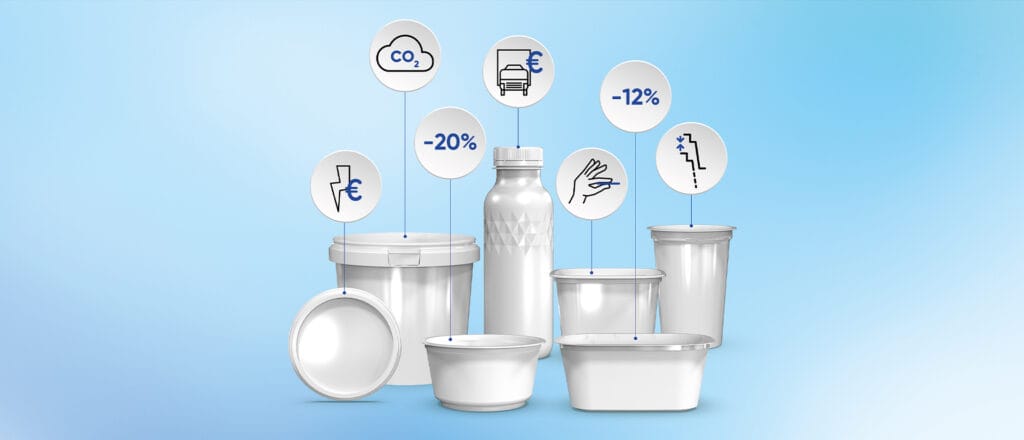
The Greiner Packaging Click-In seal lid complements this effect on the material side. Thanks to its mono-material construction, it replaces the previous three-component system, which ultimately reduces material consumption and the energy required for production and transport. The packaging can be recycled more easily, indirectly saving further emissions. The measurable CO₂ savings extend across the entire value chain, from manufacturing, transport, and storage to recycling. Thus, all factors work together.
Innovative packaging solutions of today
The trends described are already a reality in the market and are shaping the purchasing decisions of brands, retailers, and consumers alike. Companies require reliable, scalable solutions that combine ecological responsibility, logistical efficiency, and economic stability.
This is precisely where Greiner Packaging demonstrates its understanding of innovation: as an interplay of well-thought-out design, functional strength, and genuine sustainability. Both the CUBO and the Click-In sealable lid prove how a seemingly small detail in packaging design can have a significant impact. Reduced material usage, improved logistics performance, high user convenience, optimised recyclability, and lower CO2 footprints make both solutions pioneering examples of modern packaging development.
The industry is at a pivotal point. Packaging must become more sustainable, but also more efficient, stable, intuitive, and commercially effective. Those who invest today in solutions that combine mono-materials, supply chain optimisation, and CO2 reduction are positioning themselves successfully for future market and regulatory requirements. The technologies are available. The solutions are market-ready. And the trends clearly show: now is the right time to rethink packaging.