Sensitive automotive components place high demands on packaging technology, as every surface must remain flawless and component geometries allow for little error. Antalis has now developed an innovative solution that eliminates the need for foam and relies on fibre-based materials. This solution protects the components just as reliably as established plastic cushioning, but is more resource-efficient and simplifies the packing process on the line.
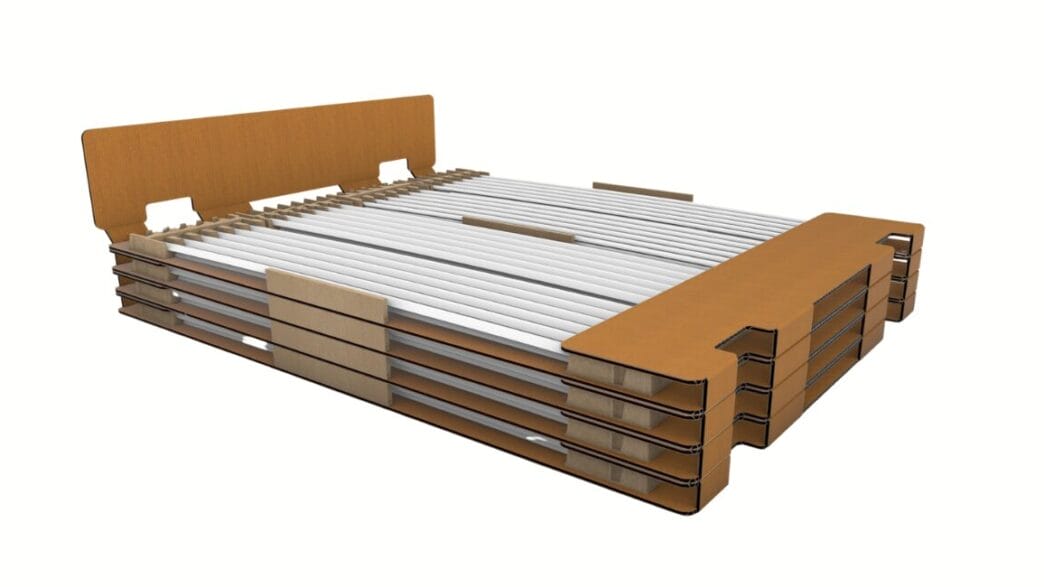
For an automotive manufacturer, Antalis's Packaging Design Centre sought a way to securely pack highly scratch-prone trim strips for overseas shipping without using foam. At the heart of the development is a system of four precisely engineered moulded pulp pads, which take up the contours of the trim strips with millimetre accuracy. Two mirror-image variants enable the secure positioning of both left and right-hand parts. The pads are fixed onto an intermediate layer of BC flute corrugated board, creating a stable composite that guides the parts with precise contour fit and guarantees a defined protective environment. Side flaps integrated into the corrugated intermediate layer offer additional space above the trim strips.
Precision through digital and physical prototypes
The design of the folding technique and the fit of the pads were optimised through the use of 3D-printed prototypes. This method allowed the shape to be checked realistically within two weeks and ensured the protective effect. „This process was crucial for the overall concept, as any deviation in geometry would have had an immediate impact on the protective effect,“ explains Heike Rauh, packaging engineer at Antalis Verpackungen.

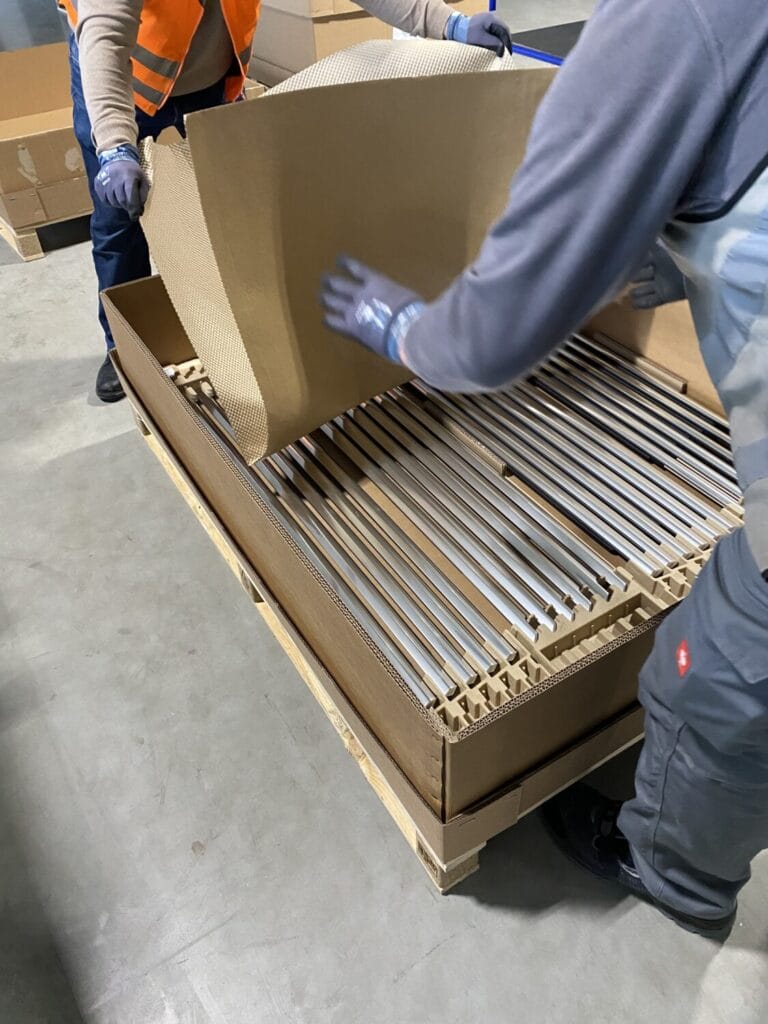
The system proved itself in practice not only through its functionality but also by simplifying the packing process. The defined positioning of the pads makes handling easier, and the design allows for simpler and faster assembly. The required packing density of six components per layer and four layers per container is maintained, demonstrating that fibre moulded solutions do not entail any loss of space or additional handling effort.
Environmental compatibility as an integral component
The new concept also impresses in terms of resource conservation. The complete replacement of the foam solution with fibre-based material, corrugated board and confectionery paper creates a material-homogeneous packaging that can be fed into paper recycling. This environmentally friendly solution offers both ecological and practical advantages and meets the mechanical stability requirements in an industrial environment.
The project's results show that fibre-based packaging solutions can unfold significant potential with complex component geometries. They improve product protection and meet key environmental requirements. „For us, this project clearly demonstrates that fibre-based solutions can play a central role in automotive packaging design in the future – and not just there,“ says Kai Hofmann, Head of the Packaging Design Centre at Antalis Packaging.
Source: Antalis packaging