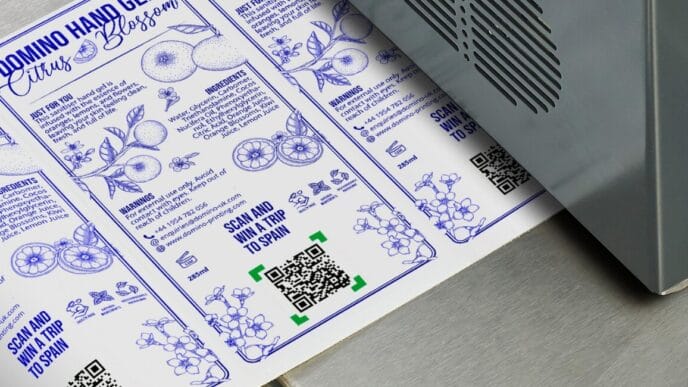
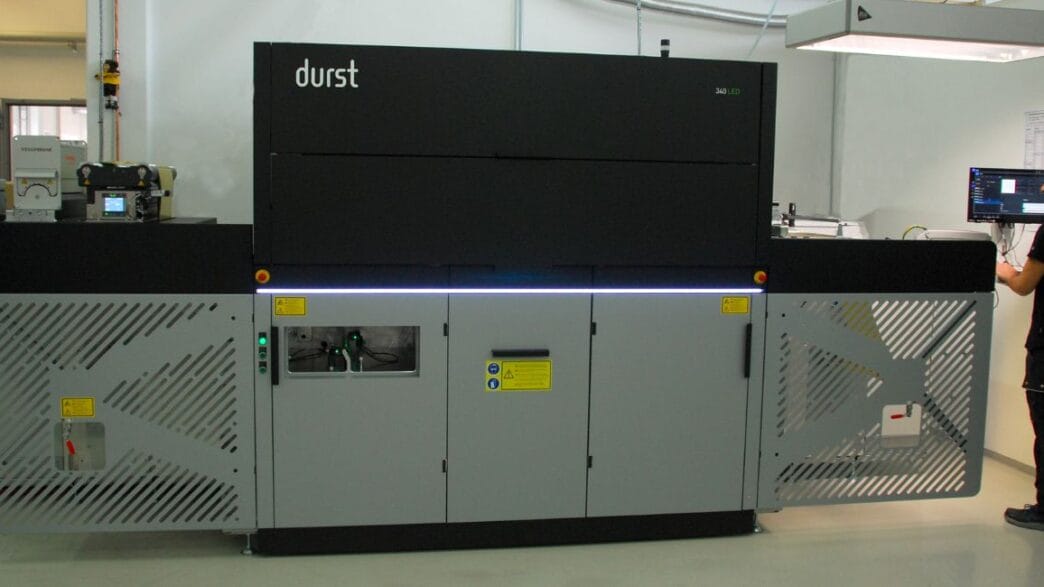
Since September 2025, Etisys Etikettierlösungen has been testing the new Tau G3 inkjet printing press from South Tyrolean manufacturer Durst in practical application. The new system offers an advancement in the further processing of labels, e.g. for thermal transfer printing and hot foil stamping.
The field test is accompanied by Chromos Deutschland GmbH, a long-standing sales partner of Durst. After several years of using the predecessor model Tau E, the installation of the new generation marks a significant leap in development, according to Etisys Managing Director Thomas Wirkotsch. Nevertheless, production began without any significant ramp-up phase. Thanks to existing experience with Durst technology and intensive training at the manufacturer in Brixen and at the printing company on-site, the production of commercial orders could be commenced immediately.
The new Tau G3 offers a crucial advancement in the further processing of labels, for example in thermal transfer printing and hot foil embossing. A key to this is the latest generation of LED inks, the formulation of which is BPA- and TPO-free and complies with current legal requirements.

„This merely requires that a ribbon recommended by us is used, the suitability of which we have determined through extensive test series,“ explains Thomas Wirkotsch. He cites the improved user-friendliness and ergonomics, such as in the newly designed roll change, as successful examples of practical optimisation of the machine.
The technical highlights continue to include the automatic register control system (ARC), which reduces setup times and waste, as well as the media edge protection (MEP), which reliably protects the print heads. Productivity has also been significantly increased. While the maximum with white printing was previously 36 m/min, the Tau G3 Core in Roßhaupten now reaches 61 m/min.
For Etisys, this opens up new economic opportunities. As inkjet printing thus comes even closer to conventional flexographic printing, the company can calculate a growing proportion of orders alternatively and always use the process that is best suited for the respective application.
Source: Etisys