The Central Agency Packaging Register (ZSVR) foundation has been operating as an authority since the beginning of the year and aims to improve the overview and control of the use and disposal of packaging. The tasks in this context are varied and challenging. Following the official launch on 14 January 2019 in Berlin, we have summarised the most important facts and asked for further details.
The Goals of the foundation In addition to the standardised nationwide control of the disposal and recycling of packaging for private end consumers, the following are clear:
- to create transparency in the competitive disposal of packaging,
- to establish a fair distribution of the resulting costs in the market,
- to support the project to reduce the burden on the environment and the further development of extended product responsibility in Germany by publishing a minimum standard for measuring the recyclable design of packaging.
Foundation and structure
The Member companies of the founders (Bundesvereinigung der Deutschen Ernährungsindustrie e. V., Handelsverband Deutschland - HDE e. V., IK Industrievereinigung Kunststoffverpackungen e. V. and Markenverband e. V.) and the other associations behind them place the majority of the outer and sales packaging concerned on the market.

To the Tasks of the foundation (§ 26 VerpackG) include in particular
- the establishment and operation of a register for producers in accordance with the Packaging Act,
- the development and operation of a database with data reports from manufacturers and systems,
- the market share calculation for the distribution of disposal costs and volumes of the dual systems,
- the definition and publication of a minimum standard for measuring the recyclability of packaging (in agreement with the Federal Environment Agency),
- checking the volume flow records of the dual systems and industry solutions,
- the categorisation of packaging as subject to system participation and
- the categorisation of drinks packaging as subject to a deposit.
Official launch
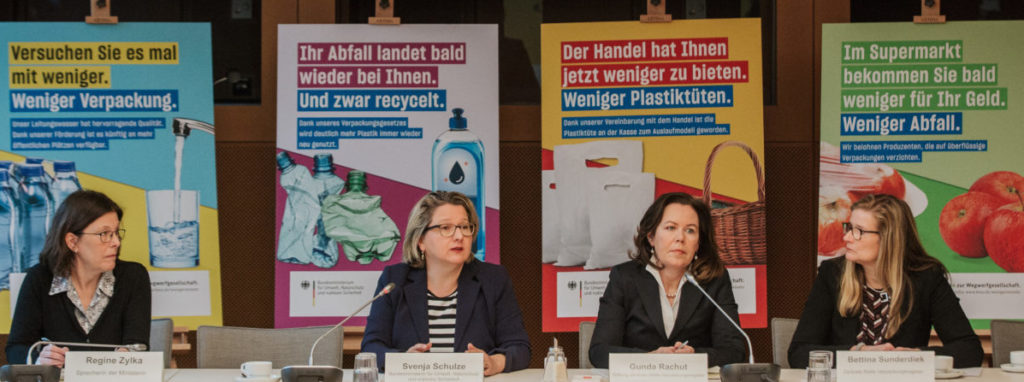
Federal Environment Minister Svenja Schulze and the Board of the ZSVR, Gunda Rachut, invited to the Federal Ministry for the Environment, Nature Conservation and Nuclear Safety in Berlin on 14 January 2019 to provide information on this topic, among other things, at a press conference, how many registrations already exist and before which Tasks of the LUCID packaging register in its first official year of operation stands.
Anyone who fills packaging with goods or imports them into Germany must at the same time Financing disposal. For packaging generated by private consumers, this is done via licence fees to the so-called dual systems, which in turn organise the recycling.
Svenja Schulze emphasised: „Anyone who separates their waste in an environmentally conscious way must also be able to be sure that the packaging is actually recycled. This is the only way to Trust in our recycling system. The Central Office makes a major contribution to this.“
This is because although the Product responsibility for packaging numerous companies have not yet complied with this obligation without being penalised. This also meant that there was no financial incentive to dispense with unnecessary packaging.
The fact that there are a large number of Free riders was known.
„The high number of enquiries from first-time distributors who don't know what product stewardship is has confirmed this, how necessary this measure and the Packaging Act,“ explained Gunda Rachut. „To date, 130,000 companies have registered in the LUCID packaging register. That is already 70,000 more companies than was previously the case with the dual systems.“
The aim was to double the number of registrations by the end of the year.
In the discussion
In addition to the tasks of the ZSVR, the results and objectives of the Packaging Act were also scrutinised in Berlin and the recycling quotas in particular were discussed. In this context, the Minister emphasised several times that the Prioritising waste prevention and reducing packaging before any further measures.
We were interested in who the Charges and, if applicable, for the payment of Bonuses is responsible for the use of (higher) recycled content in packaging. According to those responsible, these decisions lie in the Discretion of the disposal systems. An approach whose transparency still needs to be established and which we therefore currently consider to be at least worth considering.
Focus on free riders
When we asked Gunda Rachut on site about the tools available to actively expose free riders, she replied that this was in principle very easy to do via online research. We wanted to know more about this and later asked how these options are utilised:
„The Central Agency Packaging Register (ZSVR) is currently expanding the area of Data analysis on. This begins with researching publicly available data on providers and comparing it with our database and goes through various Plausibility checks up to the comparison with Purchased market research data. In addition to the manufacturer's data, we also have the Complementary reporting by the dual systems. What is new, and companies are currently becoming aware of this, is that the ZSVR also works with this data from the (dual) system commissioned in each case. synchronises and deviations can be detected quickly. This is the only way to minimise the costs of packaging disposal. polluter-pays The aim is to avoid the financial burden of packaging and make it more environmentally friendly,“ explains Gunda Rachut.
It was also reported that the ZSVR had already received 30 complaints from companies. As no names could be given, this served as a fictitious example: Online retailer A reports online retailer B. Our questions about this: What happens to these adverts? Who pursues them? And how are the countries (cities/municipalities) prepared for these tasks?
„Since autumn 2017, we have had a working group with the federal states, with whom we coordinate exactly when which information is forwarded to which authorities and how it is processed. The law does not provide for the mere forwarding of information; this would not be a streamlined solution. Rather, the clarification of the facts of the case must now be centralised and thus also Significantly more efficient has become an offence. Only when an administrative offence has been proven by the ZSVR and a complete file is available with the evidence documents is this handed over to the enforcement authority, which then only has to implement it accordingly,“ explains Gunda Rachut.
In order to expose defaulting importers, solutions under European law should be sought.
New standards put to the test
At the same time, the Packaging Register has developed new standards. These include a „Catalogue of packaging subject to system participation“ and a „Guidance for assessing the recyclability of packaging“, which is intended to help the dual systems to take ecological aspects into account when calculating licence fees. The standards are intended to ensure a high level of quality from packaging design to recycling. „At the same time, they provide a reliable legal framework for the obligated parties, who can now determine their obligations much more easily,“ says Gunda Rachut.
The fact that the industry will not always agree with the assessment of recyclability, for example, is shown by the example of airpop®. The packaging material known in specialist circles as expanded polystyrene (EPS) and to consumers as Styrofoam was excluded from the so-called good materials and is therefore by definition not recyclable. The industry is fighting back against this stamp and declares that airpop® is successfully recycled. The criteria for categorisation are characterised by economic factors. There is therefore still a need for action in this context.
[infotext icon]LUCID packaging register in a self-experimentYou can register easily and quickly via the ZSVR website at http://www.verpackungsregister.org. We have run through this once as a fictitious company. The prices per tonne differ significantly depending on the type of packaging, and the costs are displayed directly. If you want to check whether obligated companies, i.e. manufacturers, distributors and importers, have assumed their responsibility, you can use a search mask to display this in the manufacturer register and find the company name, registration number and address, as well as brand names in detail, but no quantity information. This would probably not be in the interests of data protection either[/infotext].
Fears that the circular economy will be „undermined“ Reinhard Schneider, owner of Werner & Mertz, in an open letter to the leaders of almost all parties represented in the Bundestag. Above all, he calls for a Concretisation of the Packaging Act, to create stronger incentives for the use of post-consumer recyclates. Read more here.