The discussion about sustainable packaging traditionally focuses on materials such as lighter cardboard or recyclable solutions. However, a significant portion of emissions arises during processing. Processes such as gluing, sealing, or labelling significantly influence a packaging's ecological footprint.
Regulatory requirements for manufacturing companies are intensifying and are having a profound impact on operational structures: energy prices remain volatile, and CO₂ costs are rising, partly due to adjustments in the EU Emissions Trading System (ETS) and national pricing models. At the same time, regulatory pressure is increasing. With the new Corporate Sustainability Reporting Directive (CSRD) and so-called Scope 3 reporting, companies will have to disclose in detail in the future where greenhouse gas emissions occur along their entire value chain. This is precisely what is bringing previously often neglected process steps into focus, which hold untapped efficiency potential. Low-temperature adhesives are not a detail in this regard, but rather a quick lever for reducing Scope 3-relevant emissions in ongoing operations – without capital expenditure and without interfering with existing line architectures.
This development is particularly challenging for the production of food and non-food packaging, which are produced in large quantities and at high speed. Many packaging lines are optimised for availability, not for energy efficiency – a paradigm that is no longer viable under CSRD and rising energy costs.

High line speeds do not contradict energy efficiency. Rather, it is problematic that many end-of-line processes are permanently operated at a high temperature level, regardless of cycle time or utilisation. This thermal base load, in particular, has long not been considered an independent optimisation field – even though it accounts for a significant share of energy consumption. In a situation where companies must stabilise costs while simultaneously achieving their climate goals, these hitherto largely ignored aspects are increasingly coming into focus.
It's not just the material that counts: the process shapes the balance sheet
The discussion about sustainable packaging traditionally revolves around the material: lighter cardboard, alternative fibres, improved recyclability, or bio-based raw materials. These aspects are important, but they only address one part of the overall footprint. A significant portion of emissions is generated not by the material itself, but by its processing. It's during gluing, sealing, and labelling that decisions are made about how energy-intensive and therefore how sustainable a packaging actually is. In short: sustainability is not just designed, it's produced. And this is precisely where modern adhesive solutions come into play as a strategic lever for decarbonisation.
In practice, optimisation is often absent for a simple reason: a lack of transparency. End-of-line areas are among the most heavily utilised, yet least data-monitored zones in production. Energy and resource efficiency are rarely measured separately here, meaning many CO₂ drivers remain hidden during ongoing operations. Thermal processes account for the largest share of energy consumption: classic hotmelt applications require high melt temperatures and continuous heating of tanks, hoses, and applicator nozzles. This consistently high temperature level is among the overlooked, but permanently running, energy consumers.
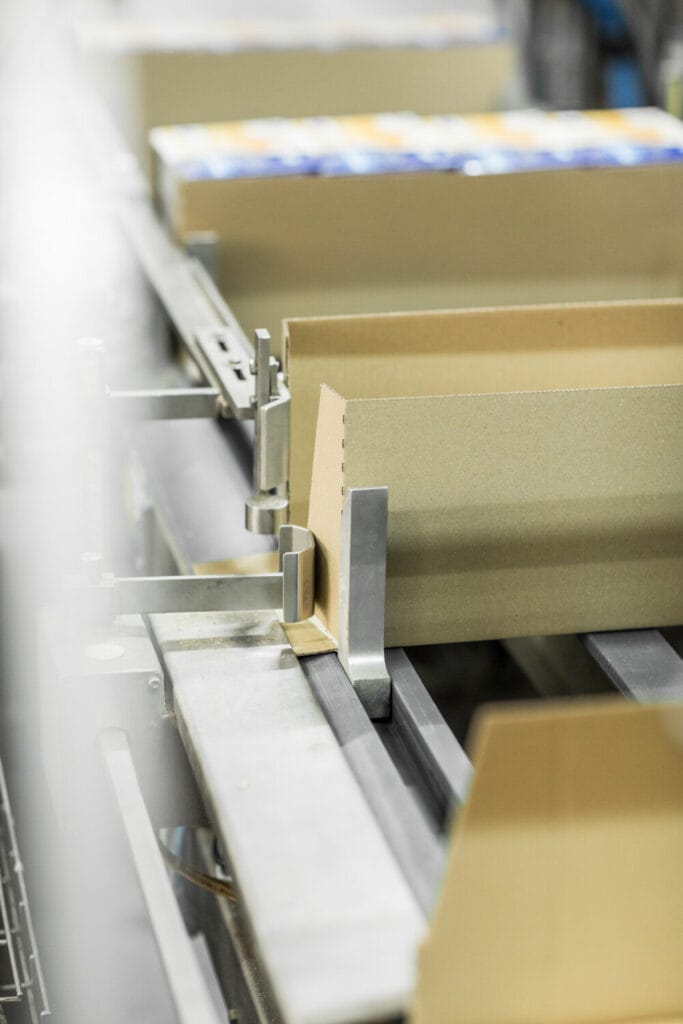
In addition, losses arise that are barely noticeable in day-to-day operations: start-up phases generate scrap, unstable viscosities cause faulty bonding, coked nozzles lead to cleaning cycles and unplanned downtimes. Each of these interventions disrupts the production flow – and each reheating phase means additional energy expenditure. Another underestimated driver is systematic oversizing: safety margins on order quantities or temperatures lead to unnecessary material and energy use.
All these factors seem insignificant individually, but are considerable in sum. The problem is that what isn't measured can't be systematically decarbonised. Sustainability therefore needs to be not only postulated, but also quantifiable – through energy consumption, unplanned downtime, equipment utilisation and overall line effectiveness.
Cool to stick, clever to save
The adhesive makes up only a fraction of the packaging, but plays a significant role in terms of energy consumption, process stability and sustainability. The processing temperature is particularly influential: classic hot melts typically operate at temperatures between 160 and 190 °C. Low-temperature adhesives, such as Technomelt Supra Cool from Henkel Adhesive Technologies, allow for significantly lower application temperatures, thereby reducing both the energy used for melting and the ongoing heat supply during production.
But the influence doesn't stop at temperature. Modern polyolefin-based solutions offer more stable viscosities and a wider processing window. This reduces the likelihood of stringing, charring, or insufficient wetting. The consequences: fewer cleaning intervals, less maintenance, and less energy lost during downtimes. Material usage itself can also be optimised via the adhesive system. Higher-performing formulations allow for lower application weights without compromising the stability of the packaging seal. Precise, reproducible application further contributes to more efficient resource utilisation.
Data from practice, not assumptions.
The question of how much energy modern adhesive systems actually save is now clearly measurable. Test series from industrial applications and Henkel's own plants provide reliable data. „The validation of such effects in industrial production environments shows that thermal optimisations at the end of the packaging line can make measurable contributions to energy and CO₂ reduction,“ says Leopold Mirow, Senior Manager Packaging & Labelling Sales Europe at Henkel, referring to the results from several practical tests.
In a specific application example, switching from a standard hot melt with a melting temperature of 155°C to Technomelt Supra 100 Cool reduced energy consumption by approximately 43 percent and adhesive consumption by about 15 percent. These effects are achieved without adjusting the plant hardware and exclusively through the change in the adhesive system. Even if the absolute values vary depending on the line, comparable applications show that the switch achieves a noticeable change after a short period. Internal packaging lines also confirm this potential. Through the use of bio-based hot melts such as Technomelt Supra Eco, CO₂ emissions were reduced by approximately 200 tonnes with an adhesive consumption of around 70 tonnes per year. The higher performance of the formulation also allows for up to 25 percent less application quantity without compromising closure stability.
The scope of potential savings varies according to plant type and operational profile, but the pattern is clear: switching from conventional to low-temperature or highly stable polyolefin systems offers a fast, transparently quantifiable, and easily integrable path to decarbonising existing packaging lines.
Conclusion: Efficiency sticks to the process, not to chance
Packaging lines are no longer just the last stop before shipping. They are developing into one of the most effective areas of influence for energy consumption, process stability, and CO2 footprint – provided they are actively controlled rather than being accepted as mere routine processes. The guiding principle is: What can be measured can be specifically optimised. Modern adhesive systems offer the technical prerequisites for this and thus significantly determine how energy-efficiently, stably, and cost-consciously a line operates. Lower processing temperatures, more stable process windows, and more precise application quantities not only enable perceptible reductions in energy and CO2, but also higher system availability and less maintenance.
This offers clear strategic added value for companies. They improve their carbon footprint, stabilise their production costs, and simultaneously increase the resilience of their packaging processes. Within today's regulatory and economic conditions, energy efficiency on the packaging line is no longer an optional optimisation – it has become a core management responsibility.