For a long time, Machine Learning and now also Deep Learning: When used sensibly, artificial intelligence expands the boundaries of what can be recognised in the empty and full product inspection in the filling and packaging process of beverages, food, or pharmaceuticals. And competently distinguishes critical from non-critical.
AI – a buzzword that no one can ignore these days: with chatbots, image and video generators, artificial intelligence has been increasingly penetrating our everyday lives recently. For Heuft Systemtechnik GmbH, however, its use is nothing new. In order to sustainably prevent unnecessary packaging and food waste, the company has been deepening the detection accuracy of modular inspection systems with its Heuft AI, which was specifically developed for the inline inspection of empty and filled beverage, food and pharmaceutical packaging, for over 15 years, and is helping to continuously reduce the false rejection rate, i.e. the proportion of incorrectly rejected products without critical defects.
Machine learning already mastered the hardware and software for real-time image processing for the system engineers from the Vulkaneifel in 2010: recognised objects are intelligently classified in order to clearly distinguish critical errors and foreign bodies from harmless structures and objects. Water droplets on the outer wall, for example, can be „learned“ as "good", so that affected packaging units are no longer rejected. New AI tools now make even more possible.

Image Processing and Deep Learning
Heuft's proprietary AI for processing inspection images is in no way connected to the internet and differs significantly from web-based tools such as chatbots. It is not a generative AI: Heuft reflexx A.I. is not intended to generate anything or create anything new. Rather, it is about intelligently evaluating inspection images and increasingly competently assessing what has been recognised as „good“ or „bad“. Objects and structures are distinguished from one another, patterns and trends are recognised, so that it is more accurately described as so-called discriminative or predictive AI. In essence, artificial intelligence that can identify differences and make predictions.
To make deeper-lying structures and objects more visible and to be able to assess them competently, suitable imaging processes are required. After all, even the best AI model can only find what is actually present and visible. Therefore, instead of focusing solely on intelligent image analysis, imaging is also constantly being further developed here. For example, the Multi Colour Image Processing (MCIP) product, which is integrated directly into the relevant cameras, always puts products and packaging in the right light: different lighting scenarios such as bright-field and dark-field illumination in transmitted and incident light are combined from one and the same perspective. This is done in different colours in order to spectrally separate the resulting information and to be able to calculate the individual colour channels with each other in such a way that the most diverse features can be highlighted in the recognition images: Blowouts and splinters in the thread and under-chip area are, thanks to structured MCIP colour lighting, not only partially mapped as before, but are always completely mapped over the entire surface during the optical inspection of the upper side walls of empty white glass containers.
Intelligent Soil Inspection
New deep learning AI now additionally increases the sensitivity of camera-based inspection. What was previously invisible is made visible, and critical aspects are clearly distinguished from non-critical ones. Multi-layered neural models shorten commissioning times and deliver more stable results, even under fluctuating environmental conditions. The Heuft-InLine II empty bottle inspectors can therefore be installed already optimally pre-configured. Lengthy, product-specific teach-in procedures are largely eliminated. Where previously almost every bottle type and shape required its own algorithm to centre its base precisely so that the inspection covers it seamlessly, a single one is now sufficient. Based on its symmetry as the sole centering parameter, the algorithm is suitable for a wide variety of container types and formats – regardless of knurling marks, embossings, and other product-specific characteristics.
Two further neural networks have been fed thousands of base shots of standard glass and PET bottles. Whether, for example, wear, abrasion or drips are still within tolerance or represent a critical deviation from these learned „good“ images is now competently decided by Heuft reflexx A.I. This means that every single detail no longer needs to be specifically trained. Instead, the intelligent image processing classifies the detected image as a whole as „good“ or „bad.“ Anomaly detection not only finds already specified errors but also newly occurring ones, such as transparent, non-polarising film deep at the base of the PET bottle. At the same time, the proportion of empty containers that the inspector considers faulty due to non-critical tolerances in the base area decreases – and thus, in turn, the incorrect rejection rate.
Smart mouth error detection
For mouth inspections, countless images of standard reusable beer bottles have also been fed into a self-programmed deep learning model, which differ slightly from each other in terms of shape, glass thickness, or colour. The result is a huge pool of „good“ images within the tolerance range. This allows the AI to automatically classify all deviating structures and objects as errors.
Nothing undefined will be overlooked anymore, empty bottles with critical neck defects will be reliably detected and rejected. If they are only affected by cosmetic deviations, they can be refilled without concern. Together with a better set-up of the empty bottle inspector, this also minimises the proportion of unnecessarily rejected containers – thereby increasing the efficiency of entire filling and packaging lines.
Using MCIP and deep learning, wide-necked openings of the most diverse shapes and diameters can now be inspected comprehensively. The intelligent technologies ensure that the sealing surface of the openings is always completely covered and that, for example, radial cracks are detected more clearly.
Competent discernment
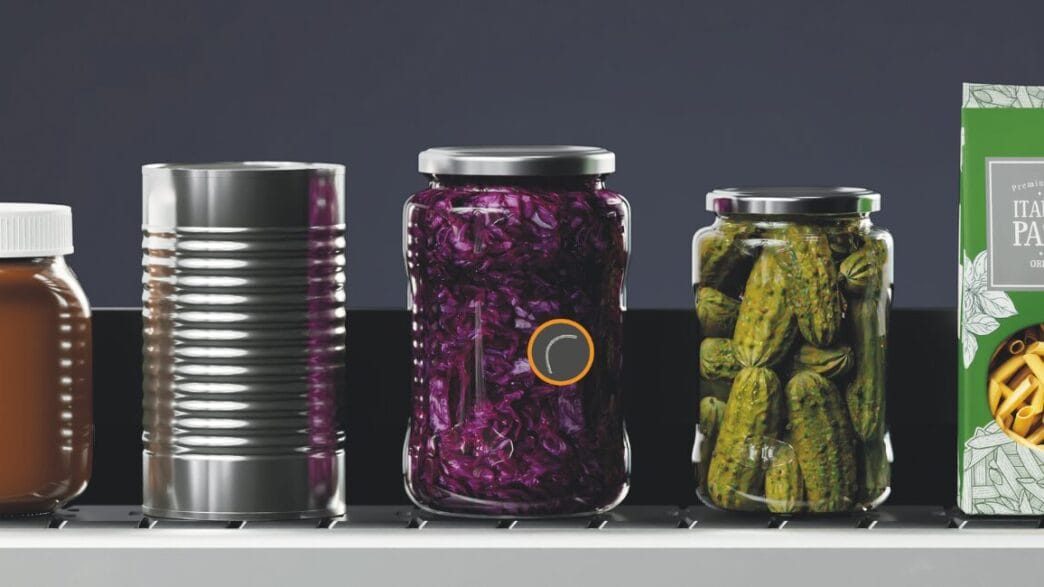
When it comes to foreign body detection in filled food jars and cans, current deep learning AI, specifically for X-ray image processing, also reveals what remains hidden in conventional X-ray scans. Among leading food manufacturers, it is already demonstrating its strengths in locating foreign objects and distinguishing them from harmless product and packaging structures. Particularly with inhomogeneous products such as gherkins or red cabbage, which have components that absorb X-rays more strongly and have voids in between, glass in glass, among other things, can be identified even when such foreign bodies are no longer perceptible to the naked eye or when their shape and size in the X-ray image are indistinguishable from non-critical product characteristics.
Heuft has combined tried-and-tested image analysis and AI methods with a multi-layered neural network that goes deeper and thus independently processes even abstract patterns in a meaningful way. The deep-learning-capable Heuft-reflexx A.I. X-ray image processing makes previously invisible elements visible, even under challenging environmental conditions.
Sensitive X-ray inspection of food jars
New tubes, generators and full-field detectors increase the bandwidth, speed, reliability and sensitivity of pulsed X-ray inspection with further developed systems of the Heuft eXaminer II series, with increased resolution and reduced radiation. Combined with new deep learning in X-ray image processing, this means significantly more is now possible when it comes to the unambiguous detection of foreign bodies in foodstuffs.
With the Heuft eXaminer II XAC, which inspects up to 1,000 food jars per hour, the size of reliably detectable foreign objects is halved. Where glass shards or small stones were previously difficult or impossible to see, pulsed X-rays with intelligent Heuft-reflexx A.I. X-ray image processing now make them visible. The double bottom and 360-degree side wall inspection creates full coverage, and the deep learning AI increases the sensitivity of the full product inspector's detection, especially in inhomogeneous products with differently absorbent structures – and at the same time, the resolution in distinguishing critical from harmless objects.
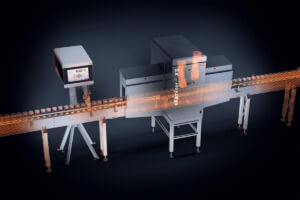
This applies equally to its „little brother“, the Heuft eXaminer II XS, specifically designed for pulsed X-ray inspection of filled cans, doypacks, squeeze bottles, stand-up pouches, or carton packaging. For foreign object detection, the modular compact system can be flexibly equipped with one or two sideways X-ray flashers. This way, the inspection covers the entire fill volume if necessary. If, as with liquid products in carton packaging, only a base inspection is required, the image processing creates an „unfolded“ base view, allowing even inconspicuous contaminants lying deep and flat at the bottom to be reliably identified.